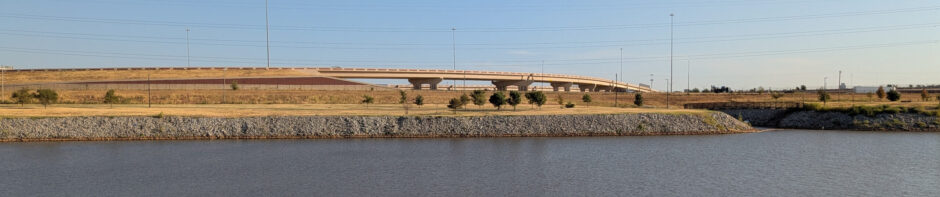
 My car is working much better now, so I tested it by driving west on US 66. Once you get past Lake Overholser, the next landmark is Yukon, one of the biggest Czech cities in Oklahoma. By the way, it’s also got lots of old money, so the city has a pretty big budget for its size. This first shot is what you’ll see approaching Yukon from the east.
 The local high school mascot is “The Millers” — maybe you can guess why. This landmark remains standing mostly empty. The even bigger grain elevator across the street (behind me) is also mostly empty. Grain isn’t such a major crop in this area any more.
 The big historical thing about Yukon is the Chisolm Trail; it runs north/south through the town. In fact, Jesse Chisolm’s grave is not too far away, north and west of here near the town of Geary. About forty years ago I hunted his grave down; folks living two miles from it didn’t know it was there, hidden out on some dirt road and barely accessible to visitors. I haven’t been there lately, but they tell me it’s a little better now. This park had almost nothing of historical interest, just a pretty park and a huge artificial mound, on which I stood to take this picture.
 The countryside is mostly flat out this way. It was just a 12 mile drive to El Reno from Yukon. This is the southern entrance on Route 66. This is a pretty big town built from the same agribusiness as most towns in Oklahoma. West and north from OKC is mostly flat plains for a very long distance.
 This is a sample of the old buildings downtown. That “haynes” sign has been there forever; it’s a photo and bridal shop. It was hard to find parking because there was some kind of festival preparations blocking some of the streets.
 El Reno’s best stuff isn’t even on Route 66, but a few blocks west along the railroad tracks. There’s a whole museum, and while generally neglected, it’s open and worth a visit. I didn’t have time to go inside and try to setup for flash, and some of the buildings didn’t turn out well. This is the original HQ from Ft. Reno. The stone monument talks about General Sherman using this thing; it was moved here from the Ft. Reno site west of town.
 This is the old hotel next to the train station, still standing and serving as part of the larger museum exhibits. You can find the original Red Cross canteen that served the US Cavalry out in these parts, the original train station, a petrified tree trunk from some tiny village nearby, and all kinds of neat stuff.
 This is one of the better examples of the old homes still standing in El Reno. This one is for sale, by the way. It stands in a rather historic district near the old rail station, loaded with older architecture like this. One thing distinguishing El Reno is that the agribusiness is still very much alive. At least half the grain elevators are still in operation as grain storage.
 In fact, the huge federal prison out here is known as “the Ranch” because it hosts a large cattle operation as a means to inmate rehabilitation. This view is from across El Reno Lake. The lake is unremarkable, except that it smells clean. There’s no sewage leaking into it anywhere, so it smells better than most of the lakes, creeks and rivers I usually visit.
The total round trip was almost a hundred miles.