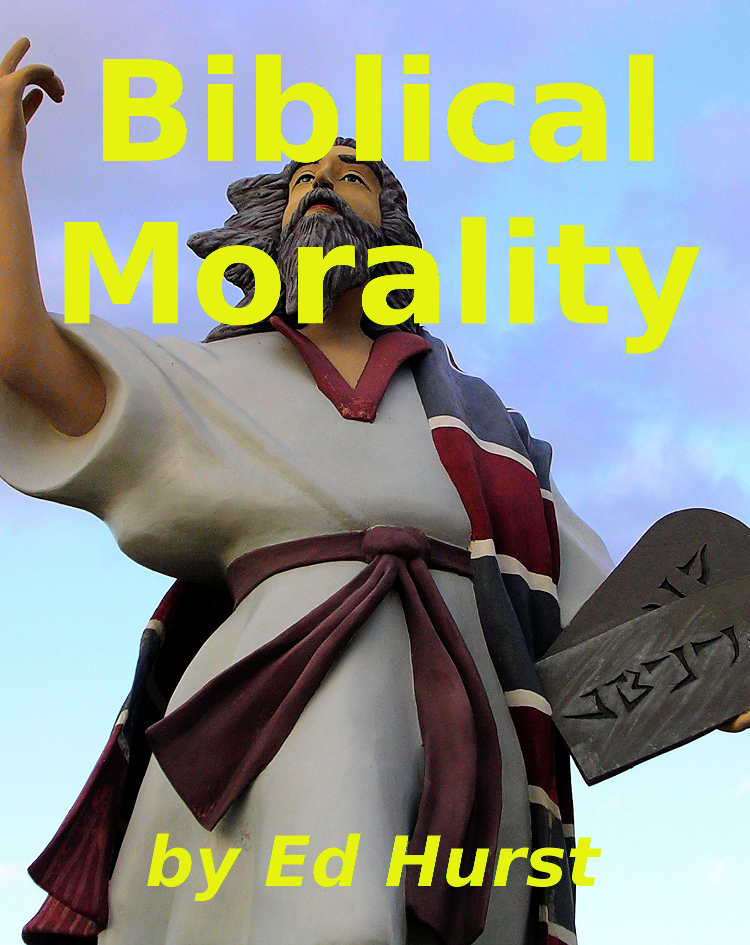
Biblical Morality: Chapter 1

It’s Personal

And one of them, an expert in religious law, asked him a question to test him. “Teacher, which commandment in the law is the greatest?” Jesus said to him, “Love the Lord your God with all your heart, with all your soul, and with all your mind. This is the first and greatest commandment. The second is like it: Love your neighbor as yourself. All the law and the prophets depend on these two commandments.” (Matthew 22:35-40 NET)

Perhaps the most damnable folly is the Western concept of objectivity.

The notion that we could conceptualize an idea as an ideal apart from the very people who give it life is evil on the face of it. Pure logic is a direct rejection of the Creator. Love cannot be described or quantified.

It’s bad enough we insist on using one English word for a host differing, and sometimes contrasting, notions regarding how people interact. Western use of language is inherently false, in that it seeks to immobilize life in the airy, nonexistent space above human souls. Labels are necessary for communication, but unless a label carries a living characterization, it isn’t real and means nothing. The hideously clumsy translation of Jesus’ words into English, from a Greek rendering of His distinctly Hebrew comments, leads a world of evil.

We cannot change the world. The solution to this problem is for readers and hearers to rise above the limits of their own world and stand, not in the fevered imagination of Greek philosophers, but in the very real space of the Spirit Realm — more real than the space we occupy in our human existence. Morality is inherently personal in nature.

Stated another way, truth is not on objective body of ideals out there in rational space, waiting to be discerned by reasoning minds. Truth is an aspect of God’s Person, another name for Him and His work in this universe. It’s our name for the high value we place on knowing Him. All truth is God’s truth; reality is whatever God says it is, and is subject entirely to His whims. He could change everything, the very fundamental nature of reality itself, and it would remain His prerogative to tell us or not.

If it would help to copy and paste that paragraph a few times, or a million times, we should do it until it has burned into our minds and turned our souls in the right direction. The only proper way to conceive intellectually of reality is to think in terms of persons. Evil human minds demand something they can control, and the mythology of objectivity is the answer to that demand. It is a blasphemous lie from Hell. No attack on that deception is disproportionate. Crush it.

Reality is personal. It depends entirely on the thoughts and direct purposeful maintaining attention of God. The moment He lets go, the whole thing dissolves back into His imagination. It would be as if it never happened. Our very existence rests individually upon His attention to us. We can’t conceive of that, but it’s what the Bible says. It seems very real to us and we generally act accordingly, but never let go of that background realization that everything is whatever He makes of it.

In one sense, the entire rest of this book is simply sketching out the implications of this one truth: Reality is personal in nature. This is the Hebrew assumption and is written into the very fabric of Creation and Scripture. You cannot read the Bible objectively. You cannot learn the teachings of Jesus objectively.

The phrasing Jesus uses in answering the Scribe demands a return to the Ancient Near Eastern (ANE) conception of power and authority among men. If you hang on the words themselves, you will miss everything He says. These words have no meaning at all outside the context of ANE feudalism and tribal living. God consistently portrays Himself as a sheikh. It so happens He rules far more than this universe, which is rightly viewed as a fairly minor project in His greater affairs.

Unlike the cold and distant monarch of Western tradition, our God is the loving shepherd father of all He holds. It is precious to Him; not the stuff, but the people. Western monarchs owned land and stuff — the people came with it. ANE sheikhs own the people as their very blood kin. Wealth to a sheikh is his people, their vast collection of talents, along with whatever stuff they carry and whatever land they occupy on His behalf.

Because of His commitment to your welfare, your duty to Him is as reciprocal as you can make it. Hebrew thinking spits on the notion your emotional feelings of warmth mean anything. They come and go with the wind, utterly untrustworthy. No, you are fully capable of deciding you will hold someone as your highest value, and will exert all possible effort to please Him. Wipe away the absolutist nonsense of high productivity; think in terms of pleasing Him with your whole being. There are times when His greatest pleasure is letting you rest and rebuild for the next mission. He is not in a hurry, and only at His specific command do you hurry along with anything in particular. It’s a relationship, not a performance.

He can read whether you care as you ought.

He it is who instructs you to love the rest of His Creation the way He does. But more to the point, He says you must love your neighbor with the same commitment to their welfare as you would yourself. You conceive of your life as His to command, and theirs the same. There is no possible way to objectify any of this. Love is commensurate with the context; your requirement is only what He gives you. Love is properly defined as a commitment to the welfare of another.

Biblical morality is defined in our minds as this whole matrix of commitment to the welfare of God’s affairs as He personally requires of you.

Posted in religion | Tagged , , , , | Comments Off on Biblical Morality: Chapter 1

Job 1

Job is introduced as one who exemplifies the highest moral standing possible for humans. His possessions and standing made him famous, easily the most blessed of men in the land. At every feast and festival, Job would ritually atone for possible accidental sins of his children. In other words, he wasn’t satisfied with his own purity, but intervened with God on behalf of his entire household. It’s hard to image anyone more concerned with pleasing his God.

The term “sons of God” is simply a word picture of spiritual beings — angels. In the Ancient Near Eastern way of thinking, Satan was God’s jailer. This is a very highly privileged position, rather like a prince not in the line of succession. The moral implication is people who disappoint the ruler will be consigned to the jailer’s domain. Wishing to make the most of an unpleasant job, Satan accuses anyone who might fail to obey the royal decrees. Thus, Satan is also chief prosecutor, seeking to enlarge his share of the domain. It’s only natural he would be patrolling the earth rather like a policeman of souls.

Then surely Satan had encountered Job? He was untouchable for Satan, someone who makes his Master boast. Satan indicates Job is hardly so pure of heart. He’s only faithful because God pays off like a slot-machine for which Job can only hit jackpots. God said he had enough confidence in Job to let him be tested in terms of property.

All in one day, the messengers came in sequence, each with horrific news. The Sabeans (today’s Yemenites) raided and took all his plowing oxen and killed the servants. The next said lightening fell from the sky and burned up the sheep and shepherds. Chaldeans from Mesopotamia raided his camel herds and took them all, killing the servants. Then a windstorm struck the house of the eldest son where Job’s adult children were feasting, killing them all when the structure collapsed.

Job was the model of moral composure. He assumed the normal ritual posture and declared the truth, that anything he had was a gift from God in the first place. God can take it all back when He likes and it changes nothing. The Lord’s name was still sacred to him.

Posted in bible | Tagged , , , , | 2 Comments

Job: Introduction

This is Hebrew poetry at its finest. Unfortunately, we are forced to read it in a very different language, bathed in a completely alien intellectual tradition. Here it is enough to note that Hebrew focuses on the interplay of thoughts on multiple levels of consideration. Each page of Hebrew verse can be several meters thick with meaning.

Of primary note here is parallelism. There is a first line asserting some thought; the second line may echo the same thought in different words, or it may offer a contrast, perhaps the same idea reversed. In some cases, the lines following a statement will carry off the thought into implications that vary. Linear thought is almost absent; multiple branches and less-than-obvious connections are often given. In terms of this being a long-winded debate, a great many responses are not direct to our Western thinking. Instead, the answer to an assertion may come around from behind and answer from a different perspective. Sometimes it’s necessary to back up and rip out the underlying assumption. Western logic is feeble by comparison, left in the dust trying to grasp such broad thinking.

Job is likely a descendant of Abraham and the setting seems around the time Israel lived in Egypt. The description fits several locations, but most scholars prefer the notion he’s living somewhere between Damascus and Edom. Everyone in the narrative believes in the God of Israel, but from a time well before the Covenant of Moses. It would be reasonable that Job’s story was known to Jethro who would have shared it with Moses. The book is typically ascribed to Moses as editor.

Job is described to us as a powerful and wealthy sheikh. The man is quite pleasing to God, but is nevertheless smitten with great tragedy. We are permitted to know why, but Job is never told. Rather, Job is beset with shallow-minded and legalistic men who assert he must have sinned. Job knows better, but slips into blaming God on the basis of human justice. The answer offered by Elihu and confirmed by God is that we may never really understand why embracing God’s justice doesn’t always bring worldly justice. Why do the innocent suffer?

In typical Hebrew fashion, the real answer isn’t directly stated, but implied: In a sense, no one is innocent; at our best every human remains a sinner. Our fallen nature fully deserves every bad thing this existence can offer. Suffering is the default. In the face of God’s holiness, only His mercy keeps us from damnation on any level. Suffering is not about buying a good place in Heaven; the most it can do is make us despair of this life. The only thing left standing is the otherworldly viewpoint, that this life isn’t that important in the first place. God’s person defines justice; the scales of justice are not in this world. Job lacks a fully developed view of the afterlife, as is common with folks having only a Mesopotamian outlook. The bracketing narrative was added by someone at least as late as Moses with a far more advanced understanding.

Posted in bible | Tagged , , , , | Comments Off on Job: Introduction

Governments Lie

Humans are disgusting creatures.

They seek control that they cannot possibly hold over things that are mostly none of their business. One human is a living disaster; aggregate humans into groups and the disaster grows exponentially. Not only do they seek to control everything they can see, but they wrestle endlessly for control over each other.

People were originally designed for beauty, peace and love. While that song calls to us, something inside us fights it with a ferocity we seldom grasp. Unless we build a structure that empowers the good and inhibits the bad, we have little hope of enjoying any of God’s blessings.

The first mistake we make is denying reality. Any concept built on a falsehood is bound to fail. You can do your best to make everyone believe in any system you like, but eventually it will fall apart if it does not take into account the reality of what we are. Every form of human government arising from human study and thought is broken, because humans are inherently broken, even in their best reasonings. No system is better; each may well be better at one thing or another, but all are inherently evil. Comparing them is comic entertainment, but characterizing one as better is simply self-deception.

Every form of government devised by man is inherently evil. If you pretend one is better than another, you are stupid. If you insist one is more like God’s revelation than another, you are blasphemous. God hard-wired us to live in a tribal social structure, governed by our own kin alone in what most derisively call “patriarchy”. Sorry about your silly ideas, but that’s God’s idea. If you promote any other form of government, you are evil. God’s people do not support any human idea that attempts to displace His truth.

It doesn’t help that we confuse types of government with the economic policies they tend to espouse. The labels are used as weapons, designed to confuse, not the help us understand. Back away and be wise. Recognize what is real according to God’s revelation and realize there is something useful in any situation because your God reigns. God can prosper the hands of His people under any economic policy, and He can use His people to promote the gospel message under any government. Do not demonize your fellow believers because they are comfortable with something you don’t like. Don’t patronize them as poor deceived souls oppressed by evil, secretly longing to live like you do.

We have a rogue’s gallery, a mythological list of demonic figures in history. The list is always defined by whomever won the last war, in the sense they remain in control over the folks they propagandize. Hitler was no worse than any one of our US presidents, largely because neither Hitler nor any president held enough actual power to do much of anything. It was all a matter of the aggregate choices of their various staffs. Even the folks directly involved could never be sure who was influencing whom. More than one president kept a friendly agreement with Stalin, even as they negotiated with Hitler. Nazis must not have been too evil because the US government protected any cooperative Nazi government leader. You need to remember that “ally” means anyone currently favored by the propagandists, and may have nothing to do with whether they actually like us.

If you do not keep this cynicism in the forefront of your mind, you’ll be led by all manner of demons, not by the Holy Spirit.

Posted in prophecy | Tagged , , , , , , , | Comments Off on Governments Lie

ACBM Published

Cover art for the book.

Cover art for the book.

ACBM is published. The ebook edition I tested seems to be okay, but you need not wait for premium rating. Get your free copy of A Course in Biblical Mysticism here.

Posted in meta | Tagged , , , , | Comments Off on ACBM Published

Caring Truth

The key to revealing God’s truth is whether or not you care.

Aside from the occasional run on my RedHat instructional posts, the biggest single traffic draw in recent weeks is my post criticizing Life Church as an entertainment business. There is some rumbling of media criticism against the CEO, Craig Groschel and lots of folks are visiting here from search engines. I have been contacted by some in the media regarding my comments, but nothing so far seems to reflect anything I said. Instead, people who actually have any curiosity come here more or less by accident.

Here is the primary point: I’m not selling anything, not even my name. Groschel is selling. He receives more in one week than I do all year. He can have it, that and the fame, too. The one thing disappointing to me is how few people go on to examine the deeper criticism I make of the complete absence of genuine pastoral care at Life Church. Not only that, but anyone trying to give that sort of care within his organization is shut down by the leadership. Life Church is hostile to the spiritual activity that isn’t directly controlled by Craig and his staff. I saw this happen with my own eyes, and his leaders aren’t afraid to use the most dastardly means of manipulation, such as the Delphi Technique. Thus, I make the criticism that they are friendly on the surface, but serving Satan in the background.

It doesn’t require a conscious effort to strengthen the hand of evil. It requires avoiding anything God calls you to do. Not only am I not afraid to work with pedophiles and their victims, drug addicts or people who are simply wacko of any flavor, I’m not afraid to let the Spirit of God lead the way in what I offer or don’t offer in terms of pastoral care. I also don’t worry much about secular atheists or religious pagans, or any other folks of a different mindset. The limits are in the mechanics of getting along together, not in the contents of what people bring to the table. Nor do I assume they are evil for being different. Whatever it is they carry around can’t hurt me, and I don’t have to accomplish anything at all that any human can measure. The only failure is refusing to care.

It’s not as if I can descend safely into the pits of Hell because I’m so pure and holy. I can go there because I have a divine commission; Satan is fully subject to the God who created him. I could spell out for you the obvious management and leadership stuff Groschel does. It’s the standard corporate savvy run by a very talented fellow. But as with all marketing campaigns, when the thing you sell isn’t really all that essential to life itself, the shifting sands of market trends and human fashion will eventually take away your audience. I’m not better than him; I’m not even in the market. He’s not in the same work at all. Comparisons and contrasts are entirely superficial. When I talk about him, I’m addressing myself to his claim that he is in the same business I am in. I’m simply pointing out he is surely not.

Several of his friends have contacted me to discuss, argue, etc. It’s almost as if you can see their eyes glaze over when I mention the basis of my criticism is the Hebrew biblical viewpoint versus their Western approach to reality. They understand that I am criticizing; they have no grasp whatsoever of the criticism. That’s frankly typical, and it’s why most of the folks who visit here looking for facts about Life Church aren’t likely to get much. I can’t help that, and I don’t worry about it. Groschel runs his church empire; I just feed a few folks who believe my stuff smells like food for their souls. When you see how things run at Life Church, you can tell it’s about the money and stats. I’m not arguing with their effectiveness in getting those things. I’m arguing with how it blasphemes the the name of God, and cheapens the blood sacrifice of the Cross.

I don’t believe Jesus was thinking about big budgets and big membership on the Cross, except when He cried about forgiving them for not knowing what they were doing.

Posted in prophecy | Tagged , , , , , , | Comments Off on Caring Truth

Biblical Morality: Intro

This is the first post on the next project, a book tentatively called “Biblical Morality.”

Introduction

Writing it is well nigh impossible.

There is no human language able to bear the load: How rich is the opportunity we have to live by the cosmic law of the universe! God created the universe according to His own character. He wove His morals into the substance of all things. It responds directly to anyone who embraces Him. It’s not some divine principle we can explain in mere words; we can’t pack it into some code of conduct.

So we do wrong when we speak, write, or even think of it in terms of duty or obligation. You can call it Law, or even better, Justice. For most Christians those words carry too much of the wrong baggage. This is an opportunity to touch the divine character itself. This is the underlying truth sought by all the various studies in science, philosophy, as well as magic and other esoteric arts — finding that handle by which we can extract from our existence the greatest possible return. We have this extravagant gift of revelation, explaining how it all works so that we can claim all the ancient heritage of things humanity has long forgotten.

It’s not hidden; it’s obscured by human reason. Our fallen nature is itself an attempt to work through all sorts of different frames of reference from the level of human resources. Redemption is simply embracing the one thing that we are all hard wired to do. God’s revelation is reality itself. Because of our tainted grasp of things, He revealed Himself in the form of law covenants. It’s the best way to get our attention, but that attention was meant to evolve in each of us into a recognition of His divine call to receive His love.

The human mind cannot know God. It can understand Law and Justice, and the Bible records a great deal about that. But we aren’t just generations away from it, more than the distance across the earth, far removed by language differences. There is a massive fundamental difference in the very frame of thoughts themselves. The Hebrew people whom God made to carry His revelation to the world had an entirely different view of reality from that of Western people. That Hebrew view of reality reflects the revelation of God; the people of God at their best were the living revelation of God.

From where we stand in Post-Modern Western Civilization, the Hebrew epistemology is totally different from ours. If you have no idea what that means, you may benefit from first taking A Course in Biblical Mysticism to understand the huge difference, and how it changes what the Bible means regardless of the translation you read.

For now, we can summarize it thus: The Hebrew people would regard our intellectual heritage as too shallow, too wrapped up in the passing plane of existence, unable to handle anything that comes from outside it. The Hebrew people knew God was not rooted in this universe, that our entire realm of existence is just a passing shadow, a minor project on God’s personal agenda. God built for them an awareness that surpasses mere human reasoning, an intellectual tradition wide open to the Spirit Realm where God lives. Our Western world has words for it, but the very structure of our thoughts excludes the whole concept. Worse, our frame of reference disparages theirs as mere superstition. What an insult to God, who made that frame of reference as His chosen means to revelation. Without that ground of understanding, you cannot understand. The West is built on sand; God’s truth is built on the rock.

You don’t simply discard your entire Western heritage; that isn’t possible in the first place. We must place that Western frame of reference in its proper place of service. The Hebrew mind would recognize the analytical approach is suitable for mere mechanics, but assigning moral value to anything requires operating from a far higher frame of reference. Reason serves the Spirit; the intellect is not the master. That part isn’t really so hard, but discarding the Western mythology of moral values is what give us so much trouble. This book is about clearing the clutter of false morals and replacing them with the foundation laid by God in His Word.

This book assumes you understand the difference between Western and Hebrew intellectual assumptions, and have done the work to at least recognize how a proper Hebrew mind works. Without that Hebrew perspective, this book means nothing. We will compare and contrast biblical Hebrew morals against typical Western morals.

This is not about saving your soul from damnation. Grace alone can do that, and we reject Decision Theology. You cannot decide to be born again because no flesh can even want it. God alone can do that; the initiative has always been His for each individual soul. What this book can do is grant you access to the best life possible in this world. That was granted to all flesh from the very beginning when men first began to call on the name of the Lord. It’s not necessary to experience spiritual birth to have this free gift. If you are born again, you will find grace demands you live by this same moral code anyway.

This book simply restates in our modern Western context what anyone could find in Scripture if they bothered to read it with Hebrew eyes.

Posted in meta | Tagged , , , , , , , , | 1 Comment

ACBM: Part 3 Chapter 4

Chapter 4 — Recap

God’s personal presence pervades all of His Creation. Here inside our tiny bubble, the time-space continuum of human existence, this presence is not obvious. There is no compelling proof that logic cannot deny; it requires more than mere human perception. It requires something of the divine essence linking to our awareness before we have any faculty for it. Reliance on human reason alone is the essence of our fallen nature. Thus, we stand in need of redemption, some help to escape the trap within which our reason holds us.

We come to life in this realm spiritually dead. On the one hand, Scripture openly affirms that while every human born at some later point becomes accountable to God, by the same token they are also offered some path of escape, something sufficient for their individual context. The ubiquitous presence of that spiritual apprehension across humanity is the plainest manifestation of this. Again, by the same token no human has standing to dispute this assertion. To whatever degree we are accountable to God, we always have offered to us a means to answer. At the very moment of the offer, whatever follows is occluded to our human understanding, in part because it is so completely individual in nature. The very act of wondering the who, how and why of what follows is the wrong question. All we know is, some take that path and a great many do not.

In the Bible, we are told that the Nation of Israel was granted a singular degree of insight regarding that path. While a basic human obedience to the Law on a worldly level was sufficient to remain under the ostensible blessings of God, the Covenant was offered in a context that openly acknowledged a higher meaning. Anyone with access to the Law who felt moved could always have that mystical enlightenment. Moses bluntly said that actually knowing God was within reach of anyone who wanted it. It was a taste of divine power and enlightenment, an unspeakable glory that overwhelmed everyone who got close. For a time, a great many embraced that opportunity. But as time went on the fire faded in the nation as a whole. At some point, the leadership exchanged this divine experience for the cheap thrill of rational discovery.

Yes, the mind is delighted by Aristotle’s order. It seems to bring the universe within the intellect’s control. It’s a lie; that rational inquiry offers no power to change anything in the soul, because it is missing a vast ocean of truth that is hidden from the intellect. Jesus taught in parables because the mind could not and should not pretend to have ultimate truth. Truth is not some objective entity apart from God; truth is the shining glory of His Person. Only a living spirit above the intellect could understand eternity, and only a mystical mindset permitted a perception of the pervasive presence of God’s justice in the world. Jesus told Nicodemas the Law meant nothing without a living spirit. Yet every miracle Jesus performed, everything He said, and everything His Apostles taught later, were already in the Hebrew Scriptures Nicodemas thought he understood.

Nothing Israel did, or failed to do, changed the moral fabric of the universe. It remains still; they simply moved out from under the blessings and into wrath within the same justice. They did so knowingly. Over the past two millennia Western Christians have done the same thing. Just as Israel’s failure could not restrain God’s hand from His plan of redemption, so the blindness of Christians has no effect on whether people are spiritually born. Indeed, God still works with His people, though more often in spite of them than actually through them. Whatever God does in bringing about spiritual birth, we know of a certainty Decision Theology is a category error against the logic of the Bible. It blindly mixes the temporal with the eternal.

Hostility to Biblical Mysticism does not result in hindering God’s eternal redemption of souls. The tragedy is in how we have all tossed aside that unspeakable joy of tasting the divine, in favor of shallow and impotent reason. We have lost out on all the blessings of God’s justice on this earth and have little hope of understanding what comes after this life.

We rob ourselves by avoiding Biblical Mysticism.

Recommended readings: Go back and reread the Bible with a proper mystical understanding of the text. Review your favorite commentaries in light of a Hebrew Mystical worldview. Pay particular attention that Paul’s Letter to the Romans was a direct repudiation of Christian Hellenism, while the Letter to the Hebrews was a direct repudiation of Jewish Hellenism.

********

This is the end of ACBM; the next step is final rewrite and publication.

Posted in meta | Tagged , , , , , , | Comments Off on ACBM: Part 3 Chapter 4

ACBM: Part 3 Chapter 3

Chapter 3 — Human Motivations

Iron discipline is for losers.

When the European tribes were confronted with the political opportunities associated with adopting the Christian religion, they still carried their gloomy outlook and lack of sophistication. The ostensible claims of loyalty to one God via one Church presented a problem: It was well nigh impossible to make it heroic and fun. The closest remedy was pulling in their ancient answer to anything else — iron discipline. Very quickly their brand of faith became a matter of hard duty. This wasn’t foreign to Greco-Roman psychology, but the German version was much darker and deeper, much more harsh.

In ANE civilizations, the psychology of life was far more complex. If you were unable to climb the heights of mystical thinking, then perhaps iron discipline would get you through. However, among the civilized upper classes, this was a loser’s game. It would eventually fail you because it only enforces moral blindness. It is dry and lifeless, and humans are not machines. Sheer logic only answers the immediate question of things on the surface; the divine life force required a higher understanding. There was never any doubt in the mystical mind that moral imperatives made a difference, even if your mind couldn’t identify an immediate connection.

The ultimate power to drive a flagging human spirit interest through difficult times was the sense of personal loyalty. Western reasoning is utterly impersonal and dehumanizing. ANE reasoning keeps the personal central. Ultimate truth would always be a personal life force, regardless what deity or deities you served. Duty could not be made an abstract; there could be no objective standard. You weren’t loyal to something because it was perfect or absolute; you were loyal to someone because you cared deeply about their wishes. You were personally accountable.

The silly Medieval notions of romantic love as some irresistible force that drove your emotions would never fly in the ANE. That’s just animal lust. Genuine human affection was entirely different; they even had different words for it. Your affections do arise independently, but they are utterly predictable. That is, where you invest yourself most deeply is where your love will stand. In the ANE, if your sense of duty to your god(s) held you in service to this or that earthly authority — always a person — you could be sure your emotional warmth would follow. Whom you willingly serve you will always grow to love. You would choose wisely where you invest yourself, because the affection of your master made life worth living. All the likely material rewards, even fame and the high regard of your peers, was of little importance without that.

By the same token, the gods were known to love in the same fashion. Few of them were considered arbitrary or capricious, despite generally being inscrutable. That vision of reaching with your soul into the Heavenly Realm was not simply some impersonal joy. The mind might delight itself with discovering some reasoning and learning logic, but the soul itself was not like that. It could sense the warm regard of a personal power in the presence of deity. This is far beyond mere emotion. The will to embrace a higher power is far above emotion because it has no root in the animal functions of the body. The confirmation is the growing desire and delight that can only come to your awareness from a higher power.

The proper motivation for serving God is the sheer joy of His personal affection.

Posted in meta | Tagged , , , , , , , , | Comments Off on ACBM: Part 3 Chapter 3

Next Project: Divine Moral Law

ACBM is pretty much finished. I’m posting the last few chapters for your comment, but I’m already praying about the next project.

I don’t yet know what to call it, but it will probably be a book instead of a course of study. The underlying theme is how rich the opportunity we have to live by the cosmic law of the universe. God created the universe according to His own character. He wove His morals into the substance of all things. It responds directly, though subtly, to anyone who embraces Him. It’s not some divine principle we can explain in mere words, or packing into some code of conduct. But if we walk in His Spirit, the whole universe works along with us.

So we do wrong when we speak, write, or even think of it in terms of duty or obligation. It’s an opportunity to touch the divine character itself. This is the underlying truth behind all studies in magic and other esoteric arts: You have the rich blessing of knowing exactly how it all works and claiming all the ancient heritage of things men have long forgotten.

It’s not hidden; it’s obscured by human reason. Our fallen nature is itself an attempt to work through all sorts of different frames of reference from the level of human resources. Redemption is simply embracing the one thing for which we are all hard wired to do. God’s revelation is reality itself. Because of our tainted grasp of things, He revealed Himself in the form of law covenants. It’s the best way to get our attention, but that attention was meant to evolve in each of us into a recognition of His divine call to receive His love.

I can’t avoid writing about that.

Posted in meta | Tagged , , , , , , | Comments Off on Next Project: Divine Moral Law