

Zizzo Forte Unboxing

This is what I found outside my door this afternoon — Zizzo Forte folding bicycle. It’s supposed to be designed for heavier riders, carrying up to 300 pounds safely. I ordered it on Amazon for about $600 and it shipped from somewhere in California. This thing is popular enough that the quantity in stock was dropping over just a few hours. This will open a new chapter in my cycling.

The bike comes double boxed. The inner box has no branding or anything. I was told that it’s just in case you need a box to ship it on an airline or whatever, no one can tell what’s in it. However, it’s much easier to strip it down a little more and pack it in a bag designed for carrying, as this typically fits inside the limits for regular checked baggage. Half the reason I bought this was the likelihood I’d be traveling, and this thing is the best way to get around once you get where you are going.

There’s a lot of packing: foam, zip ties, cardboard with tape, plastic bags and some clipped on hard plastic protectors for various protruding parts. It wasn’t too annoying to remove. The only bad part was a plastic film covering the fenders, and they applied it before it was mounted on the bike. Unless you take it all apart, you can’t get the last few shreds of clear plastic off.

It wouldn’t come loose pulling upward, but once I turned it on its side, it came out quite easily. It turned into a mini-workout for me, because I’m so much larger than this thing when it’s folded up like this. On the other hand, it’s much lighter than any of the regular bicycles I’ve owned.

It took awhile to remove enough packing for the frame to unfold. There was a nifty Velcro belt that you can keep for use when you bag it up for travel. When I do travel and I’m not driving, I actually prefer to go by bus. This thing would easily fit up under the bus. I’m going to order a bag that makes it less obvious what it is.

Once I got it unfolded for the first time, it still looked like a little child’s bike. The wheels are 20″, which is becoming quite common these days, not just on folding bikes, but recumbent trikes typically run this size. Tires and tubes are easy to get all over the place.

It took maybe 20 minutes to remove all the packing materials. It was a lot of stuff to wade through.

This is pretty close to ready for riding. The main thing for me was getting the seat height just right. I really like how it sits upright; I’m getting too old for head-down riding. I’ve got arthritis in my shoulders and elbows, so I need to keep my hands up well above the seat level. The handlebars came fully extended and I left them that way. The handlebar itself also tilts easily with a lock just for that.

The tires come deflated to just 10 pounds or so. I had a relatively new floor pump for Schrader valves and it fit just fine. Once I got it all ready, I rode around a bit, stopping repeatedly to adjust the seat height, until the seat felt comfortable pedaling. Then I got on the bike and grabbed the box, dragging it around to the far side of the apartment complex where the dumpsters are. A couple of neighbors commented and laughed at the sight. I’m still a clown.

This is not for off-roading, though it can take just a little of that. It’s mostly for big heavy guys riding around town or on roads. However, YouTube is loaded with videos of people who use folding bikes for touring the whole world. This thing comes with a special mount on the front of the frame. There is a whole range of bags and racks that slip onto the fitting. I’ll worry about fully equipping it later, as the extra goodies cost a bit. At least my old saddlebags fit just fine.

In that last photo, I’ve already mounted my lock and cable, some bungee cords on the rear rack, and right in the center of the handlebar is a soft bottle carrier. I like having a water bottle up close to my hands.

Posted in cycling | Tagged , , | 2 Comments

NT Doctrine — 1 Corinthians 4

Once again, it’s best to share here my previous commentary on this chapter.

In the Kingdom of Heaven, a mystery is mysterious, not because those who know it keep it away from prying eyes and ears, but because it can scarcely be spoken under any circumstances. The Ultimate Truth of things is ineffable, cannot be told, only indicated by human words. It is so much greater than any of us that we wisely avoid taking ourselves seriously. Those whose spirits are dead cannot grasp any part of this. Paul says the Corinthian church acts too much like they have no spirits.

A mystical faith is self-effacing, making no claim in the person of any. So it was Paul said the most important thing any man could know of him was his service in the Realm of the Spirit. The one and only thing that matters is a desire and commitment to serve. Paul had no concern whatsoever how the Corinthians or any human court might judge him. By the same token, he didn’t trust his own judgment of himself. While his conscience was clean, that was no proof of innocence. God alone judges and God alone can say whether Paul pleased Him. So it is we who walk in Christ refrain from presuming to judge anyone, because God alone will reveal such things when He is ready.

By using himself and Apollos as examples, Paul simply offered a demonstration of the principles. No one on this earth has a call from God to lord it over anyone else in Kingdom matters. The only difference between any two believers is whatever God has done in their individual lives. No one has any gift, calling, office or anointing that they earned, so no one has any reason to boast at all. The Corinthians were so full of themselves! What marvelous things they boasted! If only it was true, Paul and the other preachers could then share in the blessings.

It seems God left out the poor apostles. Instead of big titles, accolades, power and riches, they got death sentences, public ridicule, and were a laughingstock in view of heaven and earth. They did not compare well with the boasts of the Corinthians. The apostles barely survived in a very hard life, and many had to pay their own way. But they never took it personally; they accepted every abuse as an opportunity to bless. Sorrow was something they took for granted. They knew they were called to walk the Way of the Cross.

Paul wasn’t trying to make the Corinthians feel sorry for him. Rather, he was trying to warn them. Now, a child might pass through any number of teachers and tutors, but he would only ever have one father. Paul was their spiritual father, and it was only natural that they should model themselves on him. Toward this end, Paul sent Timothy, rather like their big brother that had already begun walking in Paul’s footsteps. His very presence would remind them of Paul’s teachings, the same teachings Paul consistently shared wherever he went.

The Corinthians weren’t being short-changed. Paul had the same mission to teach everywhere he went, and the Corinthian church was hardly the only one he started. Their pity-party was unjustified, and accusations that Paul had abandoned them were silly. If God allowed, Paul would return to them shortly following this letter. He was not concerned about the rowdy talk against him. People say all kinds of things having no connection to reality. What mattered was whether God worked through them. The gospel of Christ, and His Kingdom, is not wrapped up in mere words of human language, but in the power to turn men’s hearts to eternal things.

Would they be impressed if Paul showed up with a fasces, some symbol or means of exerting human authority? Or would the Corinthians want to learn the power of God through love and gentleness? That’s how the Kingdom of Heaven operates.

Posted in bible | Tagged , , | Comments Off on NT Doctrine — 1 Corinthians 4

Urban Journey 01

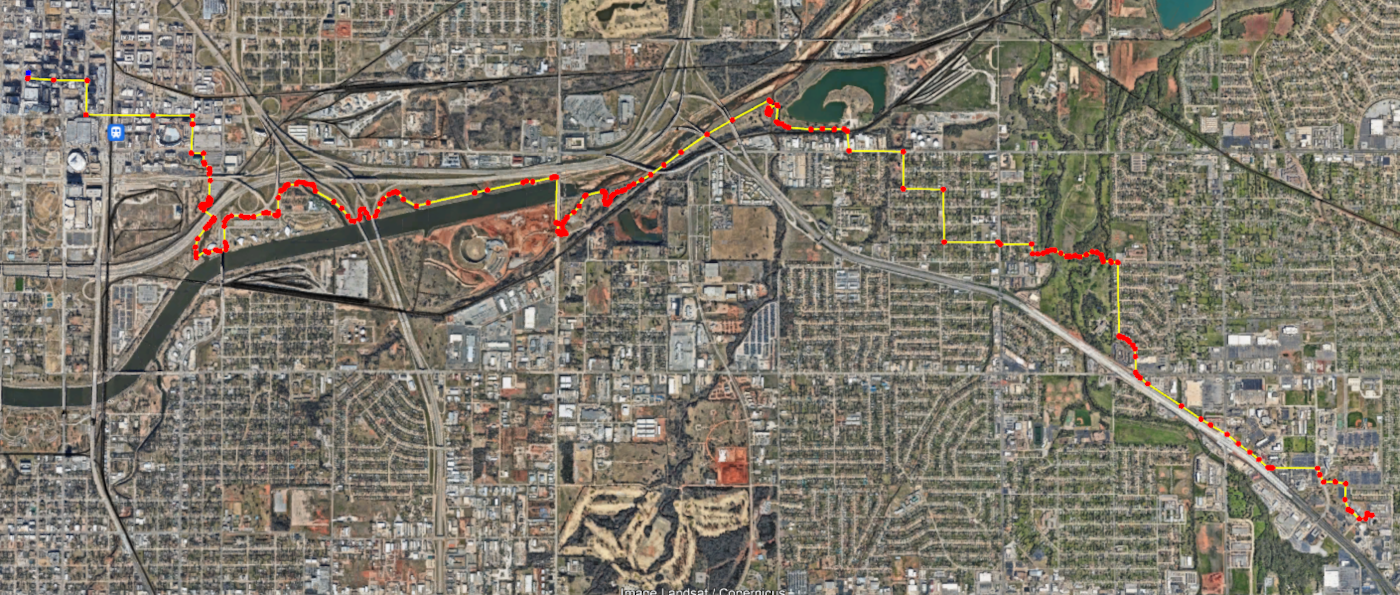
Today I had to make a trip to the Oklahoma County Courthouse. That’s downtown OKC, about ten miles from where I live now (we moved recently). The satellite image is courtesy of Google Earth showing the route. Yes, it could have been straighter, but there’s no fun in that. This route was specifically chosen to avoid motor traffic as much as possible.

My residence is on the backside of Rose State College. There’s a gateway cut through a shared fence between my apartment and the Health Sciences building. However, it was dark and I couldn’t get a good picture until I was almost back home. Depicted here is the new student services center.

This is one of the nice, quiet neighborhoods on the route. This one is called “Midway Village” — midway between Mid-Del (Midwest City-Del City) and OKC. I pass through here often enough that some residents and even dogs recognize me on sight. It’s the best way to get to one of the connecting trailheads of the OKC Trails system. The Mid-Del city governments are lagging a little on funding and building the matching trail network.

This is the entrance to Eagle Lake Park, where one of the trail connections stand. You can ride through a narrow gate that lets riders follow a rough dirt double-track to the edge of the city limits, which is where I pick up the Eagle Lake Trail built by OKC. It follows along the south bank of the Canadian River, which is where I got badly hurt a few years ago.

This is the start of the Eagle Lake Trail, showing the bridge over Crooked Oak Creek. On the other end, the trail loops around and under to follow the river bank. It doesn’t see a lot of traffic, so Parks and Rec don’t maintain it that well. I’ve done a lot of vine cutting along this bike path, because they poke through the fence along the high side of the bank.

At the Eastern Avenue crossing, the Eagle Lake Trail dead ends at a construction site. It will be months before they reopen the bike path farther along that south bank of the river. Meanwhile, this is where I cross the river to the north bank and ride the new Greenway Bike Trail that takes me right past the Oklahoma River Adventure area, also known as the “Boathouse District”. During warm weather, all of these fancy facilities are open to public use. Prominent is a water slides there in the middle.

This puts us just outside of the Bricktown District and to the southeast of Downtown OKC. You can see our few skyscrapers in this view. Honestly, it’s not as fancy as plenty of other cities, but it’s not bad for a old oil and farming town. The old grain elevator on the left now houses a rock-climbing facility. However, most of the former agricultural structures are long gone, moved out from the city center.

This is just about the fanciest structure in Downtown OKC. This is at the base of that massive Devon Energy Tower. It made it to national news once because a weirdo climbed it without ropes once, and another time when some maintenance workers got caught in a window-washer cart that had come loose from its mooring line up near the top of the tower. They were whipped all over the place in high winds, and one was badly injured. The others simply thought they were going to die.

This is the old County Courthouse. It really is used for almost nothing else but court hearings. There is a very substantial more modern tower behind it (obscured by the trees here) where all the offices are. All of this so I could get a copy of my marriage license, which in turn was required to get some other government document necessary for normal life. Once I had them, I pretty much took the same route back home.

I like to turn things like this into an adventure.

Posted in cycling, photography | Tagged , , , | 5 Comments

NT Doctrine — 1 Corinthians 3

Hellenism was a man-centered religion. Man was the measure of all things, and the whole goal was to rise to the full potential of what mankind could be from strictly human resources. This breeds the Boastful Pride of Life. And in the end, you would die, and your only hope was that others still living would remember you. Only the most elite could gain that kind of “immortality”.

What a contrast from the free offer of the gospel message, the path to Eternity for everyone. Paul had wanted so much to share the depth of that message, but it seemed the Corinthians took forever to grasp the simple truth: This human existence is a tragedy. The greatest human triumph is nothing, a bit of trash left on the earth to be cleansed when Christ returns. Wisdom that belongs to Eternity was far beyond the Corinthian reach. Paul had to restrict his message to mere baby formula, because they seemed so severely locked into the fleshly orientation. Even as he wrote this letter, they were not ready.

As I wrote elsewhere: “Spiritual people did not give much attention to human significance. If you are seeking Christ, you aren’t going to pay much attention to what other people have. Spiritual folks have no use for political maneuvering, jockeying for position, or forming teams and parties.”

Paul regarded himself as of no significance. Of the things he did, only what brought his Lord glory would be remembered. He had zero appetite for leadership on human terms, no ambition at all. As far as he was concerned, he and his associates were just hired farmers, or even better, a building crew.

The greatest foundation of our existence is Christ. Paul knew just enough to recognize this, so his whole business in life was laying that foundation wherever he went. He was not in a position to say much about what others built on that, but he knew it was the best he could possibly do. God would sift out what He wanted built on His Son, testing everything as if by fire, whether it would stand.

Building a faith community on anything human will see you standing in the smoky ruin with nothing, and fortunate to be alive.

Did the Corinthians together not know that they were God’s Temple on this earth? His Holy Spirit resided in them. If anyone sought to defile that Temple by inserting man-made trash into the structure, God would treat him as trash and consume him. Don’t bring that stuff into the church.

They aren’t fooling God, only themselves. As long as you revere human wisdom, you can never learn divine wisdom. Discard the trash so you can be filled with treasure. Paul mentions a quote from Job indicating that God is not impressed with human wisdom, and the quote from Psalm 94 says the same thing. Stop boasting in mortal accomplishments. Learn to place a high value on the moral and spiritual treasure that God offers in His Son. Our divine inheritance is all of Creation, and we in turn are the inheritance of Christ, who is the heir of God.

Posted in bible | Tagged , , | Comments Off on NT Doctrine — 1 Corinthians 3

NT Doctrine — 1 Corinthians 2

The whole Corinthian incident shows that Jews are not always the problem. Most of what was wrong in Corinth was the direct result of pagan Gentile culture following people into the church. Jews were not the problem in Corinth. It was the Gentiles with highly rational Hellenism. I cannot do better than my previous commentary on this:

In the entire Bible, there is no statement so blunt, so patently obvious as this one in rejecting the importance of human reasoning and logic in understanding spiritual truth. Lest anyone forget, Paul wrote this to a congregation that came out of a Hellenist intellectual background, either of the Jewish brand, or the original Greek. Short of using the term “Aristotelian” itself, how can he not be addressing that very false worldview?

Paul had been to Athens before coming to Corinth. Doing his best to reach that particular audience in Athens, he spoke on their academic level, offering a very well-reasoned and logical explanation of the gospel. Mostly, it fell flat. Upon coming to Corinth, he was rather low-key for a while. During that time, we can sense that he regained his composure after that bad experience in Athens, realizing that the gospel of Christ could not be made reasonable enough to win hearts that way. So, he writes here how he approached the Corinthians altogether differently than he had the Athenian crowd.

Setting aside the fine oratory, the sharp logical structure, and anything arising from human intellectual authority, Paul spoke simply the truth of Jesus on the Cross. This was not some grand performance and skill, but a man shaken by the vast glory with which he was entrusted. If the power of God Himself could not accomplish the mission, nothing any man could do would make any difference. Thus, many in the city came to Christ simply because Paul told the truth and told it simply.

Surely, there is wisdom from God among mature believers, but it is nothing like the wisdom of this world. The most brilliant of rulers can’t possibly grasp the wisdom of Heaven. This world and its rulers will be forgotten, but the mysteries of God are eternal. Had the high and mighty been aware of this wisdom, Christ would have been crowned, not crucified. Paul quotes Isaiah 64 where the prophet notes that if God were to make a demonstration that human minds must acknowledge, they still would not understand the things God shows His servants without all that noise. The truth comes through the Spirit, not the intellect. And it is the full and ultimate truth of all things, because the Spirit who dwells in us has seen it all. Do you understand that no one knows the intentions of man so well as the man himself? Just so, God the Spirit knows the mind of God the Father.

When the Lord awakens our spirits to receive His Spirit, we reject the things of this world. Whatever God has for us comes through His Spirit. This is what Paul had been teaching, not speaking with the best understanding of human intellect, but the way God speaks to us. He spoke in a way that required exercising the spirit to grasp spiritual truth. Men with dead spirits have no place for God’s Spirit, and no capacity for receiving the Truth. They dismiss the whole thing as senseless babble. We who have living spirits see things through God’s eyes, and we are above human understanding, living in ways mere intellect finds incomprehensible.

Again, Paul quotes the prophet, this time Isaiah 40 where God is described as measuring the universe with the span of His hands. Who is on a par with God? Who has standing to advise Him, let alone evaluate what He has done? By implication, the only answer would be His own Son. That Son has brought His mind into our spirits.

Posted in bible | Tagged , , , | Comments Off on NT Doctrine — 1 Corinthians 2

NT Doctrine — 1 Corinthians 1

The balance of Paul’s Letter to the believers in Rome is personal in nature, not doctrinal, so we follow the canonical order into 1 Corinthians. We’ve already taken a look at the back story to his troubles with the church at Corinth. We have today only two of the four letters he wrote to them during a crisis of obedience to the Scripture. That church had a serious problem trying to shed the notoriously lax pagan morality for which the city was renowned.

After a rather brief introduction, Paul jumps right into a major embarrassment: The church members in Corinth had not left behind their worldly approach to human organization. The various English translations of this chapter themselves often seem to miss the point by catering to a very human form of organizational wisdom. What kind of unity is Paul demanding here?

Whatever it is, he does not refer to the kind of unity humans typically seek. It’s not uniformity of thought, per se, because that is simply not possible without violating everyone’s convictions. In an effort to bring human unity, some members of the church were promoting one model or another, trying to pressure the rest to follow their choice. It was partisan politics, as if they could vote for whom the Lord meant them to follow. Paul was deeply offended that anyone would push a partisan model using his name.

He quotes Isaiah 29:14 from a passage where Isaiah castigates the nation of Israel for pursuing worldly ways. The people kept saying the Lord’s name, but they substituted man’s ways for His Word. This is what the Corinthians were doing. It didn’t matter what name they claimed as their model, none of them were actually following the models, who were all servants of Christ.

Jews demanded a miracle that benefited them materially, while Gentiles demanded something that tickled their human reasoning. Jesus on the Cross condemned fleshly desires; that grisly death was His greatest victory. It was neither profitable nor worldly wise, but it’s how He saved people from this life.

Humans cannot comprehend the Cross with their own capabilities. Paul chides them for losing sight of grace. The majority of the church members had been losers in flesh when the Spirit of the Lord drew them. The only way you can come to the Cross is to nail your fleshly nature there. You must humble yourself as nothing by human reckoning, so that you have room to receive the Lord’s wisdom and power.

Paul quotes from Jeremiah 9, where the prophet warns that nothing humans can generate on their own amounts to much in the eyes of God. Boast in Him.

Posted in bible | Tagged , , | Comments Off on NT Doctrine — 1 Corinthians 1

Ask Me Why

The subsystem in Linux called systemd is okay… until it’s not.

From what I read in the commentary online, the kernel itself is less complicated and Byzantine than systemd. Yet, systemd is controlled by a tiny few people who are openly hostile to comments from the outside. And when it’s broken, you cannot tell them unless you become a part of their little club.

I tested an aging Dell laptop with Mint, SUSE, and Rocky Linux. All of them kept throwing up the same error that arises out of systemd. It’s that crazy complaint coming out of hibernation, that the system is dazed and confused because it does not understand the ACPI implementation. It’s because systemd has changed recently, and as so often is the case, it’s stupid again.

Picking through forums and mailing list archives, near as I can tell, that error traces back to the way systemd handles ACPI events. And having no way to fix it or give feedback is part of the heedless domination that comes for systemd development. Those three distros have worked on this laptop in the past, but not now. And unless you are a developer and master with hardware internals, the systemd folks don’t want to hear from you. If you don’t have a useful patch, don’t contact them.

After running diagnostics on my laptop and finding no problems, I installed PCLinuxOS, which doesn’t use systemd. It works fine and the system doesn’t complain at all. There may be other minor glitches, but hibernation is not a problem.

That’s what it boils down to for most users. If I can’t use the hardware as designed, then don’t offer me something that satisfies philosophical goals or some kind of doctrinal zeal. For example, I still had to learn how to get XTerm to use misc-fixed fonts, but that’s easy to figure out.

!/home/ed/.Xresources
XTerm*renderFont: false
XTerm*font: 9x15

I’m not a coder, just a power user — if that. Which means I know a whale of a lot more than the vast majority of those who finger computers all day long. One of my missions in life is to help those other computer users with all the crazy stuff computers do. Developers typically despise ordinary users, so I do what I can to mitigate user sorrows.

I’ve done a lot of volunteer tech support. I’ve got a big pile of CDs and DVDs with various software on them, collected over the years to help others. I’ve done it for a lot of individuals and a few institutions. Some of them have Linux machines on site. I’m told over and over again that mercy is a quality that they find rare in the tech support business.

As bad as Windows is, ask me why Linux hasn’t replaced it already. I’ve encountered plenty of people willing to switch to Linux, until they learned for themselves that Linux people are typically anything but merciful. I can assure you that systemd is quite typical of Linux development.

Posted in computers | Tagged , , | 2 Comments

NT Doctrine — Romans 14-15:13

That First Church Council back in Acts 15 should have buried the issue, but Jews kept trying to drag Gentiles back under their customs. And it was not just Moses, but several centuries of customary legalism.

No one should be surprised when Jews who come to Christ carry a lot of baggage, but so do Gentiles, just a very different kind of baggage. I noted previously: Paul first makes the subtle point that he agrees with the Gentile Christians regarding freedom from Laws through the higher principle of faith — a direct and personal commitment to God. But that commitment should lead back into community. By grace we surrender some of that freedom back to the Father whence it came, so that we may keep the door open to those still bound by scruples from their old life under the Law.

When kosher was hard to get, Jews typically avoided eating meat. This was how Daniel and his friends handled the pagan Babylonian court diet. But for Gentiles, kosher was just a single cuisine among others that never challenged their faith either way. Paul isn’t making law here for Christians. On the contrary, he appeals for peace between two very different backgrounds coming into one congregation.

There’s no secret here that Jews were strong on law and weak on faith. It was the same regarding various holy days. For Gentiles, it was easier to just forsake their pagan practices and decide that every day was holy in one way or another. It was a very hard pill to swallow for Jews to be told their customs were contrary to faith. It was all too easy for two different brands of arrogance to create tensions that complicated the mission of the Body of Christ. It all hinged on the previous chapter about loving your own faith family.

Paul admits that he had philosophically stepped back from the Jewish ways; he was convinced it was baggage that slowed him down in pursuit of his Savior. Nonetheless, he pleaded with Gentiles to go easy on the encumbered Jews, to be sensitive about how far along they were in faith. Bear with them; go back and help them catch up.

So, moving on to Chapter 15, Paul calls for Jews and Gentiles together to go back and reexamine what the Old Testament Scriptures actually say. If you are truly zealous for God’s reputation, you’ll be forced to confront people and shake them out of their comfort zone. That was the point of Paul’s quote from Psalm 69. It was the same passage quoted about Jesus when He cleansed the Temple. People who care more about power and wealth instead of God’s will end up insulting His name, and it makes a mess that we all have to clean up, even when it’s not our fault personally.

Jews and Gentiles inherited each other as family, the nation of Christ. Their sorrows are yours.

On the one hand, Jesus came strictly to the Jews. And Jews were notorious for their racist hatred of Gentiles. If there’s one thing that caused Jews to reject their Messiah, it was His insistence on the very thing God’s Word demanded: that the Jews reach out to Gentiles. That’s what the Cleansing of the Temple was all about. And not by dragging them into Judaism, Jews were to offer Gentiles a particularly Gentile path to Jehovah (the Law of Noah). Much of the resentment Jews held was the old Talmudic insistence that Gentiles could never be equal to them but could be accepted only as slaves. And here in Rome were Gentile Christians actually serving as leaders in the church.

The Roman Christians had a long way to go.

Posted in bible | Tagged , , , | Comments Off on NT Doctrine — Romans 14-15:13

Faith Puzzle

There’s a Java game you can get for free: jShisen. There’s an installer for Windows and a zipped file for everyone else.

For Windows, you’ll need to be sure and get Java installed. I recommend you get it here. It’s not as complicated as it looks. Look at the fourth column near the top of the page (“Runtimes”), and select the fourth item with “Java” in the label. That’s the latest Java runtime environment for 64-bit computers, which means just about every Windows computer since Win7. Just follow the instructions on the page. Click the item and scroll down to the “Get Your Ninite” button.

Navigate to your Downloads folder and double-click the Ninite file. It will install Java without troubling you about anything except permission to install. Next, we’ll set up jShisen.

I haven’t tried to Windows installer lately; it didn’t work too well the last time. If it doesn’t work for you, then it requires setting it up manually. Get the zipped file for other operating systems. It’s not that different internally. Unzip the package and you should have a “jShisen” folder with some files inside.

I drop that folder into my “Documents” directory (on the machine itself, not in One Drive). Then, inside the folder I right-click on the “jShisen” file with the cartoon Java character on the icon, identified as a “JAR” file. On the right-click menu, select: Send to > Desktop (create shortcut). Your system should automatically associate the executable with Java.

For Linux, you have to know how to create your own menu entries or desktop icons, since all the various desktop packages have their own methods. Typically you’ll need a command like this:

/usr/bin/java -jar /home/[USER]/jShisen/jShisen.jar

Years ago I created a PNG icon from the Windows icon file. Feel free to download this for your Linux version of the game. (Right-click and “save image as…”)

Open the game and run through the various settings. On Boardsize, I recommend 24×12 or 27×14. You’ll have to decide whether you like having the tiles slide down with “gravity” or stay in place. There are a few other options; explore.

To play, learn how to read the buttons on the menu line. Start a new game. You can right-click on any tile to see where the matching tiles are. Only if two matches are adjacent can you click inside the matrix. Mostly it’s a matter of eating away at the matrix by clicking two matching tiles from the outside. The line between them must take no more than two corners.

You’ll learn how it works. Unless you have some odd talent for it, you’ll be surprised at what will and won’t work in trying to get matches to disappear.

Here’s the point for faith: You must take what comes. Trying to build a strategy won’t do much good. Maybe you’ll notice that cutting a line up, down or across will increase your opportunities for finding matches, until it doesn’t. There are things you need to watch out for — like when two types of tile are lumped together in an diagonal square. It’s not possible to match either pair by themselves. You must remove one using an outside match.

Otherwise, the whole point of the game is just eating away at what can be matched as is. The game teaches you the virtue of opportunism. Believe it or not, that’s a biblical moral value — take what God grants and make the most of it.

Posted in computers | Tagged , , , | 1 Comment

NT Doctrine — Romans 13

In this letter, Paul keeps hammering on problems Jews have with faith in their Messiah. To be honest, the previous chapter was aimed more at Jews and their peculiar challenges than it was to Gentile believers. It’s the same with this chapter.

First century Jews were notorious for objecting to pagan governments. They wouldn’t hesitate to use the Pax Romana to make money (Jews in Rome tended to be wealthy), but suffered from a serious, almost maniacal obsession with demanding their “rights” as the Covenant Nation under Rome. They gained that unique privilege because a major faction in the Jewish government at the end of the Maccabean Period willingly invited Rome to get involved in an internal dispute. By the time Paul writes this letter, they deeply regretted it.

So, this passage is aimed at Jewish Christians there more than anyone else. By rejecting the Covenant of Moses, they brought a whole string of pagan imperial governments down on their own heads. They needed reminding of that. Thus, Paul warns them that their own God has arranged to keep them under Roman authority. They had better get used to it. At the same time, keep in mind that Paul didn’t mean this as it sounds to our ears in English, given how he did not hesitate to manipulate the situation to avoid both Jewish and Roman government oppressing him. What Paul is warning against here is the standard Jewish truculence and senseless resistance out of spite.

You want government to leave you alone? Start working toward peace and efficiency in the world around you. Stop trying to circumvent every little thing. That is not righteousness. He reminds them what Jesus said more than once: Love your covenant family as family. That covers all the Law of Moses, and it works pretty well under Rome. What kind of behavior is really in their best interest? How do you keep from bringing the wrath of a pagan government down on your brothers and sisters? That would answer every question.

Paul’s reference to knowing the time and waking up does not refer to the Return of Christ. Rather, anyone with half a brain could see that persecution was brewing in the Roman government. The only way to avoid a panic is to be ready for the worst. Make strong moral habits so that you are less likely to compromise when the pressure rises. Polish up your testimony; make sure you look like Christ. When the time comes, He will deliver you according to His divine will.

Posted in bible | Tagged , , | Comments Off on NT Doctrine — Romans 13