Today I had to make a trip to the Oklahoma County Courthouse. That’s downtown OKC, about ten miles from where I live now (we moved recently). The satellite image is courtesy of Google Earth showing the route. Yes, it could have been straighter, but there’s no fun in that. This route was specifically chosen to avoid motor traffic as much as possible.
My residence is on the backside of Rose State College. There’s a gateway cut through a shared fence between my apartment and the Health Sciences building. However, it was dark and I couldn’t get a good picture until I was almost back home. Depicted here is the new student services center.
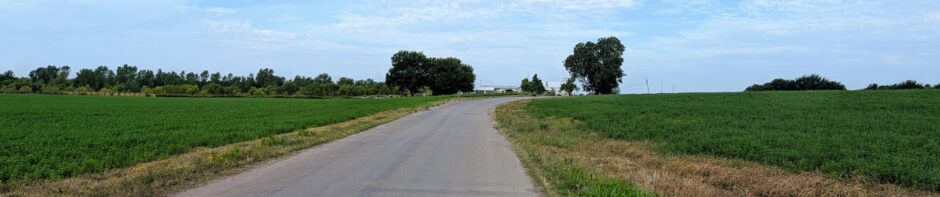
This is one of the nice, quiet neighborhoods on the route. This one is called “Midway Village” — midway between Mid-Del (Midwest City-Del City) and OKC. I pass through here often enough that some residents and even dogs recognize me on sight. It’s the best way to get to one of the connecting trailheads of the OKC Trails system. The Mid-Del city governments are lagging a little on funding and building the matching trail network.
This is the entrance to Eagle Lake Park, where one of the trail connections stand. You can ride through a narrow gate that lets riders follow a rough dirt double-track to the edge of the city limits, which is where I pick up the Eagle Lake Trail built by OKC. It follows along the south bank of the Canadian River, which is where I got badly hurt a few years ago.
This is the start of the Eagle Lake Trail, showing the bridge over Crooked Oak Creek. On the other end, the trail loops around and under to follow the river bank. It doesn’t see a lot of traffic, so Parks and Rec don’t maintain it that well. I’ve done a lot of vine cutting along this bike path, because they poke through the fence along the high side of the bank.
At the Eastern Avenue crossing, the Eagle Lake Trail dead ends at a construction site. It will be months before they reopen the bike path farther along that south bank of the river. Meanwhile, this is where I cross the river to the north bank and ride the new Greenway Bike Trail that takes me right past the Oklahoma River Adventure area, also known as the “Boathouse District”. During warm weather, all of these fancy facilities are open to public use. Prominent is a water slides there in the middle.
This puts us just outside of the Bricktown District and to the southeast of Downtown OKC. You can see our few skyscrapers in this view. Honestly, it’s not as fancy as plenty of other cities, but it’s not bad for a old oil and farming town. The old grain elevator on the left now houses a rock-climbing facility. However, most of the former agricultural structures are long gone, moved out from the city center.
This is just about the fanciest structure in Downtown OKC. This is at the base of that massive Devon Energy Tower. It made it to national news once because a weirdo climbed it without ropes once, and another time when some maintenance workers got caught in a window-washer cart that had come loose from its mooring line up near the top of the tower. They were whipped all over the place in high winds, and one was badly injured. The others simply thought they were going to die.
This is the old County Courthouse. It really is used for almost nothing else but court hearings. There is a very substantial more modern tower behind it (obscured by the trees here) where all the offices are. All of this so I could get a copy of my marriage license, which in turn was required to get some other government document necessary for normal life. Once I had them, I pretty much took the same route back home.
I like to turn things like this into an adventure.


NT Doctrine — Romans 14-15:13
That First Church Council back in Acts 15 should have buried the issue, but Jews kept trying to drag Gentiles back under their customs. And it was not just Moses, but several centuries of customary legalism.
No one should be surprised when Jews who come to Christ carry a lot of baggage, but so do Gentiles, just a very different kind of baggage. I noted previously: Paul first makes the subtle point that he agrees with the Gentile Christians regarding freedom from Laws through the higher principle of faith — a direct and personal commitment to God. But that commitment should lead back into community. By grace we surrender some of that freedom back to the Father whence it came, so that we may keep the door open to those still bound by scruples from their old life under the Law.
When kosher was hard to get, Jews typically avoided eating meat. This was how Daniel and his friends handled the pagan Babylonian court diet. But for Gentiles, kosher was just a single cuisine among others that never challenged their faith either way. Paul isn’t making law here for Christians. On the contrary, he appeals for peace between two very different backgrounds coming into one congregation.
There’s no secret here that Jews were strong on law and weak on faith. It was the same regarding various holy days. For Gentiles, it was easier to just forsake their pagan practices and decide that every day was holy in one way or another. It was a very hard pill to swallow for Jews to be told their customs were contrary to faith. It was all too easy for two different brands of arrogance to create tensions that complicated the mission of the Body of Christ. It all hinged on the previous chapter about loving your own faith family.
Paul admits that he had philosophically stepped back from the Jewish ways; he was convinced it was baggage that slowed him down in pursuit of his Savior. Nonetheless, he pleaded with Gentiles to go easy on the encumbered Jews, to be sensitive about how far along they were in faith. Bear with them; go back and help them catch up.
So, moving on to Chapter 15, Paul calls for Jews and Gentiles together to go back and reexamine what the Old Testament Scriptures actually say. If you are truly zealous for God’s reputation, you’ll be forced to confront people and shake them out of their comfort zone. That was the point of Paul’s quote from Psalm 69. It was the same passage quoted about Jesus when He cleansed the Temple. People who care more about power and wealth instead of God’s will end up insulting His name, and it makes a mess that we all have to clean up, even when it’s not our fault personally.
Jews and Gentiles inherited each other as family, the nation of Christ. Their sorrows are yours.
On the one hand, Jesus came strictly to the Jews. And Jews were notorious for their racist hatred of Gentiles. If there’s one thing that caused Jews to reject their Messiah, it was His insistence on the very thing God’s Word demanded: that the Jews reach out to Gentiles. That’s what the Cleansing of the Temple was all about. And not by dragging them into Judaism, Jews were to offer Gentiles a particularly Gentile path to Jehovah (the Law of Noah). Much of the resentment Jews held was the old Talmudic insistence that Gentiles could never be equal to them but could be accepted only as slaves. And here in Rome were Gentile Christians actually serving as leaders in the church.
The Roman Christians had a long way to go.
