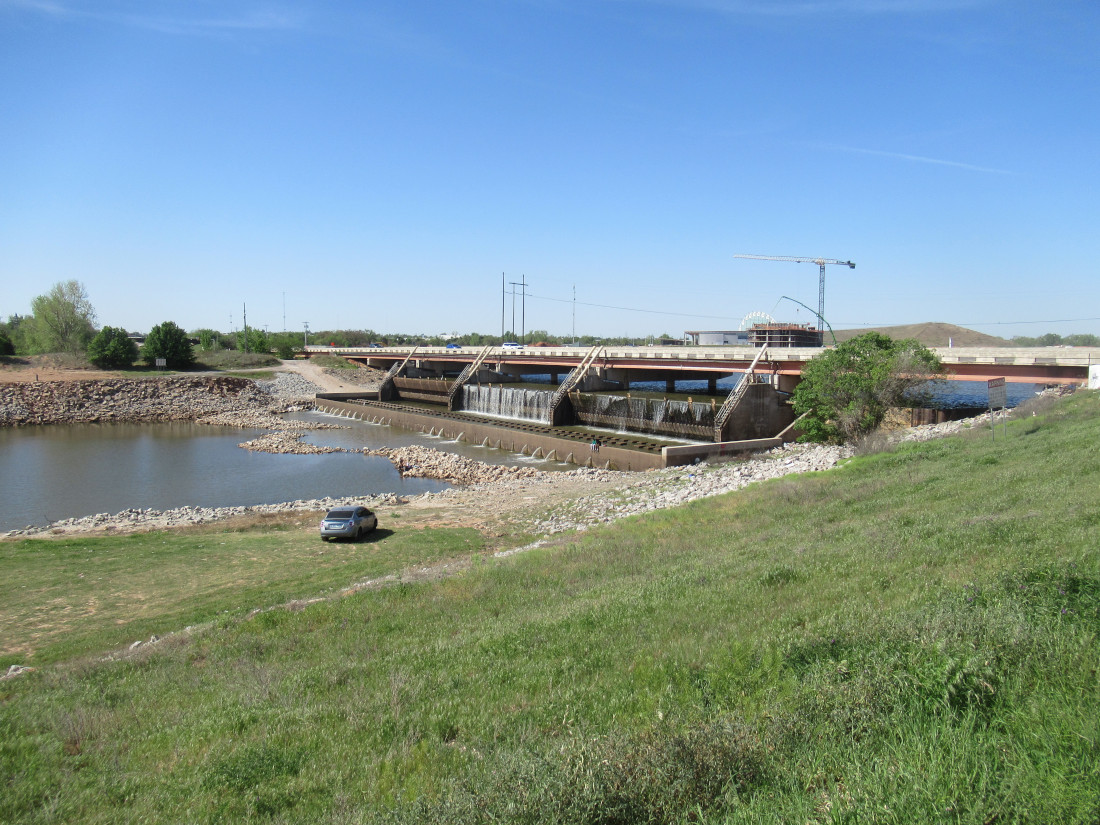
Ride Photos 20

This is what the new bikeway signs look like. You can find them scattered all over the Oklahoma City area, wherever these established trails exists. More trails are in the works, and at least one new trail is always under construction somewhere. The city has decided to invest a surprisingly large amount into the project of improving bike routes and walking routes. This specimen stands on the Stanley Draper Lake Trail.

This field has been used for cattle, but only during warmer months. It gets grazed down, and then looks almost like it’s been mowed over the winter months. The creek is nothing special, but it looks rather nice running across the property. In the heat of summer, I often encounter the cows hugging the shady areas in midday.

Not too far away is this even nicer scene. I’ve seen horses on this property from time to time, but not consistently. I recall the little bridge under construction a few years ago. It was previously just a couple of planks. I don’t get out this way too often any more.

County and federal funds were awarded to smaller communities that built bike paths, like this one in Harrah, OK. Of course, the city was supposed to handle the maintenance, but I can tell you they’ve spent very little on that. Large stretches of this path are crossed by tree root swells that make it very rough riding. In a couple of years, the asphalt will crumble off the tops of the roots and it will smooth out just a little. Then a few years after that, large craters will appear as the roots continue breaking the surface. That’s how it works in these small towns.

A mile or so north of Harrah is this row of sturdy Sycamores. Last year someone decided to trim the lower branches on them. I stop here whenever I’m in the area; it’s one of my favorite prayer chapels, and a dandy picnic spot on those long rides. The camera angle doesn’t show all of them, as they aren’t quite lined up neatly.

Posted in photography | Tagged , , , , | 2 Comments

NT Doctrine — Acts 3:1-4:22

It didn’t take long for the Jewish leadership to take offense at this explosion of faith in Jesus. Diaspora or not, the crowd of Jesus’ disciples was growing, and their presence was strongly felt in the city.

Jesus had said that God really didn’t care about the place people worshiped, but wanted worshipers who had a spiritual nature to meet Him in the Spirit Realm. Yet, instead of moving His followers to abandon the Temple, this breathed fresh life into what was by now empty ritual for most. With the holiday crowds mostly gone, it was very easy to draw attention to oneself in the relative sparsely attended Temple rituals.

Nobody knows where the Beautiful Gate stood, but it was a good place for customary beggars. You would have found as many there along the walls as space permitted, hoping to catch people entering the Temple in a pious mood. To keep the pretense that charitable gifts were given to God, the beggars avoided eye contact and simply called out for alms. It was late in the day. Peter and John, making their way through this gate with the cacophony of beggars calling, sensed the presence of faith in this particular fellow.

Normally, demanding the beggar give them direct attention meant a substantial gift and the recipient had better be ready to give profuse gratitude. However, Peter gave something quite different than money. He grabbed the man and pulled him to his feet, and his lame legs were healed. Being a man of faith, he would much rather have his legs than mere money. In Hebrew culture, manly men were marked by strong legs, not big arms. Peter and John restored this fellow’s manhood, doing so in the name of Jesus.

The man began jumping up and down, shouting praises to God with irrepressible thanksgiving. He clung to Peter and John and celebrated that he was now whole and eligible to enter the Temple (the blind and lame were by tradition not permitted inside the gates of the Temple structure). This was his first time to formally worship the God who had just healed him, whooping and hollering, dancing and leaping during the whole service. It would be impossible to ignore such noisy joy.

As they were leaving following the service, a crowd surrounded them in the Court of Women. The regular worshipers recognized the lame man due to his constant attendance at the gate, and this was a noteworthy miracle. Even the most jaded urbanites were moved.

Peter seized the opportunity to preach. He wondered aloud at the their surprise. Was this not the Temple of the great God of Abraham, having granted so many miracles over the centuries? It was not their own power or moral uprightness that healed the man. Peter never forgot how unworthy he was, having betrayed His Lord; it was miracle enough for the rest of his life to be forgiven.

And he didn’t spare their feelings at all, quickly pointing out how it was the people of this city who had called for Jesus to be crucified, when Pilate was striving to get Him released. The people had insisted on a murderous thug who had preyed on some of them, instead. Peter spoke in unmistakable terms that Jesus was the Messiah, the Holy One of God. He was one of many personal witnesses that God had raised Jesus from death, and it was His name that raised this man from lameness.

Peter of all men was able to testify of God’s mercy and forgiveness. If he could find peace with God, they could, too. He invited them to repent and commit their lives to Him as their feudal Master. Yes, it was tough to serve a Lord they could not see, but He was in Heaven until the Father decided it was time to restore Eden, something promised by the prophets since the beginning of revelation.

Well, Jesus was the prophet of all prophets, and Peter quoted Moses, warning that Israel must submit to Him or perish. The people crowding around him were the heirs of the prophets, standing in the day they had testified would come. The Messiah reigned now; it was the time to declare the New Covenant to His own kin first.

The commotion brought the attention of the attending Sanhedrin and Temple Guard. Any disturbance was risky these days, so they came to see what was happening. As soon as they realized Peter was teaching that the Jesus they had recently seen executed was the Messiah, and that this Jesus had raised from the dead, they had the trio arrested. It being so close to sunset, they placed the men in prison overnight.

Meanwhile, the message brought a harvest of souls; 5000 men joined the disciples that very day. This sect was exploding.

For the Sadducees — the secularized party of priests and Levites — the teaching of rising from the dead was anathema. They insisted there could be no Spirit Realm, and thus, no place where the dead could exist until resurrection of any kind. For the Pharisees, Jesus was the wrong kind of Messiah, whose teaching threatened their wealth and power.

So the next day, the whole council of the ruling class assembled and called for these men to stand before them. They demanded to know what authority these men had to heal this man and stir up so much trouble. The presumption here is that this council, as the hereditary government of Israel, was the official voice of God and His Covenant. These men were obviously working outside the system, so it must be some other god.

Peter was filled with Spirit of their professed God at that moment and didn’t hesitate to reply. It was impossible for anyone to debate the healing itself, a healing the men of this great council either could not or would not do for this poor victim of paralysis. The authority was Jesus of Nazareth, the man they had only recently had crucified, but whom God Himself had raised from the dead. The rulers had rejected His claims, but God was building a whole new covenant with Jesus as the foundation.

Peter had a bumpkin’s accent from Galilee, no rhetorical format, and none of the educated mannerisms of rabbis. Instead, he talked pretty much the way Jesus did. It was quite perplexing to them. Nobody could dispute the miraculous healing, and they could neither produce the body of Jesus, nor even an eyewitness from among the guards keeping watch over that body.

So they had the men escorted outside the chamber while they conferred in executive session. There was nothing they could do. Here was a miracle that could not be covered up. But they could not have these crazy people running around teaching the message of Jesus, so they resolved to censure them officially. The trio were brought back in and warned not to speak in the name of Jesus.

Peter and John both replied that they were unable to obey that order. Should they obey this order, or should they obey the God who drove them to speak this message? They were determined to obey God at any cost. The council threatened again, with more specific demands and warnings, but it was pointless to detain them any further. It would surely cause a riot if they did, so the trio was released.

Luke notes that the healed man was over forty years old, and had been lame his whole life. This was not some hoax, nor simply a novel medical treatment, but a radical restoration of limbs that had never worked properly.

Posted in bible | Tagged , , , , , , | Comments Off on NT Doctrine — Acts 3:1-4:22

A History of Jewish Predation

Obviously, I am an antisemite. Of course, the proper definition of the word “antisemite” is anyone Jews do not like. Further, it identifies anyone who resists Jewish manipulation and their predatory agenda. The Apostle John was just such an antisemite, calling Jews the Synagogue of Satan. I’m going to outline how they went from God’s Chosen to Satan’s Chosen.

The Nation of Israel was called into covenant with Jehovah for one purpose: His divine glory. The glory of God is His reputation via His revelation of how we must live in this world, and how He pours out blessings on those who embrace that truth. Israel’s primary mission was to breathe life into divine revelation and open a highly visible path for the world to find peace with God. It didn’t take them long to reject that mission. Over a number of centuries, the Lord worked with them according to His revelation, showing extreme indulgence and patience. In the end, He sent His own Son to clarify things.

Jesus’ teaching, backed up by His miracles, pointed out just how lost they had gotten from the path of peace with God. At that point, they had moved so very far from God’s purpose that they could not recognize this Son, and they had Him crucified. Their vicious spite was palpable, even from this distance.

The Bible points out how the Jewish leadership had become obsessed with the covenant blessings, but rejected their covenant obligations, which was their identity. They came to the believe God owed them because of their racial/ethnic identity. It was outlined in the Wilderness Temptations of Jesus. They demanded that God provide for them abundant wealth, spectacular miracles that entertained them, and political dominance over the whole world. They considered themselves the only real humans, while all Gentiles were animals, a different species entirely. The leadership even went so far as to regard their own peasants as subhuman.

Satan wanted Jesus to become the Messiah they were expecting. He refused, becoming instead the Messiah that was actually promised. The difference between the two was shocking, and resulted in His execution.

The miracles of Jesus continued and expanded among His followers after the Day of Pentecost. The Jewish leadership took counsel and sought ways to silence this movement that was so galling to their sense of privilege. When persecution failed, they began sending crafty rabbis to seduce the churches the Apostles had planted. Very early, the Judaizers developed a mind-bending strategy of deception. At first it was meant to seduce them into coming back under the Talmud. This didn’t work too well, so the emphasis shifted to simply disrupting genuine faith itself.

It was no different from the counsel of Balaam used against them centuries ago. The Judaizers sought to seduce the Christians away from faith so that they lost their miraculous powers, which miracles was a burning flame of ignominy for Jews. It kept the culpability for the Cross in their faces. So the Judaizers brought things back into the realm of human reasoning where they knew they could dominate, having long mastered such things (they had embraced Aristotle’s epistemology after Alexander the Great passed through Palestine, developing a special talent for legalism). As long as Christians clung to faith, they could easily reject Jewish lies. So the long term strategy was to weaken Christian faith by pulling things back down to the realm of human control.

The primary power of the Judaizing influence was to complicate things intellectually. This was their home ground in spiritual warfare. Pulling all questions down into the sphere of human intellect was the very nature of the Fall in the first place. The Forbidden Fruit symbolized the choice to approach questions from human capabilities, instead of trusting the revelation of God and keeping personal loyalty to Him. Thus, asserting the dominance of the fallen human intellect over faith through the heart and convictions was the key to Jewish leadership gaining control over the Christians.

The battle lines drifted as the Jewish leaders perfected their craft. Since God would not grant them a Messiah to their liking, they would become their own Messiahs. They would seize from the Gentile world the things they lusted for in this world, and reject the otherworldly path of the true Messiah. Since they rejected the reign of their God and the Messiah’s spiritual kingdom of hearts, their God cut them loose. But they refused to disband as a nation, and so Satan was quite happy to take over the position as their national deity.

Satan had not lied to Jesus about those things he offered in the Wilderness Temptation, but the deception was in the unspoken assumption that the things he offered were worth having. The Jews are now the Chosen people of the Prince of This World, and they would come to dominate wherever there was no Covenant protection. Every human activity that is not specifically and explicitly under the Covenant of the Messiah now belongs to Satan. And Satan uses the Jewish people to dominate his realm. He gives his servants what he offered Jesus, and it’s not worth having.

Throughout history, the Jews maintained their obsession with dominating the Gentile world through deception and manipulation. They tricked the early Christians into seeking to answer the Judaizers’ intellectual challenges instead of relying on faith. They tricked the early churches into seeking relief from persecution by encouraging church leadership to seek political solutions. Thus, Constantine was able to seduce the church leadership into an alliance that served only the human political agenda of government. It also put things squarely in the Jewish home ground for battle.

The obsession of the Jewish leadership has never changed: They are determined to seek ethnic advantage in every situation by using deception and manipulation. They have always sought to degrade and destroy every nation, government and people while building up their own. They have refused to assimilate into any country, holding themselves separate and privileged. While they have admitted as much in their own writings, we can see it clearly through the evidence of how they act in every context throughout history.

From time to time, Gentile rulers would get just enough of the gospel truth to realize Jews were the single greatest threat they faced politically. When they began to treat Jews accordingly, Jewish leadership sought ways to undermine and destroy, not just that particular ruler, but the whole national identity of the people. They would infiltrate where they could and prey upon any cultural or political weakness they could find, seducing the people into every vice imaginable, even as they strictly rejected such vices among their own.

At some point, Jews realized that the European people in general, and northern Europeans in particular, were the most resistant to their strategies. So they sought by steps to destroy first the feudal system that was so effective in singling out the Jewish threat. The revolutions of Europe were always provoked by Jewish manipulation. The Enlightenment was a Jewish program to undermine feudalism and secularize government. It destroyed the pretense of faith, and destroyed the belief in ethnic identity among the Gentile nations.

As the years rolled on, the Jews continued to tinker with the effects of the Enlightenment to further degrade the northern European cultural legacy. (I’m not defending that cultural legacy; this is simply an examination of how Jews operate.) It turned into a visceral hatred and attack on white people as a whole. The other branches of human ethnic and cultural identity have been, up to now, not much of a problem for Jews to work around. However, over the past couple of centuries, Jewish leadership have treated the entire range of northern European peoples as their greatest threat.

So here we are in the US today, and just about everything that could have worked to keep the nation viable has been destroyed by Jewish manipulation. It’s not hard to find how they infiltrated academia, organized religion, government and media. They are responsible for middle class materialism, destructive social theories, communism and socialism, feminism, pedophilia, and just about every kind of social rot you can name. See Kevin MacDonald’s Culture of Critique series of books for a solid analysis of this.

Meanwhile, Jews continue to reject any attempt to inject that crap into their own society. They militate against any ethnic discipline but their own. Their primary weapon is to insist that no one notice they keep themselves separate from the very same harm they promote among Gentiles. They are always whining about persecution and oppression, they very thing to do to everyone else. The message they keep pounding is that there is no Jewish conspiracy of any kind, and that Jews are always inherently harmless, and have always blessed the Gentiles with their benevolence. The sheer audacity of their claims is beyond words.

Please keep in mind: Any attempt to use human political or intellectual tools to fight them is a tactical blunder. It surrenders to them the only advantage God has given us in resisting Satan. Satan is the Prince of This World, and anything you can do via reason, education, culture, politics or military action is meeting them on their own battlefield. The only defense against this hideous threat is heart-led faith in the Messiah they rejected. The otherworldly focus of the gospel is the only answer.

Regardless what happens in this world, Satan shall rule over human activity. God has granted Satan that authority. The only way to escape is the Covenant of Christ. Obey the Code of Noah and keep yourselves undefiled by the cares of this fallen world. The Lord will not remove the Jewish threat; He has granted to Satan control over them as part of this world. Don’t leave the boundaries of the Covenant or you will be on Satan’s turf. Our ultimate victory over Satan and his Jews is to stop getting entangled in what they do. Focus on escaping this world, because it has been delivered to Satan.

The best defense is to seize the Covenant they rejected and live by its power. Meanwhile, keep declaring the truth, including the truth about Jews.

Posted in sanity | Tagged , , , , , , , | 3 Comments

NT Doctrine — Baptism

The English word “baptism” is taken from the Greek word baptizo used in the New Testament to signify the ancient Hebrew ritual washing. The Hebrew word most commonly associated with the practice is mikveh, which means “a gathering of waters”.

The original idea in the Law of Moses was ritual cleansing. In particular, it was a remedy for ritual defilement. It was rather detailed regarding what kind of defilement and whether it was rainwater, a stream or spring water. The point was to restore one to the ritual purity necessary to enter the divine Presence. While the focus was on entering the Tabernacle/Temple, it included the concept that God was present among the Chosen, and ritual cleansing was necessary to restore covenant fellowship with the nation.

Once the Temple was built and standing in Jerusalem, ritual baths were built all around the city. It became a common practice for men to bathe on the way to the Temple out of an abundance of caution to wash away accidental defilement the worshiper might not know about.

Rather early in Israel’s history, the symbolism of the mikveh was associated with both the womb and the grave. These were the natural portals of human existence, beginning and end. Thus, the ritual washing symbolized a new life, with the implication of eternal life. It was restoring the primal relationship as a child of Jehovah, a rebirth. This was the teaching under the Law of Moses.

At the same time, there is no mention in the Old Testament of mikveh in relation to the ritual washing. The association of the term with ritual washing came rather late in the Second Temple period. After the Return and Restoration from Exile, Daniel’s prophecy of the timing of the Messiah was noted among rabbis. It was not so much a precise date, but in typical Hebrew fashion, was regarded as an approximation. Thus, about a century before Christ, the practice arose of using the mikveh to mark a repentance and turning to a life fit for the coming of the Messiah.

It was noted that Jeremiah used mikveh as the image of a fountain (Jeremiah 14:8, 17:13, 50:7) as the “hope of Israel”. Thus, the Messiah would be the ultimate mikveh of cleansing. This teaching was associated most clearly with the ministry of John the Baptist. He used the symbolic mikveh ritual as a way of marking preparation for the coming Passover Lamb of God. He will baptize in the fire of the Holy Spirit!

All of this was fresh in the minds of pious Jews during John’s ministry, through the ministry of Jesus, and in Peter’s preaching on the Day of Pentecost. In the minds of such Jews, it was the symbol of completing the Old Covenant and embracing the New. It was already in their minds that this ritual mikveh was departing from their old Jewish identity and moving forward into the Messianic Kingdom. It required understanding the Old in order to live in the New.

All the previous sweet sounding talk of the Nation being one people under the Covenant, one big family, was widely recognized as fake. Jesus was not proposing anything new in the Parable of the Good Samaritan; the ruling class of Jews were not one family with the people. And it was widely recognized that Samaritans at that time were quite conscientious about obeying a more primitive understanding of Moses. It was shocking only that Jesus would be so frank about what everyone knew all along. But when the first hundred or so disciples began actually living by the concept of adopting each other as the true family of the Messiah, it restored the real meaning of Covenant identity. It was something worthy of celebration.

This is why baptism became associated in Acts with people forming a fresh tribal identity, and merging their material assets into one single household. This is inherent in Paul’s teaching in Ephesians 1:10 about the “administration” or “dispensation” of the new age of the Messiah. Paul was explaining to a Hellenized audience in Ephesus the rich imagery of the old Hebrew prophecies about the Messiah. The merging of assets wasn’t required, but it was a natural voluntary response. This had a lot to do with the later event regarding Ananias and Sapphira. It represented the compassionate care of family folks.

Baptism is the mark of new life in the Messiah. It was purely symbolic, but an obligatory symbol to declare the new life in the household of the Messiah. What followed was the radical kind of obedience that made one alien to the rest of the world.

Posted in bible | Tagged , , , , , | Comments Off on NT Doctrine — Baptism

NT Doctrine — Acts 2

The symbolism is so thick you could cut it with an ax.

The Day of Pentecost is just another name for First Fruits. In this chapter of Acts, we are about to see the first fruits of the New Covenant in Christ. This is by no means a coincidence, but was the hand of God drawing a linkage impossible to ignore. The New Covenant finished the Old, yet much of the Old still lived in the New.

It was no longer possible to confine this large body of disciples in the Upper Room where Jesus held His last Seder with the Twelve. They had taken over the whole structure, including the courtyard, and likely scattered around to other places for sleep at night. On the Day of Pentecost itself, they were packed into the house to celebrate together.

We have no record of what folks outside this home experienced, but those inside heard a very loud roaring sound coming down from the sky. It fell upon the entire structure, accompanied by a stirring of the air like a gentle breeze, but by no means matching the howling sound of wind. One of the Hebrew words used for the Spirit of God is commonly translated as “wind” or “breath” — this was the breath of God.

With the wind came fire. Like the wind, it was not damaging, but a manifestation powerful enough to leave no doubt it was beyond human ken. Luke chose odd words to describe this glowing presence that divided and distributed itself above the heads of everyone in the building. They were all filled with the divine Presence, something that had been quite rare up to now. Instead of a miracle for a limited purpose and time, this was a permanent change in the very nature of the people there.

Luke says the primary result is that everyone was driven out of the house and into the streets, proclaiming the glory of God in different languages they had never learned. Keep in mind that a great many Diaspora Jews from all around that part of the world traveled to Jerusalem for Passover and stayed until after Pentecost. All of these Jews were fluent in different languages, representing the wide array of locations where they lived the rest of the year. The Spirit of God enabled the disciples to speak in all of these languages. Even some Gentiles in town heard their own languages from places where there were no resident Jews.

Most of these people knew little, if anything, about the rabbi that had recently been executed, and about the large number of His followers. Most of these folks from out of town had not seen the miraculous signs, so this scene really puzzled them. Meanwhile, some locals suggested cynically the whole group was drunk.

While the rest of his group were drawing the Diaspora Jews and Gentile foreigners, Peter managed get the attention of the locals, addressing them directly. He noted that such a large group was unlikely to be drunk at 9AM, especially on a day when every observant Jew was fasting until just about that hour. Besides, drunks seldom spoke eloquently at all in any language, much less to prophesy of Jehovah’s mighty miracles. Peter connected this manifestation with the words of the prophet Joel (2:28-32) about the coming of the Messiah.

When Peter got to the line about calling on the Lord for redemption, Peter pointed out how Jesus had fulfilled this prophecy. He did not shrink from blaming the locals for the mistaken execution of Jesus, yet assured them that God was not caught off guard and had been ready to resurrect His Son. To make sure they understood this, Peter referred to David’s prophecy in Psalms 16:8-11. There, David talked about how the final heir in his dynasty would rise from death to reign. It wasn’t David himself that rose; he was still in a grave that anyone could visit right there in the city. Rather, it was a prediction of the Messiah who would not rot in any grave.

Peter boldly claims that all those from the group preaching on the streets had seen the risen Messiah first hand. Even now, said Peter, He reigns from Heaven. Then he specifically warned that those who rejected or opposed the Messiah would be crushed under His feet.

A significant portion of the crowd was struck with conviction. Peter’s words are so easily missed by modern Gentile readers, though. First, the Covenant of Moses had always demanded repentance, to turn away from sin. In this case, it would mean disavowing the crucifixion and embracing Jesus as whom He claimed to be, the Messiah. As a sign of the new loyalty to the Messiah, they should participate in the old Mosaic ritual of cleansing in water, but now in the name of Jesus the Messiah, cleansing away the old life and living in the new life of the Kingdom of Heaven. In the eyes of the Jewish leaders, this was a form of treason, had they considered what this all meant. It meant repudiating their Jewish national identity in favor of a higher claim on their loyalty. Those who were able to do such a thing would find this same power and enlightenment was theirs. Notice how Peter says no man can choose this for himself, but it is the Lord who chooses and calls, and human national identity means nothing.

The preaching continued off and on for some hours until some 3000 had joined this group, embracing the ritual baptism and committing themselves to their Lord. Over the next few days, this commitment bore fruit. The Twelve performed miracle signs and those who learned the teachings of Jesus were changed by the unanimous miracle of the Holy Spirit living within.

Many of them felt compelled to stay in the city with this growing household of faith. They executed sales of various properties, some with significant holdings back in their Diaspora homelands. Grasping the nature of their New Covenant identity, they acted as if it was their real family household and began sharing their wealth. They were one tribe, and everyone was their brother or sister. Having found a family worthy of such commitment, they never went back to their Diaspora homes, but stayed in Jerusalem. The permanent population of the city grew massively in just a few days.

Meanwhile, a significant number of locals also joined in this new life. Instead of crushing the movement, the Jewish rulers found themselves inundated with these followers of Jesus right in their own capital, swarming into the Temple daily, and running around the city streets with irrepressible joy. And their numbers just kept growing.

Posted in bible | Tagged , , , , , , | Comments Off on NT Doctrine — Acts 2

The Lie of Great Destinies

There are dozens of explanations of Frank Herbert’s Dune series of novels on places like YouTube. I won’t recommend any in particular; if it matters to you, it’s worth some time exploring it on your own. The only reason I bothered was because I was once deeply enamored with that sort of epic science fiction, and have read several different series of that sort. The written Dune saga isn’t really as deep as it appears, but it’s a whale of a lot deeper than the crap coming out of Hollywood.

Herbert was a big thinker and published a couple other series of that sort, each one sticking to a continuous backstory of the universe. He first came to my attention when I read The Dosadi Experiment, set in one of those other universes. Then I discovered the Dune story. I confess I didn’t read all six of Herbert’s Dune series. On the one hand, I suppose I learned all I was going to and lost interest. My own ideas outran the story, which was getting tattered and thin for me. On the other hand, Herbert was getting downright preposterous with characters and devices that seemed to stretch just a little too far without any justification.

There were other authors and some with even better storytelling, but during my military sojourn in Europe, where I got deeply involved in volunteer ministry, I lost all interest in such entertainment. It was there I learned an ultimate truth that changed my whole outlook. I’ll admit my mind contains its own fantasy engine, something that generates fiction non-stop, most of which never sees the light of day. It’s part of how I explore my own character; it’s how I inspect my convictions. Indeed, it’s how I became awakened to my convictions.

It works like this: Let’s take a look at reality in general as we have experienced it so far. Now, let’s tweak something just a little, but keep it generally plausible. Then let’s run my alter-ego character through the scenario of this alternative universe. How would I respond to various things that I encounter? What would be the life purpose of this character, according to my own convictions?

As a child, this fantasy engine produced predictable results based on the literature to which I had been exposed. As I got older, the fantasies were shaped by my voracious appetite for science fiction and fantasy books and magazines. My tastes drifted and narrowed as I got a better idea of what felt comfortable for me. But I kept reading that stuff into my first round of military service. A very bad assignment in Germany with serious trouble at home caused that mission to abort, and I left the military early. During that time, I got much more involved in ministry. Then I decided my mission required another plunge into the military, and I went back to Europe again. This time I was far better prepared for the ugliness of our human existence. I stopped reading science fiction and fantasy.

It wasn’t a conscious decision. It was conviction. Everything I could find was based on the assumption of how important human destiny was in the universe. That’s a false assumption. That period of my life, including two stints in the military, taught me one very important lesson: This world is a big lie. Humanity is of no real importance in itself. It’s not that the fiction was so terribly improbable, because a lot of it does reflect quite realistically how humans would act under the different circumstances. Rather, the premise that it matters is what I found so uncomfortable against my convictions.

Yes, human ambitions are quite entertaining at times. However, they are also the epitome of tragedy, because they assume that humans and their dreams are significant. They are not. My internal fantasy engine tells radically different stories these days, because my convictions call for a radically different set of assumptions. Every once in a while, that internal noise might produce something worth sharing. I am by no means a master storyteller, but the real issue is that telling the moral truth has a very small market. Still, don’t be surprised if I drop some more fiction in the future to help dispel the false assumptions.

Posted in sanity | Tagged , , , , | 1 Comment

Ride Photos 19

The theme today is testing the camera on my new cellphone. This is not a review of the cellphone or anything like that, but my wife decided to upgrade my Pixel 4a to the Pixel 7. The only thing lacking for use as a regular camera is telephoto. Thus, this view of Point 19 at Draper Lake, shot from a distance, is what it is. But I thought it was pretty good, at that.

This is one of the older farm houses standing along Midwest Boulevard at Wilshire Boulevard. The turf companies and sand companies have been competing, buying a lot of land here in the river valley of the North Canadian. The previous owners disappeared some time ago; I noticed the place looked vacant a while back. I’m guessing one of the turf companies has bought it and plans to demolish it with the barns. I doubt anyone has bothered to register this as a historic place, but the architecture is quite old.

Along the River Trail not too far from the downtown area of OKC sits one of those sand mining ponds in a park. I tried to get down in the tall grass along the shore to change the framing of the skyscrapers. It was only partly successful, as you can still see some mowed grass in the middle ground under the trees. I wouldn’t have tried it during warm weather; that grass is inhabited by a dense population of blood-sucking insects. During cold weather, they hide underground. Only when the ground freezes for about two weeks straight does their population decline any.

Yesterday I took the 50-mile loop, which includes the West River Trail. This takes me a good ways upstream on the North Canadian River. Right close to the confluence with Mustang Creek is this spot where the river isn’t really too wide. Recent work along the bikeway has made it possible to stand on the bank very close to the water and get this shot. I would classify the flow as moderate in terms of what is normal in these parts.

This is another attempt to get some nice framing. The body of water is Crystal Lake, yet another sand/gravel extraction lake. This one has been a well developed park for several decades. Indeed, there’s a picnic table along the bikeway with an actual bike rack. It’s hard to convey just how few bike racks there are in this county. Most businesses can’t be bothered, and protesting with management accomplishes nothing. Anyway, the pampas grass has its own appeal in the winter season.

Farther upstream on the North Canadian River it’s even narrower. In the distance sits the Mustang power plant (one of many owned by Oklahoma Gas and Electric) sits high above because the river cuts deep at this point. There is an awful lot of unofficial camping all along the West River Trail, and I was trying to avoid capturing any of them. Some of our homeless aren’t too friendly.

This 50-mile loop crosses the Northwest Expressway, the central thoroughfare in a mostly high-class area. While it’s not yet open to cyclists, this new bikeway overpass is looking pretty good. The city built a new path to get to this feature, and that part has been open for a couple of months. I’m standing on the eastern side of this structure. I can offer no explanation for the wing-like decoration mounted across the bridge.

Posted in photography | 2 Comments

NT Doctrine — Acts 1

(For this chapter, I can find no reason to rewrite the commentary I’ve already published elsewhere.)

Luke mentions that Jesus in His resurrected form remained for some 40 days on earth. During that time, He met with His disciples extensively in Galilee, after which they returned to Jerusalem. What Luke and John seem to emphasize was the critical importance of their understanding of how the Old Testament prophesied of His death, burial for three days, and His resurrection. They were taught quite a bit during this time based on their changed understanding of these things. Still, they did not have the Spirit. Jesus assured them He would come very soon, describing it as a baptism in fire.

But because they lacked that illuminating Presence, they still stumbled over their impression that the Kingdom was meant to be a human political order on earth. Was Jesus about to set Israel free from Roman domination? They had no doubt He could. Jesus had already told them repeatedly that this was not in the plans, but their minds were not ready for it. Instead, He pointed them back to the fundamental principle of believers living under various human governments. God retains full authority over such things, had long since ordained how it would all turn out and when, and seldom deemed it necessary to inform humans of his plans. Instead, they were to focus their minds on the coming of the Holy Spirit, and the mission which paid little heed to governments among men – to carry the gospel across all national borders to all men.

It almost seems as if we can see them hiking out of the northeastern gate of the city, across the Kidron, up the long sloping road to the pass between two peaks on Mount Olivet. As they crossed the zenith, they started down the slope toward Bethany, Jesus walking firmly in the lead. Except He didn’t head down the road to Bethany, but simply stepped off into the air and floated away into the clouds, turning to raise His hands and bless them. As they stood there watching for one last glimpse of their Master, a voice told them that the time for such things was past. Turning to look at who spoke, they see angels. The angels promised that Jesus would someday return in pretty much the same fashion.

It was a Sabbath Day’s Journey back into the city. By that time, the Pharisees had fiddled with the meaning of the phrase until it stretched as much as 2.25 miles (3.6km). We find the disciples had moved their latest base of operations away from Bethany to the home in the Bethesda Quarter that hosted their banquet before Passover.

Luke names the eleven surviving disciples, as well as the women associated with Jesus’ ministry, but he includes the Lord’s own younger brothers. Indeed, the group had grown to some 120 members. About the only thing they could take action on at this point was replacing Judas Iscariot. Luke explains that Judas’ betrayal bribe was used to purchase the field, apparently where Judas had decided to hang himself. That was the evening before Passover Day, when no one was going to retrieve a dead body, particularly one having died so shamefully as hanging. Since he wasn’t dealt with until sometime later, his swollen body was pretty hard to handle, and may have already fallen to the ground. The easiest answer for the Sanhedrin, seeking to keep all of this secret, was buying the field where he lay and designating it as a pauper’s grave site. The money they used was Judas’ reward for betrayal, which could not be returned to the Temple treasury because it was blood money. Since the secrecy was so poor, the acreage was eventually called “Field of Blood” in honor of Judas’ death there, and the dirty money used to buy it.

It turned out there had been a handful of other men who had strung along with the Twelve pretty much the whole time they followed Jesus. While He officially called out the original group, nothing kept others from participating as volunteers. Perhaps they were younger men not yet working, or wealthy enough to afford the time. It’s typical of ancient, and particularly Eastern cultures, to pay little attention to this minor detail, since it was too common. Central figures in a narrative get named, but it was almost silly to name servants unless they took part in the action, and equally silly to assume there were none present. Jesus had a steady entourage much bigger than the Twelve, except in those places when the Gospels specifically say otherwise. At any rate, these men had experienced pretty much the same as the Twelve, so they chose one of them for the office Judas held. The method they used was a holdover from the Temple rituals. It was still appropriate because the Holy Spirit was not yet present to change the mode of operations.

There is nothing to indicate that Peter was wrong to seek fulfillment of the passages in Psalms (69:25; 109:8). Both of those were long regarded as prefiguring the trials of the Messiah, so finding in those verses a call to fill Judas’ empty place is typical of Hebrew thinking. On the other hand, we have almost nothing about this man. Luke never mentions him again, but that’s not exactly surprising, since this is mostly about Peter and Paul, and events that connect them. Further, the scraps of information we can find among the Early Church writers are contradictory. Perhaps a historian might guess he eventually went on mission to Ethiopia, but little else can be said. What matters is these people continued applying the Law of Moses as best they understood in the absence of the Holy Spirit to clarify things. It may have been a pointless gesture in the grand scheme of things, but the action was not wrong in the context. They simply did the best they knew until the one defining miracle of God changed it all.

Posted in bible | Tagged , , , , | Comments Off on NT Doctrine — Acts 1

First Step in the Right Direction

Scripture is not revelation; it is a manifestation of revelation. Revelation is God telling you about Himself, in terms of what you can know about Him while in your fallen state. The whole point is to get to know Him via seeing how He operates. You must absorb what is normal for God. You don’t get that by intellect; intellectual grasp is the wrong tool for knowing God. You know God in your heart. It’s personal, or it’s nothing.

Part of that revelation is backing off far enough from specific events to see the moral pattern of Creation. God made all things based on His moral character, so reality is naturally going to reflect that. As I noted in my previous post, it requires that you adopt a view that embraces the full scope of human existence, not just the sort of stuff you can grasp from the shorter time span of your own life. You have to see things across the ages. Every pursuit of man is best understood from that perspective.

If you stuck with just the shorter time span, and tried to isolate moral questions into compartments, you would never grasp the incalculable wisdom of hearing from God. Until you actually study economics as part of this kind of bigger picture, instead of trying to narrow it down to economics alone, you cannot hope to understand human behavior at large. More to the point, you will never understand the dynamics of what causes unnecessary suffering in our world, because you will have no clue what sort of suffering is necessary.

Scripture condemns the very notion of real estate ownership. The whole question of who gets to claim what turf in the Bible is a matter of trusting the Lord. You trust Him to grant some portion of His creation for your use in serving Him. You further trust Him to enable control of that grant via occupation. The term “occupation” is the closest we can come in English to the image of using and defending geographical boundaries.

It opens up a question of shared use, for example. It places the question in a proper context, so that it is less likely that participants will not spoil it for each other. Context is everything in biblical thinking. When you look at the Western system with its materialism, you should not be surprised that attempts to establish a common (shared) use facility never works very well. It requires building on a moral foundation that attacks materialism.

With a proper moral foundation, and the naturally attendant philosophical assumptions, you’ll know something is wrong instinctively before you can articulate what’s wrong with it. That’s how heart-led wisdom works. But it’s also quite refreshing when someone comes along to criticize eloquently what you already knew from your heart was evil.

In economics chatter these days, the role of Michael Hudson is to ask better questions and shoot holes in the lying system of economics under which we live in the West. In the linked interview, he notes that the bulk of what the elite use to enslave folks in the West is real estate lending. It requires pulling everything in under a centralized government that will enforce debt obligations. Thus, owning the debt becomes the key to owning the people, without having any accountability to anyone.

Unproductive debt is when the debt doesn’t enable you to earn more money to pay the creditor. In an unproductive debt, you have to earn the money elsewhere and take money that you may earn as wages or profits and pay the bank. And it’s your loss. It’s a zero sum game, not a positive sum game.

Now this distinction between productive and unproductive debt was built into Sumerian and Babylonian laws. Only unproductive debts were canceled under the Jubilee year the rulers announced. Their word was, andurarum and, the Hebrew, cognate was deror and that was the word used for the Jubilee year….

And if you didn’t cancel the debt, then the poor cultivator would be forced into a debt bondage to the creditor. And if he did that, then his labor would belong to the creditor and he couldn’t serve in the army. He couldn’t go to work on building public infrastructure. The business debts were all left in place. Debt denominated in silver were left in place and not canceled. The debts denominated in grain were canceled.

This is the primary difference between covenant and contract. In a covenant — ANE feudalism — you own the people, not as mere property, but as treasure. They are your covenant family. Further, that treasure is a feudal grant from God. In western feudalism (“contract”), the moral obligation is dissolved and the only thing left is the cold, hard hand of force. The duty of the contract parties is highly restricted to mere material. Thus, western feudalism is all about owning land, and the people are simply an artifact of the land. There is no family relationship with the people.

Satan has lied to the globalist elite. They honestly believe that their system can work. It cannot. In every generation, and in every locale, God continually raises up people with a sense of moral character that rejects the western globalist system, even if they cannot verbalize what’s wrong with it. They will not bow the knee to false principles of land ownership and a proxy of force.

Sure, it’s easy to get bogged down in how Michael Hudson doesn’t talk enough about how the western globalist system is a Jewish conspiracy; he typically refers simply to “billionaires” or “the 1%”. But if you are going to criticize the way the Jewish ethnic agenda has been secretly inserted into everything, you really must ensure you understand how it works. It’s not enough to blame Jewish elite for this situation; you have to understand why and how they are wrong. Otherwise, you are no better than the Jews you condemn.

Those who call out the Jewish conspiracy are typically ignorant of the difference between Jewish and Hebrew. The Jews are not Hebrew, neither in DNA nor in ideology. What Jews do today has only the most superficial connection with Old Testament religion. Jesus was a Jew only in the sense of political and legal jurisdiction. He was not at all Jewish in His orientation. As long as you cannot tell the difference between what Jesus taught and what Judaism (Talmudic ideology) does, then you will be just as much a slave of Satan as the Jews.

I’m not saying Michael Hudson is a prophet of God. Rather, he is a good antidote to the lies of the Jewish elite globalists. It’s a good first step in the right direction. Also, keep in mind that there is no significant moral distinction between left and right; they are both on the same false scale of materialism. Neither has a moral advantage.

Posted in social sciences | Tagged , , , , , , | Comments Off on First Step in the Right Direction

The Scale of Things

Solomon said that all is futility and chasing after the wind. He was referring to typical human concerns, as opposed to the deeper moral issues of Eternity. The rest of the Bible makes it clear that the only way to escape futility is to stop seeing the world through the lens of your own experience, your own short lifespan.

The prophet Malachi in particular addressed this. In his prophecy he portrays the Covenant duty of seeing oneself as just a single paving stone in the road on the vast stretch of God’s involvement in human affairs. He does this by rebuking the priests who had already begun to secularize, not seeing the critical part they played in the bigger picture. You have no choice in the path that road takes; your only option is to help make the road strong and stable, or to fall out of place and weaken things. You may not feel like you are doing that much, but it matters enough that God uses key individuals to change whole eras in history. You cannot know what part you will play until, in Eternity, the Lord shows you how important your faithfulness was to Him.

Or, you can simply choose to embrace the message that asserts your obedience matters, whether you can see it or not. Even without prophecies and revelations to us, He speaks most loudly to every human alive via their convictions, what we also call the leading of the heart, the moral language of the soul. If you would just pay attention to that, you would see all too clearly that your obedience matters in His ongoing revelation.

It is from the prophecy of Malachi that I got the image of moral infrastructure, building for the future. The biggest part of what God does on this earth comes in a time lag that is longer than human lifespan. He allows us to see that if we choose to look. If you really need some kind of moral affirmation, it’s found in your heart. It’s where you begin to see all things in terms of a timeless perspective, which in turn enables you to see across the ages of human activity in one broad sweep. That’s the place where Malachi still stands, warning us today: Build the moral infrastructure for future generations.

God works on a wholly different time scale. You are living with the results of choices made by previous generations. He established cycles that are thousands of years long, and all of that is included in His revelation. While you may lack the talent for thinking like that, what you do not lack is the ability to know His will for you. If you decide to play your part, He promises that it will work out in blessings you cannot see in this life. That’s simply the way it is. That’s why it is so important to embrace faith. And you should know that “faith” is a fancy word that means your lifelong commitment and submission to the will of God.

If you truly desire His will, He will show it to you — without fail.

Would you like to see some evidence of those vast cycles in thousands of years? Try this: Suspicious Observers. We are now living at the end of a 12,000 year cycle of galactic activity that will result in solar catastrophes. While the exact timing is impossible to measure with our current technology, it appears that the peak of disasters will come in about 25 years. That includes our sun experiencing a micro-nova, blasting the entire solar system with super-heated dust, high energy emissions, and a host of other effects that will likely wipe out most of the human population on this planet.

I believe the general thrust of that story; my convictions witness to the broad conclusions. To the degree this scientific estimation is accurate, it portrays for us the vast sweep of God’s hand. Whether mankind turns to Him or not, these events will come. For those who ignore the voice of God speaking in their hearts, their survival will be fairly random. For those who seek peace with God, their survival will fit into a pattern of divine purpose. If all you are worried about is whether you will make it, and how comfortable you’ll be, you will completely miss the point. If you tend to see yourself as a small part of what God is doing across the ages, you won’t care too much about your personal fortunes.

What you will care about is how to maintain that peace with God. You’ll be thinking about practical ways you can keep your testimony of His glory intact, regardless of the circumstances. All you really need to know about what’s coming is what it demands of you to remain faithful. And the answer will be in your convictions. Learn to recognize the truth of who you are and what role you play in God’s plans; learn to hear the voice of your convictions. They will often contradict the voice of your reason and your senses.

Minor example: It is not a matter of reason that I refuse to trust Microsoft as a provider of software and networking services. My reason suggests they are safer than Google. Yet, my convictions tell me just the opposite. It’s not a question of who is the good guy or bad guy, or places along the spectrum. Rather, it is intuition that says, despite my strong dislike for Google, I’ll trust their cloud services for the time being, and I’ll avoid Microsoft. I’ll invest in the Google technosphere for whatever use I have of technology, and avoid Microsoft (and Apple, for that matter). I’m not suggesting you join me in my choice here, but that you should be listening to your own convictions on the matter, or whether it even matters at all.

It should be obvious, though, that if you embrace the story told by Suspicious Observers, then over the next few years, you know technology will take a serious beating from solar activity. We are overdue for a major solar flare/CME that will likely take down the electricity grids of the world, and could fry a lot of electrical and electronic equipment. There will be no networks, neither cellphone nor computer. Use it while you’ve got it, but make plans to proceed with life minus such things.

And not just your own activities, but think a little about how life will change if electricity becomes absent or sparse in our world, at least for a while. To wonder how we would all keep doing the same things is the wrong question. Rather, stop and think about how you’ll live in the utter chaos when everything shuts down. Again, the faith question is not survival, but keeping your testimony alive. How do you keep building the moral infrastructure for future generations when everyone else is scrambling for mere survival?

That will be merely the first catastrophe. While society is struggling to recover, we are still heading toward the collapse of civilization when Sol and Earth together become extremely hostile to life on this planet. I offer a bare outline of that here [PDF]. Do your convictions witness to the truth of such a thing? What does it demand of your faith? How should we live, knowing that all of this is coming?

I assure you, the current trend toward political and economic tribulation is actually a rather small threat by comparison. Most of what shows up in the news and alt-news is speculation on truly petty concerns. Most of you reading this will be alive to see the incomprehensible disasters from solar disruptions.

It’s all just chasing after the wind.

Posted in sanity | Tagged , , , , , , , | 1 Comment