Don’t Kill It

Another thing that’s been cooking in the back of my soul is that not everything children do is childish. On the one hand there is that verse about putting away childish things, but then Jesus also said regarding children, “of such is the Kingdom of Heaven.”

A peculiar mistake American women make is that men being men means they are childish. This, of course, rises from the feminist spite for men. And this, in turn, rises from the Western traditions rooted in our Germanic heritage that insists women are the roots of civilization, more valuable to society than men. This is a pagan notion, not at all consistent with the Hebrew assumptions about reality.

The Bible states flatly that Eve didn’t comprehend the moral threat of eating the Forbidden Fruit. Paul goes on to clarify that Eve was deceived because of her own created feminine nature. And while men can be morally deceived, it’s a matter of their fallen nature, not their created nature.

The accusation that a man is being childish almost always comes in the context of a man who doesn’t bow the knee to the variable breezes of her feelings at any given moment. She works from the assumption that, whatever she feels at any given moment, everyone around her must also feel. She quickly forgets that her childlike girlish instincts can also flair up.

There are some people in this world specially gifted with a talent for teaching children. They remember being a child and empathize with that huge mountain of understanding children have to climb. They remember not knowing things, and how they learned. These adults are capable of getting inside a child’s world and guiding them to security and competence. Unfortunately, this is not a part of what the system looks for when selecting people to become school teachers.

That’s in part because there are flaws that come in the same package, and those flaws frighten women in particular who lack that gift. Women who cannot understand children can still mother well enough, but they refuse to take advantage of the gifts God gives to men and women who do understand children. They associate that package with danger because they know bad things can happen, but “bad things” as measured only by people who don’t understand children.

It’s a vicious circle. Our society rejects the good things children, and childlike adults, do because it’s economically inefficient. So when that behavior shows up in adults, it’s a really big annoyance to those who lack the vitality of a wonder and joy about the world. It just so happens that virtually everyone who steers society lacks that wonder and joy, in part because children don’t want to steer society that way. The desire to steer society through rules is anti-child, anti-joy and anti-wonder. Joy and wonder take time, and greedy people think time is like money. They can’t stop and smell the flowers.

Thus, those who are sensitive to joy and wonder as children get damaged by TPTB. They come into adulthood with a lot of unfinished business. Do you not realize that the vast majority of pedophiles are adults with a lot of unfinished business like that? If you create a social structure that hates joy and wonder, you cannot avoid having pedophiles. Our society permits all kinds of perversion. If you create a structure that embraces perversion without understanding its implications, it is tantamount to embracing all perversions.

Let’s get one thing straight: God is not nearly as worried about child molestation as Americans are. With average Americans it’s the crime of the millennium, but in God’s eyes it’s actually a rather small problem built into the fallen world.

Meanwhile, the same joyless powers-that-be have this false notion that we cannot help pedophiles. They have zero faith in God to heal the hurts that create pedophilia in the first place. Go ahead, let a recovered pedophile testify to God’s grace in any church. Watch how folks will drag their children to the far side of the room from that person. Their paranoia is precisely the kind of thing that provokes children to curiosity about such people. Children ask, “Why is he/she so dangerous?” And it’s the healed pedophile’s sensitivity about children what will draw children.

It’s not the presence of children that makes a pedophile desire sex with them. It’s the presence of sexual perversion, the winking and laughing about it, that awakens their own perverse desires. If you build a society that is too embarrassed at its own perversions to examine the underlying psychosis of pedophilia, the problem never goes away. Society itself needs to be healed.

Hebrew society took human sexual desire, with perversions, for granted. It didn’t demonize them. It was just a natural result of the Fall. Nor can you get from the Bible the obsession that sex is only for procreation. Sex should be play; thus, the KJV refers to Isaac “sporting” with Rebecca, which betrayed the nature of their relationship. Children are actually a joyful side effect, not some onerous duty. The Bible frankly leaves the door wide open for joyful exploration of sexual experience — within the safe boundaries of lifetime covenant commitment.

Women, if you don’t embrace the childlike joy of your husband, you are pushing him to sexual wandering, to include pedophilia. If you can’t enjoy the childlike moments we all should have — the joy and wonder about things — then you cannot fill his needs. If you cannot be the gal he needs, stay out of his life in the first place. He will be frustrated and hate you for being a chain and ball, instead of being his partner in facing the world. If you must dominate, and cannot surrender yourself to responsiveness, you have already killed the relationship.

Posted in teaching | Tagged , , , , , , | 4 Comments

God Doesn’t Play Games

Something has been cooking in the back of my soul for a couple of days. I expect it will spin off several posts, but the first one is this: I’m living in a miracle marriage.

No one has to tell me how bad it can be. Years serving in both formal and informal pastoral roles has shown me any number of unhealthy marriages. To this day, there are a handful that I still find incomprehensible. How do people live like that?

Then I stumbled across the men’s Red Pill movement. Finally, someone was able to articulate a lot of what I sensed but couldn’t formulate. The single biggest revelation was the use of Game Theory in social sciences. It’s by far more scientific than almost every clinical study I’ve seen, not to mention a lot of theoretical stuff. It allowed me to organize and describe both male and female human nature.

But the one thing that has always disappointed me? Virtually nobody writes about the Red Pill revelations as it tends to reflect ancient Hebrew culture. It’s not that the Red Pill lore is biblical, but that it tends to parallel what Scripture says; the assumptions tend to overlap. What to do with what we learn from it is where I take issue with most of the Red Pill stuff out there.

On Jack’s blog I’ve become pretty alienated from the rest of those who comment. All I had to do was assert that faith and a sense of calling was sufficient to answer all the woes of marital relations. It might still be work, but God’s power to overcome fallen human sinful tendencies is sufficient to answer all our needs. He still does miracles today.

I’ll even grant that some people are destined for a bad marriage as part of God’s ineffable planning in some of His servants’ lives. Recall Hosea, whom God commanded to marry a whore. But then look at how Hosea’s faith made it possible for him to handle all the sorrows that arose from that.

The fixation of so very many “Christians” on the outcomes is a major flaw in religion. The Bible says be faithful and let God steer the ship. Stop trying to create rules by which you secure some particular outcome, and somehow find Bible verses that appear to support this or that man-made rule. The issue is not the outcomes, but the faith that carries you through it.

My calling and my radical faith commitment in my youth went a long way to setting me up for such a fine marriage. Most of the men commenting on Jack’s blog don’t even believe it’s possible to have what I have. It’s not that Veloyce is so very perfect (and Lord knows I’m not) but that we share a faith commitment. We both bring to this marriage a sense of divine calling, something that sees us through the situations arising from a very imperfect world.

Let me reiterate: It’s commitment and calling, two edges of the same sword. The majority seem to ignore this, even when Jack bluntly echoes what I say about it. Rules will provide some useful guidelines, but they can’t be treated as on par with Biblical Law. They are not; they are most certainly man-made.

I don’t even dare talk about the heart-led way with those guys on Jack’s blog. They would choke; they’ve already ridiculed me enough on the issue of faith and calling. That’s the real issue between Veloyce and I — we were both heart-led before we even knew what to call it. We both came into this marriage able to commune with nature. We could hear the songs of Creation, the music of the natural flora and fauna around us. We could sense things our minds could never understand.

I refuse to accept the notion that this isn’t for everyone. I remain utterly certain it’s built into human nature itself. I’ve met tens of thousands of Christians in my life, and very few can even swallow the idea. Oddly, I’ve run into a substantial number of pagans who rely on it. This is part of what gives shape to my conviction that it’s a common human capacity.

My convictions tell me that this teaching is going to open new doors as tribulation grows around us. My convictions also tell me, by the way, that Ben Davidson and Suspicious Observers are essentially correct but that God isn’t going do another Noahic destruction of the human race anytime soon.

I’m utterly convinced the Lord wants this message to go forth, and that we won’t be wasting our breath telling others. Yes, plenty of death and destruction are coming, but this is not the end of everything we know. God isn’t playing games with those of us He called to teach the Radix Fidem way. Some of us shall live to see this message spread to a substantial number of souls.

This is our answer to life, the universe and everything.

Posted in personal | Tagged , , , , , , | 8 Comments

Random Photos 10

Today’s ride took me north along Midwest Boulevard and more or less along the Canadian River. I noticed last week the signs at the major section line corners north and south of the Canadian River saying the road was closed, bridge out. This time I was curious enough to take a look. The first image shows the concrete barriers across the road at the Crutcho Creek bridge.

The barriers left a gap that my bike could easily pass through, and after looking it over, the only damage to the bridge I could see was this guardrail. Given how the lawyers in these parts think, I’m not surprised they would close off the road for something this minor. Granted, it’s possible they are planning significant repairs or even replacement, but there’s nothing to indicate either way.

A fellow was sitting in a pickup near the southern barrier and told me he was there to make his weekly check on the railroad signal box. He told me that the barriers had been there for at last two weeks, but that no work at all had been done since they went up. That’s also typical for these parts. Try to imagine how the greenery growing on the edge of the road will encroach significantly without the traffic coming along to rip it off at the edge of the corridor. Already there are vines reaching out some three feet onto the pavement in places.

While I’m not equipped to do much of anything about that, I will note that I’ve been carrying my hand-loppers already the past few weeks, clipping back greenery in all the usual places I ride. I’ve already spent one day with bigger cutting tools at one spot. Time for some more serious cutting in other places.

Posted in cycling | Tagged , , , , | 2 Comments

Lost in the Wilderness?

I’ll go with this. I think it summarizes nicely what I believe I know about the current situation.

I still believe the current ruling regime in the US stole the election, that Trump won the election, and I don’t even want him to return to office. I believe that the dispute over this is not finished, regardless how desperately the alleged winners want to squelch it. I suspect that this thing will arise again this summer or fall, and that it could well be the source of armed conflict, or maybe even the beginnings of secession.

You can’t dissuade me from the idea that Microsoft will do something terribly foolish with the Windows operating system, and that it will create a huge mess. I foresee consumers and businesses resisting the migration of their computers to anything else, despite the problems. It won’t be the end of Microsoft, but it will be a miscalculation that will cost them dearly.

I am still convinced that Israel will also do something stupid, something so objectionable that there will be an exodus from Zionist Christian institutions. The leadership will generally refuse to admit they were wrong, and people will simply not stick around. A lot of American evangelical organizations will collapse. Naturally, this will also create a political furor, but I have no vision about how that will turn out. Indeed, I rather think it won’t make that much difference politically, simply because the chaos will be significant for other reasons.

Yes, I’m still praying for a right-wing backlash, and for secession leaders to rise in many of the states. I get the vague sense that a lot of this will happen during the current calendar year, so that means the next six months will be pretty rough.

By no means would I say these things as a word from God. The nature of conviction is not exactly predictive, but is meant to help you see the moral threads of human existence. You should have a firm image of what ought to be from your own perspective, to guide your mission and calling. Christians have long lost the ability to handle these things properly. It always feels to me like I’m pioneering. It’s a good place to live, but nobody’s been there in such a long time, it’s hard to find a path.

Maybe I can contribute in some way to rediscovering the lost heritage of faith, because I surely have not found much along these lines in the existing institutions.

Posted in personal | Tagged , , , , | 2 Comments

The Ministry of John the Baptist

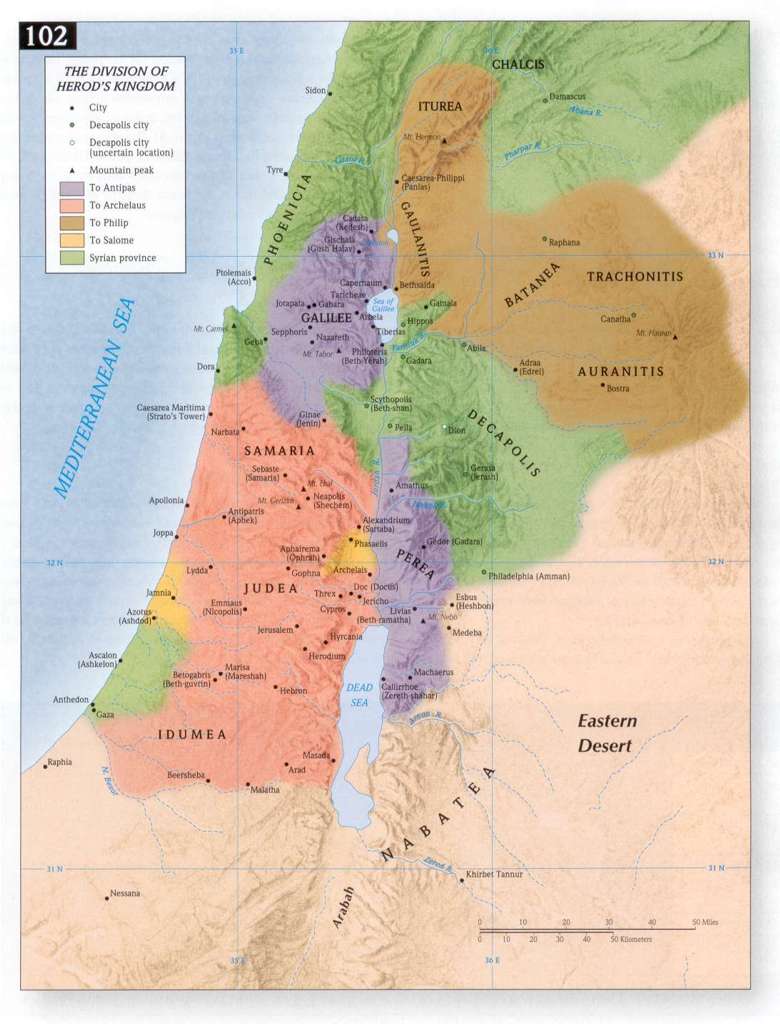
Let me suggest an experiment for you. Go to Google Earth if you don’t have the application installed on your computer. Give it a moment to load. When the earth is visible on your screen, spin it around to the Middle East. Scroll your mouse (or spread your fingers on a touch screen) to zoom in on the Dead Sea. Hit the “3D” button down in the lower right corner so it changes the perspective. If you zero in on the upland region NW of the Dead Sea, you’ll see a yellow-brown wilderness, almost white in places.

In general, it slopes down from the highlands, where there are trees and towns and so forth, dropping gently down to the cliffs above the Dead Sea. Up close, you’ll see it’s riven with many gullies, so that it’s hilly with a few big gorges running across it. There are a couple of times each year when this greens up just a bit from rain. The rest of the time it’s just rocks with thin layers of dirt here and there.

This is where John the Baptist hung out most of the time until he sensed his mission calling. He hiked across this hilly shelf above the Dead Sea, and began preaching, most likely near Jericho and some of the shore towns. At some point he got enough attention to take his work out away from town and to the Jordan River. He began proclaiming baptism as the appropriate ritual to prepare for the coming Messiah.

We know that the lower Jordan Valley has changed a good bit from the time of Jesus, but all we know about it is that water conservation measures weren’t in place back then. Thus, the flow was entirely seasonal. The valley floor was wide and flat, and most of the year the water level wasn’t that high. In the dry season, we know that John favored areas where the river slowed and was a little deeper. Still, it seems his ministry remained tied to the Jordan River during the whole time he was free, which wasn’t all that long.

Sometime during Jesus’ ministry, John was arrested for criticizing one of the successors of Herod the Great. It wasn’t long before he was beheaded.

Posted in teaching | Tagged , , | 1 Comment

New Testament Doctrine — Matthew 3

John the Baptist grew up knowing his mission. He also knew that his cousin Jesus was the Messiah, so his job was to prepare the way for Him.

Matthew (another cousin of Jesus) tells us that John began his ministry traveling the Wilderness of Judea. That term refers to a specific area along the western shore of the Dead Sea, mostly up on the heights in a range that runs into the Hill Country. This stands to reason, since John was born there in the Hill Country (the hilly range between Hebron and Bethlehem).

Would you believe that we can’t actually nail down with precision just what Luke refers to at the start of his version of this story (Luke 3)? We can’t climb inside his head and grasp the reckoning he used. Does he count the years Tiberius Caesar co-reigned with Augustus, or is it based on his official coronation? There’s a lot of debate, but I take the position John began his ministry around AD 26-27.

Keep in mind that his father was a priest, so John was of the priestly clan, even if he didn’t take the path of training for priesthood. There is a strong representation of prophets from among the priests in the Old Testament. This figures into John’s public persona. The prophecies required John to begin his ministry in the wilderness areas. There were some small villages in that area, and news of his preaching spread quickly. The primary reason is that Messianic speculation was already strong among Jews, so anyone who heard John was likely to pass on the word.

Matthew’s description of him is loaded with symbolic terms that emphasized the simple asceticism of John’s life. He was so driven by his preaching mission that he never took the time to worry too much about the comforts of life. Outer garments made from the woven fabric of camel’s hair were exceedingly durable, but also quite plain, with their distinctive brownish color. If we understand the angel’s instructions to Zacharias as short-hand for John becoming a Nazarite, then his eating habits would be a good match. The phrase simply indicates that John never put much time or effort into worrying about food, but took what God provided in the wild. This was far from the typical grape-growing terrain.

John eventually worked his way down to the lower Jordan River where he began calling the penitent to engage in the common Hebrew cleansing ritual. But instead of doing so only near the Temple, as most Jewish men would stop to bathe on the way to worship, John was calling them to do it out in the open, far from the Temple. More than precautionary cleansing, he made the ritual represent a very genuine and austere repentance.

So when the religious partisans began showing up, they brought the same attitude as men on their way to the Temple, just trying to check off all the boxes for the sake of keeping the rules, John hammered them with demands that they actually repent according to the Covenant. He said this wasn’t about their genetic heritage. The signifying mark of God’s people was the Covenant, not their DNA. He warned about the wrath of God coming to destroy people who refused to humble themselves before Him. The Pharisees and Sadducees were notorious for teaching that God owed them something.

This ministry went on for some time. Onto this scene Jesus appears, and John recognizes Him instantly as He approaches for the ritual. John argued that it was he who needed the baptism of fire that the Messiah would bring. What was the Messiah doing here repenting? Jesus told John to play along, that the reason for coming to be baptized was a matter of fulfilling the Covenant,as John preached. Jesus was going to insist on operating under the same Covenant His nation had rejected over the centuries. John’s response was, “I don’t get it, but okay.”

Then Matthew describes a scene that would clearly justify it all to John. What words would you use to explain that a dimensional portal opened in the air above this scene? Anyone with eyes could see clearly that it was no mere parting of clouds, but something qualitatively different, reaching across from Eternity itself. Something came through that opening, moving rather like a dove descending to the ground, but was no ordinary bird.

Matthew affirms that this was the Spirit of God, a visible anointing carried out precisely so people could witness it. And for those capable of discerning it, a voice thundered from above with divine authority: “This is My beloved Son, in whom I am well pleased.” John witnessed it; so did those who by now were his disciples. Some in the crowd caught on to what they had just experienced, and told others about it. Only those who took John’s ministry seriously would have this privilege.

John’s Gospel (written by yet another cousin of Jesus) gives us a more dramatic account of the days surrounding this whole thing. Jesus had come and gone a couple of times while John was prophesying and baptizing. During that time, John faced some queries from the Sanhedrin. They asked if he claimed to be the Messiah or Elijah, but he denied it. Instead, he cited the passage in Isaiah 40:3, and noted that the Messiah was somewhere among the Jewish people that very day.

Later, John recognized his cousin Jesus as the Passover Lamb. As the Jewish leaders continued pestering him, John the Baptist explained his mission in terms they could grasp, without getting himself into trouble. The phrasing is a little hard to translate into English, but it amounts to John the Baptist saying (John 1:29-34) that he lacked full certainty of just who his cousin was until that moment of baptism. Thus, this business of repentance and ritual washing was a way to draw a crowd who would be there to witness that moment.

This was God’s planning, telling John to run this kind of ministry precisely so He could manifest His anointing away from the tight throttling control of the Jewish government. It could have been done in the Temple, but the Father wanted to show how He wasn’t bound by the false assumptions of the Talmudic teachings. This broke all the rules, and they couldn’t argue against something hundreds of people witnessed first hand.

Posted in bible | Tagged , , , , , , , , , , | 1 Comment

What Difference Should It Make?

To answer the question in the title: Nothing.

I apologize if some of you got the impression I have really bought into everything that Ben Davidson of Suspicious Observers has been saying. I think it’s interesting stuff, but my personal attitude has been, “Let’s wait and see.” Let’s assume for a moment Ben is a scam artist. To be honest, I’m not in a position to debunk anything he says. I know just enough from other sources to recognize some of what he says. So it strikes me as plausible, but I’m not convinced to the point that I’m investing all my resources into getting ready for what he predicts is coming. There’s a very good reason for that — I don’t have that kind of resources. All I have is just enough to get by for now.

I’m okay with that. My income is the result of obeying my convictions, and my conscience is clean. I have what I have; it’s what I believe the Lord has given me to work with. For special cases, I’ve done some fundraising in the past, but I see no need for anything like that now. In order to take Ben’s predictions more seriously, I would need tens of thousands of dollars in a very short time. Trying to milk that from others would go against my convictions. So I’m left believing that the Lord wants me to trust Him for the difference.

That’s what you should do, too.

Should it turn out that we do not see solar storms rising to unprecedented levels over the next few years, Ben Davidson might be wrong about some things. Gosh, what a disappointment! (That’s sarcasm, folks.) All this time I’ve been taking his noise as something interesting, and certainly consistent in some ways with what I believe about the way God does things, but I’m not buying the books and I’m certainly not going to invest in his planned facility in New Mexico. For all the difference it makes, I believe the Lord wants me to stay put and see how it turns out. This life is not precious to me, so dying from such a disaster is nothing to fear. And to be honest, I’m convinced the Lord will be merciful, and things won’t turn out so dire as Ben’s stories indicate.

What can we do if it’s all true? In my case, not much different than what I’m already doing. I’m preparing for God to pour out His wrath on the US. I’ve said that I’m pretty sure the Internet won’t be that useful much longer. I’ve been reducing my reliance on it. My attitude has long been that I would taper off, using it for the limited range of things I still need until it no longer matters. I’ve also been buying tools I know how to use. If another Carrington Event comes along and fries the electric grid and all things electrical, all that means is that I will discard the power tools and keep on trucking. It isn’t likely to affect bicycles, but will destroy all cars, along with just about every other bit of infrastructure we use today.

Or maybe not. To me, the only difference is in the decisions I have to make afterward. And as long as I’m alive, I’ll keep having to make those decisions. But until that day comes, there’s nothing I can do. It’s just a hobby interest, largely because of that. I’m sharing it, as I do with my other hobbies here on my personal blog. Maybe it will demonstrate something about God, as most things we experience do, but I’m not asking anybody to panic. I honestly thought that was coming across.

Isn’t funny how there’s always one or two folks in any audience who really never quite pay attention to the core teachings, but always seize on things that are on the fringes? FYI, as I understand it, Ben Davidson was a lawyer first with a JD. He’s not a scientist, per se, but apparently has the intellect to grasp the science behind what he says. He’s made some enemies in the mainstream, but that actually is a good thing, if you ask me. My work gets the same reaction his does, but I’m a nobody who gets far less attention than he does. Frankly, I don’t buy all he says, but I’m intrigued by the possibilities. I certainly agree with him about so-called “Climate Science.” I see no reason to think he’s intentionally deceiving anyone. If his material is not your kind of thing, I can understand that.

But the whole point here is that the only difference it makes is in terms of awareness about what’s possible. I doubt any of us could afford to prepare for the worst of his predictions, so it shouldn’t make that much difference. Follow your convictions.

Posted in sanity | Tagged , , , , , | Comments Off on What Difference Should It Make?

The Humble Place

In the beginning God created the heavens and the earth. The earth was without form, and void; and darkness was on the face of the deep. And the Spirit of God was hovering over the face of the waters. Then God said, “Let there be light”; and there was light. And God saw the light, that it was good; and God divided the light from the darkness. God called the light Day, and the darkness He called Night. So the evening and the morning were the first day. (Genesis 1:1-5 NKJV)

Hebrew assumptions about Creation are humble, that it would be impossible to know more than God tells. Leave it where God puts it; His boundaries are in our best interest. The Hebrews would have flatly refused to speculate out of reverence for the God who speaks. From that basis, we can begin to look around us to find meaning in what we can experience directly. Thus, the narrative assumes to know only a little about our own world, and that we can grasp the limits of what God wants us to know about it.

So there’s nothing in this text that we should assume talks about the rest of the universe. It’s confined to just human space. We know nothing about the sun except what we experience here on the earth. The same with any other luminary bodies in the sky. The Hebrews knew that God made all of those things, too, but they would never presume to stretch revelation beyond what God actually offered. Thus, in the Hebrew mind, this passage doesn’t suggest that God made those luminary bodies from scratch at the same moment, only that He brought light into human space.

Indeed, the symbolism of light as revelation is more important than the physical experience of light. Don’t try to nail down syntactic precision when it’s not there. The Hebrew language and Hebrew thinking doesn’t support it. So, the term “the heavens” isn’t meant to refer to whatever was or wasn’t out there in space; they had no such concept. It wasn’t excluded, just not mentioned. The Creation narrative of Genesis 1 refers to what little we can know about our own existence here on earth.

We have the instinct to read our Western mythology back into these things. On the one hand, the Medieval mind of superstition flatly excluded anything outside their world, until science proclaimed things otherwise. The prejudice died slowly, and the instinctive reaction remains. This is because of the barbaric sense of fear for the unknown in the roots of our Germanic ancestors. The cosmopolitan scientific outlook sleeps uneasily in the same mind with superstition, yet they both come from the paganism, so it’s a marriage made in Hell.

I’m not trying to justify the wild notions like the Gap Theory or the Age-Day Theory. Both of those are an attempt to bring revelation down to the level of reason. Nor do I exclude such speculation, but I simply assert that Scripture doesn’t address such things in the first place. Those ideas are asking the wrong questions. Perhaps it would clarify things if we characterized it thus: “Let there be light on the earth.” It’s not meant to address whether there was already a sun, moon and stars, only that they became manifest on the earth. The earth is the whole reference point here.

Nor was the text meant to speak to what may or may not have existed outside the earth at the time God began preparing it for our use, nor does it presume anything about what went before. That phrase, “in the beginning,” refers to the beginning of God’s dealing with humans, nothing more. Scripture is the revelation of how God deals with humans, not the rest of Creation. The idea is not to presume we are the center of Creation, but simply the center of revelation. This is revelation to us alone. We cannot possibly comprehend God’s other concerns. All we know about such things is that there most certainly is something else going on, and that it’s none of our business. We have more than we can do already in our own unique accountability before Him.

This is the humble position we are called to take.

Posted in teaching | Tagged , , , , , , , | 1 Comment

Coming Soon to a Planet Near You

I made it a point to catch the latest from Suspicious Observers this evening:

I believe it’s correct in substance, but I am personally planning on the Lord’s mercy to make it less extreme than the narrator predicts. My convictions keep telling me that this is not the end of the world, nor humanity, by any means. Ben also admits that the timing could be a little off, even by a decade or more. The thing to watch for immediately is the sunspot activity.

Meanwhile, the situation closer to home here in the US is likely to be ugly enough in just a few months. Again, the timing isn’t the issue, but that God’s wrath is certain. On the one hand, I’m trying to make sure I’ve done all I can do to be ready to witness to His glory. My heart keeps telling me these are good things. On the other hand, most of what any of us can do is almost certainly short-term. It’s not the details, but the heart-led awareness that matters most. It’s more important to obey your convictions than to worry about what some of the items signify. We really need the habits more than the results.

Even without the solar and galactic disturbances, things are going to be shockingly difficult. My heart keeps tell me that we should expect significant changes in the economic and political situation. TPTB have been lying about their plans, and it’s far worse than most people dare to imagine. Even when they see it happening, the majority will simply not believe it.

No, you don’t have to agree with me on any of this; it’s simply what I see. Trust in God.

Posted in tribulation | Tagged , , , , | 1 Comment

No Vested Interest Except God’s

The use of polemics implies a vested interest in the outcome of the debate.

It’s one thing to engage in polemics; it’s another to simply dissent and go your own way. The latter is the signature of the heart-led way. There’s no reason to correct someone else unless they specifically place themselves under your covenant leadership. Our covenant community is tiny, so there’s almost nobody we could remonstrate with on anything.

I reject the idea of church as an institution. To me, that’s a pale man-made shadow of what Christ intended. About the only similarity between a genuine covenant community and an institutional church is that both exist primarily to self-perpetuate. The primary difference is that a covenant community is nearly impossible to eviscerate the way you can take down an institution. You would have to literally kill the members in a covenant community to remove its power and influence over the membership, because its whole identity is the shared heart. There’s no way to objectify things enough that someone could come along and restore it from written documents, for example.

A covenant community exists solely where the people involved agree in their hearts to have one. It’s utterly personal. There can easily be successors in the leadership roles, but the community changes as soon as the baton is passed. It must; that’s how it’s supposed to work. If the new leadership kills it, that’s the way it goes. Only God can bring a community together, and only God can keep it alive. It can remain active in human terms after its soul departs, but it ceases to be a “church” as far as the Lord is concerned.

But a covenant community exists to breathe that same life into every member. The whole point is to aggregate the moral resources, to inculcate the same moral essence in each person. The study and practice of moral truth is the whole point. There is no other mission. There are no objectives or accomplishments to worry about. Yet, staying exactly the same is also death. People must adapt in how they react, how they undertake to shine divine glory into the fallen world.

The moment you institutionalize any part of this, it dies. Divine glory is entirely personal in nature; it’s God and you together as family. The covenant exists to give it physical shape, to provide boundaries of privilege. The covenant is alive in itself; it is personified in the Risen Messiah. The leadership can guard the community, but only the Lord can guard our hearts and minds. Nobody but the Father decides who belongs to Him. His anointed leaders simply decide whether you belong to the community.

It’s not a public accommodation; it’s an extended family household. The shared DNA is entirely moral in nature. We could say “spiritual,” but the way church folks use that word, it comes with a lot of false baggage. The whole idea is that you know when a community is your family because your convictions say so, as do theirs. Convictions are your ultimate personal source of moral truth. Yes, you are responsible for searching and knowing what your convictions say.

You are part of a community that searches to know what your shared convictions require in the context. There’s a give and take, but the structure is tribal feudal. You have an organic leader and ritual leader. If you can’t follow the appointed shepherds, stay out of the way. This is the pattern Our Lord lived with when He walked the earth. It’s the pattern His apostles taught. But no flesh carries the fullness of His authority on this earth. Walk by your convictions; departure is not apostasy. Departure is pursuing the Lord to another mission calling.

No one has a vested interest in the outcome except the Lord.

Posted in teaching | Tagged , , , , | Comments Off on No Vested Interest Except God’s