Small World (Updated)

PassUnderTurnerRemember this shot on the left here? That’s the underpass on Midwest Boulevard where Tuner Turnpike runs overhead. It reminded me of a gateway, a portal to the hilliest area I can ride without going back out east into allergen territory. It’s very narrow and exceedingly sturdy. I also noted that the two “ghost bike” memorials are not too far from there.

So the other day the ex-CEO of Chesapeake Energy was indicted here in OKC. Made big news. Today he died crashing his SUV into that same huge concrete portal.Crashsite This image was taken from aerial fooltage shot by our local Chopper 9 (KWTV News).

Is the world crazy, or what? I suppose we’ll never know if this was in any way suicide or something else. I get the impression he hit that thing going awfully fast. If he threatened to take someone down with him, it would’t be that hard to knock him off the road there with some other heavy vehicle and just keep going. At this point it’s not likely there would be any evidence either way. I’m told his body was found in the back seat, supposedly because he didn’t wear his seat belt. Let the conspiracy theories fly.

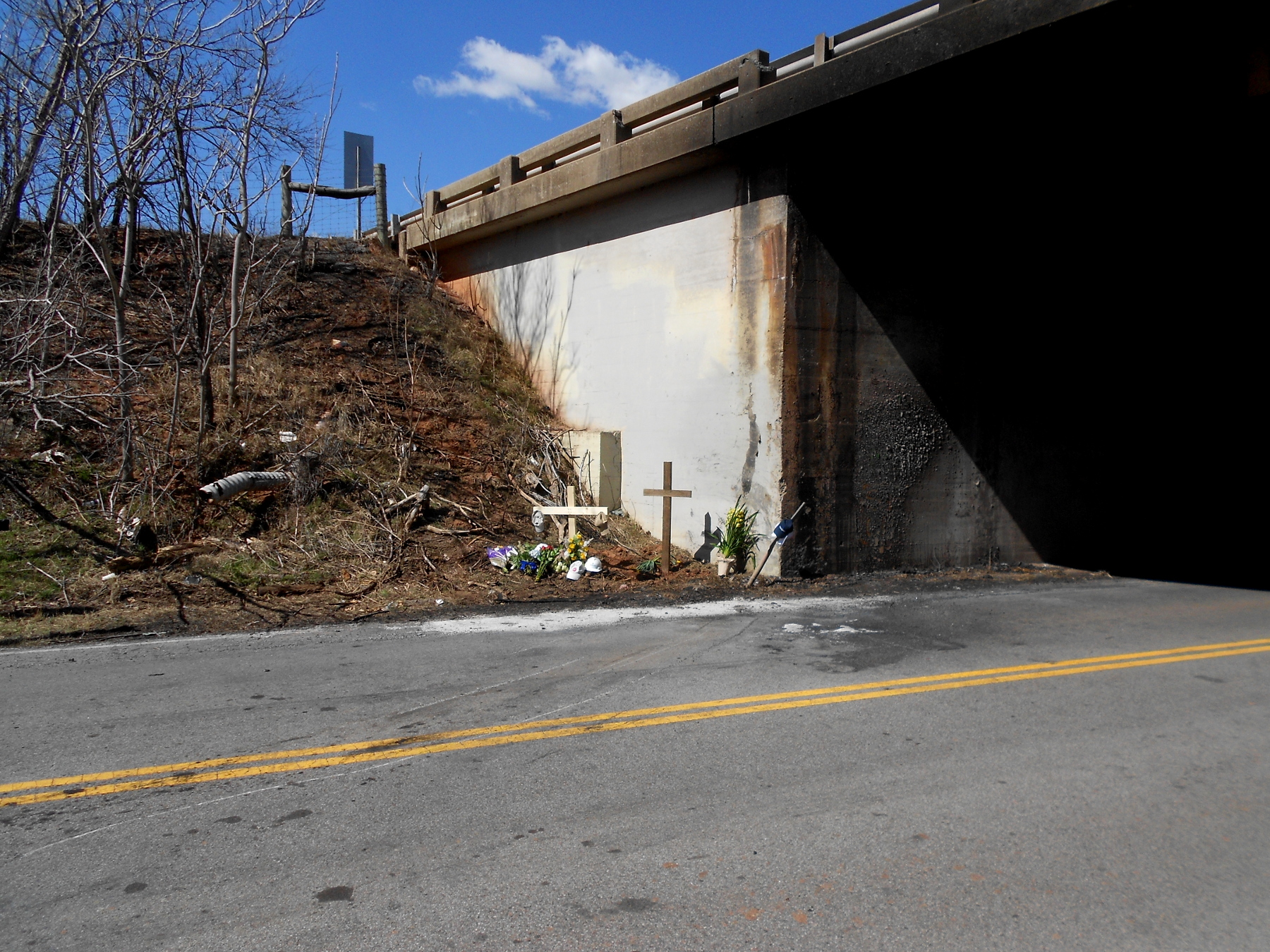
memorialPostscript: This image was shot the day after the crash. Our local news team from KOCO was out there shooting and perhaps recording a snippet for the broadcast. There were a half-dozen cars most of time parked along the northbound edge (behind me from this shot) the whole time I was poking around there. Some came and went, people sat in their cars or stood staring at the memorial.

There is just a small chip missing from the corner of the structure due to the impact. The charring runs all the way up onto the edge of overpass deck, and covers the interior facing of the concrete to the ceiling for several feet inside the shadowy interior. The fire crept up very near the top of the grassy embankment along the outside concrete face. I climbed up to see. A sprouting redbud tree overhanging the slope commiserated with me about the sadness of the scene. At one time I would have wished a tree could tell me the facts of what it witnessed, but those questions no longer haunt me. It was enough to know I was not alone up there.

Honestly, I can’t give a rational explanation why, but I knew I had to go. That was my ride for 03 March.

Posted in personal | Tagged , , | 2 Comments

Rewrite: Revelation 18

As I’m working through my study in Revelation, I realized I left out an awful lot. Here is a sample of the revised material. My whole idea is that you climb out of moral distraction and find the peace God offers to you as His unique child; this is written into John’s message.

Revelation 18

We saw in the last chapter how Babylon is identified with human lusts as expressed through the market place. Don’t get lost here; Babylon is a consistent symbol taking on different meanings on different levels, with a common thread in the market for human souls. The first Babylon sold primitive astrology and human pride as the means to capturing the human race under one evil rule seeking to smother divine revelation. It aimed to replace the ineffable spiritual pull with something hedonistic and material. Here it is more specifically the market place of cosmopolitan religious ideas — choose your beliefs to fit your lifestyle. The real god here is Mammon (AKA Materialism), a guise for Satan. Babylon is always identified with the urban setting, cultural sophistication and highly specialized labor and goods. Not necessarily harmful in themselves, these things always leads to moral slavery. Instead of serving human need, humans serve the deity of commerce, where everything has a price and nothing else matters. This Harlot builds commerce through the marketing of every human desire, regardless how abominable, seeking to capture the church. This is a long way from the simple pastoral lifestyle of trust in God.

There is so much of this in our world today that it is hard to know where to begin. Even selecting the more egregious moral degradations leaves us with a very wide selection. The sex trade, from every angle, is an obvious element. The related pornography business is equally obvious, especially the various perversions that are so popular. Gambling, chemical substances, acts of violence and just about everything we call “entertainment” today falls under this heading. Most of these tend to be blatant in their appeal to human weakness. But we could say the same for the brisk trade in loans, speculations, most forms of stock and other securities, all of which lend themselves to a form of slavery. These pretend to be responsible professionals handling “your” wealth. Most mainstream religion treats these as degrading in one sense or another. However, John points out that the underlying theme is spiritual adultery, also known as idolatry. For each of these vices, along with many other commercial activities that typically avoid the label using some squeaky clean veneer, the underlying error is serving and worshiping something — anything — rather than God. How many churches are trapped in the false vision of building bigger and drawing larger crowds? How many seek huge budgets to buy stuff and great visual and sound systems? How about that vigorous search for staff with just the right talents, as opposed to developing staff from the folks God sends locally?

In a thousand ways, we all find something so important to us that we have to sacrifice some piece of our spirituality, some element of holiness, in order to keep that thing. Any element in our lives tying us to this fallen realm is inherently evil. It is less the activity itself and more the net result within our souls. Each of these idolatries is an expression of human appetite that can be righteously fulfilled, but mankind insists on flavoring it up by dodging the requirements God put forth so clearly in His Word. Babylon the Harlot feeds on human addiction and the misery of false guilt. As we saw in the previous chapter, the Beast (human government) teams up with her to feed on the power it gives. Frankly, both would be powerless if no one was buying. But there is always a buyer and a seller, and these bear the Mark of the Beast.

Therefore, we hear the refrain already echoing across the text since we began this study: “Babylon is fallen, is fallen!” This is true in one sense from the very beginning, for it requires a fallen soul to be trapped by her seductions. Thus, the angel coming aglow from the presence of God Almighty announces yet again that Babylon has fallen. By no means are we surprised to see she is the haunt of evil beings, for thus has it ever been. The point made here: This is both her life and her doom. In the end, there will be nothing left, for she will consume all her customers. She is not content as symbiotic parasite, but must consume it all. Thus, we note she will crumble not merely under the hand of the rapine taxation of her beau, the Beast, as we saw in the previous chapter. She will fall eventually because the market in sin carries the seeds of its own destruction. Sated lust only grows a bigger appetite and at some point, there is nothing left offering a new thrill. In the end, the market for her flesh will collapse under its own weight.

Take a moment here to notice the gender characterizations. The worst of fallen masculinity is oppressive control and brutal power. It calls up fear in every form. The worst of fallen femininity is the siren song of provoking lust, seeking to control through the fleshly appetites for comfort. Wherever and whenever the merchant cult has taken control through materialism, feminine demonic power is always in the lead, a perversion of the nest-building instinct of motherhood. The quintessence of human failure is a man too self-absorbed and inhumane to serve as shepherd of souls, paired with a woman willing to take control and ride his back to gain power against her divine call to trust. She refuses to rest in God for provision of what she needs for her redemption through motherhood, but must have total control by any means necessary. In both images, love is totally absent. The gender imagery here is no accident.

The believers who carry the Mark of God are called to get away from Babylon; she is the perversion of good motherhood and good church fellowship. This call echoes down through the ages in the Old Testament. In Jeremiah 51, Babylon is the target of prophetic warnings. The prophet repeatedly calls God’s people to come out (vv. 6, 9, 45 & 50). It is echoed by Isaiah (48:20; 52:11), and similar sentiments are scattered throughout the prophets. The warning is clear not to give oneself over to such commerce, to become independent of the fallen economy of the world. Use it as a tool but don’t serve it. Not that we should cease all buying and selling, but to cease being enslaved by it. Of all people on this earth, Christians should be the first to resist advertising. Instead, we incorporate it into our church management.

The angel calls for a full cup of vengeance against the Harlot Church. We note that the merchants who depended on her for their livelihood will join the governments of the world, weeping from a safe distance as she is destroyed. At some point, all economic activity will suffer a catastrophic failure. As it reaches the peak of power, it will last but a short time even by human standards. All the luxuries of human existence will be forgotten and bare survival will be the order of the day. This affects a worldly church as it does the rest of the world of human institutions.

John provides one last stark image to jolt his readers awake: “The blood of the saints and prophets was found in her, along with the blood of all those who had been killed on the earth” (v. 24). Allowing yourself to become wrapped up in worldly materialistic concerns will kill you, spiritually and literally. You cannot afford to ever come to the place you regard human commerce as essential to your religious life. If you can’t simply walk away from the provisions of the market place on short notice, you serve the Harlot — Babylon is your goddess. Christians must maintain but a light grip on all the things of this world. That includes how we do church.

Posted in bible | Tagged , , , , | 1 Comment

Proverbs 30

This chapter has provoked a lot of debate because of serious variations between different manuscripts, though mostly in the introductory portion. While our translation here (Green’s Modern King James) adheres to common traditions, it’s not hard to find other translations that take a different approach. And frankly, an ancient Hebrew scholar would consider most of that debate downright silly. Where Solomon got this material is not important, nor even if it was added by later editors. It would seem obvious that it represents non-Hebrew thinking, perhaps more Arabic in the sense of Abraham’s other sons. Even if the thoughts are from outright pagan sources, as other material in this book surely does, it shouldn’t be too difficult to see how the wisdom reflects Solomon’s habit of finding God’s truth everywhere because he operated above the mere intellectual legalistic nit-picking more common of the Post-Hellenist rabbis of Jesus’ day.

We note that the author of this material is fond of Ancient Near Eastern (ANE) structures not common in Hebrew literature. There is heavy use of the three and then four, which is meant to portray completeness in moral terms.

1-3. The words of Agur the son of Jakeh, the prophecy: The man spoke to Ithiel, to Ithiel and Ucal, saying, Surely I am more like an animal than any man, and do not have the understanding of a man. I have not learned wisdom, nor the knowledge of the holy. These names are meaningless to us as presented, and may well be something else badly garbled in transmission. Whoever he is, the man confesses that he is brutish, using a term for someone’s calloused foot or cow’s hoof. It’s the simple wisdom of humility.

4-6. Who has gone up to Heaven and has come down? Who has gathered the wind in His fists? Who has bound the waters in His garments? Who has established all the ends of the earth? What is His name, and what is His Son’s name? Surely you know. Every word of God is pure; He is a shield to those who put their trust in Him. Do not add to His words, lest He reprove you and you be found a liar. By implication our speaker asserts that true wisdom is only from God, by asking who it is capable of crossing the boundaries between earth and the Spirit Realm, capable of handling Creation like a toy. Rather as a joke he suggests that it shouldn’t be hard to discover the fame of any man who did such a thing, if only because any family or tribe that descended from him would still be telling his legends. Of course, we are talking about God Himself, whose revelation is pure in the sense of gold refined by fire. That is, it has been tested and found reliable. Don’t put words in His mouth, as it were, because that is blasphemy. Our reasoning is hardly on His level. We have all we can do just obeying things He did say.

7-9. I have asked two things from You; do not deny them before I die; remove far from me vanity and a lying word; give me neither poverty or riches; tear for me my portion of bread, lest I be full and deceive, and say, “Who is the LORD?” Or lest I be poor, and steal, and violate the name of my God. Agur says he has been consistent in two simple requests, and implies that he has yet to see them carried out — Don’t wait until I die to do these two things. Each item is a pair in itself. First he wants people to stop trying to deceive him. He uses two terms that don’t easily translate into English. The word for “vanity” is the concept of good things destroyed and made useless; “lie” is from two words meaning a thing expressed or spoken but meant to deceive. It’s a common ANE literary device to ask one thing that everyone desires and knows you’ll never get, and the asking for something just possible. The second request is more doable: a reasonable level of prosperity. This is more precisely asking a fair share of the family’s resources. He uses the image of the flat bread eaten in that part of the world, similar to pita. Don’t give him the whole thing, but tear it in half. By the same token, don’t deprive him a fair share from the common resources, lest he feel compelled to steal just to survive.

10-14. Do not accuse a servant to his master, lest he curse you, and you be found guilty. There is a generation that curses their father, and does not bless their mother. There is a generation that are pure in their own eyes, and yet is not washed from their own filth. There is a generation, O how lofty are their eyes! And their eyelids are lifted up. There is a generation whose teeth are like swords, and their jaw teeth like knives, to devour the poor from off the earth, and the needy from among men. It’s easy to get lost in the images here and miss the whole point. He begins with the portrayal of slandering someone like a busybody with nothing better to do than stir up trouble. The word translated “curse” offers the image of dehumanizing someone. He completes the picture by pointing to arrogance and how it eventually results in physical violence. The whole point is that if you start off acting like your desire for entertainment is more important than social stability (the symbol of ultimate moral good), it’s not too many steps from there to murder.

15-17. The leech has two daughters, crying, “Give, give!” Three things are never satisfied, yea, four things never say, “Enough!” The grave; and the barren womb, the earth not filled with water, and the fire, have not said, “Enough.” The eye that mocks at his father and despises to obey his mother, the ravens of the valley shall pick it out, and the young eagles shall eat it. You can almost see Agur gesturing dramatically, turning to face each fist, “Gimme, gimme!” Then he goes on to portray certain mental images that symbolize what we call a bottomless pit, each unpleasant in some way. Death will consume every living thing and never be filled. A barren womb will absorb every thing many men could give without producing offspring. In a semiarid land, you cannot imagine the soil being so saturated that it runs off without eventually being absorbed somewhere else. And of course, fire only dies when everything is burned up. Each in its own way compares favorably with something a little obscure in our culture today — contempt for your own family. We have built a society that buries the consequences, so we can’t imagine how it holds such a high moral concern. Agur says that it matters not what provokes such arrogance or what hides it; the destructive nature of it is beyond measure.

18-20. Three things are too wonderful for me, yea, four which I do not know: the way of an eagle in the air; the way of a snake on a rock; the way of a ship in the middle of the sea; and the way of a man with a maiden. Such is the way of an adulterous woman; she eats, and wipes her mouth, and says, “I have done no evil.” Don’t we marvel at things we cannot do ourselves? The word “way” is repeated here as the image of something typical or natural for the thing depicted. We struggle to understand how eagles can travel their invisible roads in the sky, how a snake propels himself across a rock without feet, how a ship stays afloat on the sea, and how a pretty young lass who is still a virgin can lead a man to do her will. A man can experience it himself and still have no idea why he does what she wants. There is a subtle connection here. It’s not human sexuality in itself, but the way we move so easily from one thing to another. Have you ever noticed how an adulterous woman can just wipe away the obvious evidence of her immorality and say with a straight face that she’s done nothing harmful? Yet, how easily we tend to believe her story, even when the consequences come back on everyone. Do we not marvel at how easily we destroy our social stability?

21-23. Under three things the earth quakes, and under four it is not able to bear up: for a servant when he reigns; and a fool when he is filled with food; for a hateful woman when she is married; and a servant girl that is heir to her mistress. To avoid a lengthy explanation: A “servant” is either an enemy captive or someone without the protection of normal extended family resources. Either way, you don’t expect them to be sympathetic to the society that enslaves them. Thus, a slave who suddenly gains power will be oppressive ogre, as would be any fool who gets what he wants. A harridan usually gets married only because her family deceives the poor groom’s family or because it’s a political arrangement, but this is not the image of your good wife who sees herself on the same team as her husband. Finally, it takes some serious manipulation and perhaps even murder for a slave girl to legally inherit the position of her mistress. In each case, Agur portrays these things as violating the nature of reality itself.

24-28. Four things are little on the earth, but they are exceedingly wise: the ants are a people not strong, yet they prepare their food in the summer; the rock-badgers are not a mighty people, yet they make their houses in the rock; the locusts have no king, yet they go forth by bands, all of them; you can take the lizard with the hands, yet it is in king’s palaces. Wisdom is portrayed as making the most of God’s provision for life; it goes without saying that wisdom precludes excessive self-interest. You can crush ants under your feet without notice, but they manage to eat year round and survive most attacks. A rock-badger is more like a rabbit, easily startled and the prey of many other creatures, yet they have no trouble making a home among the most inaccessible places. Locusts independently manage to act in concert and records indicate they have utterly destroyed whole kingdoms economically. And common lizards aren’t very big but nothing you do can keep them from infesting a king’s palace. In each case, human efforts at eradication are wasted. Finding your place in God’s Creation is the most empowering thing you can do.

29-31. There are three things which go well in a march, yea, four that go well in walking: a lion is mighty among beasts and does not turn away for any; one girded in the loins; and a he-goat; and a king when his army is with him. The figure of speech here indicates things splendid to see as they walk confidently on their way. The lion acts like he’s in charge over every other creature. The second is a little ambiguous, probably indicating something or someone trim and fleet of foot, the very opposite of lumbering and corpulent. The third is an alpha ram in the herd. The last is a figure of speech unknown in Hebrew literature and translations vary widely. However, a king who is genuinely confident in his moral position, possessed by a sense of divine calling for his mission, is the definition of regal.

32. If you have done foolishly in lifting yourself up, or if you have thought evil, lay your hand on your mouth. This is probably a subtle contrast to the previous proverb. The point here is: If you are going to do something morally unfitting, at least be wise enough not to boast. Given that all of nature will be against you, it’s best if you proceed with serious caution and get what you can out of it without rubbing it in.

33. Surely the churning of milk brings forth butter, and the wringing of the nose brings forth blood; so the forcing of wrath brings forth fighting. In this triplet, the primary verbs are all the same root word meaning “to press” — churning, wringing and forcing. It’s okay to do that to curdled milk, but it doesn’t work too well using the same action on people.

Posted in bible | Tagged , , , , | 1 Comment

Mere Imagination?

If God doesn’t capture your imagination, He doesn’t have your heart.

I don’t feel competent to propose a psychological profile for people who live a heart-led existence. Jesus used parables because it defied description. At some level I can offer some characterization of what it’s like for me, and I can share some things I’ve learned from others as they attempt to verbalize their own experience. It sounds just like everything our society marginalizes as somehow inferior to their mythical objective reality.

Does a heart-led existence sometimes bleed over into mere imagination? Of course it does. How would you keep them separate? I maintain that common perceptions of reality are broken for the simple reason that “reality” is shadowy and untrustworthy. I believe the record of revelation is replete with incidents where God retooled His own Creation in ways that allowed people to see He could do it. The Hebrew nation departing Egypt was not a gladiator revolt; these folks had been slaves. Yet they managed to humble what was then the most powerful military force in that part of the world without using armed resistance. And while Egypt’s ruler sounded like a maniac, the Egyptian people had seen enough to fear things that were way beyond their control.

Any way you slice it, common perceptions of reality don’t make the grade. The cultural legacy of objective reality cannot account for some very real things that have happened and continue to happen. Anecdotes abound and genuine experts are unable to explain, or even theorize, how these things happen. The ragged edges of reality can’t be cleanly cut off to suit the Western prejudice.

So maybe the real problem is not what we can say we know for certain, or even with some reasonable measure of certainty. Maybe the real problem is claiming that it is possible to know against a very certain truth that human awareness is iffy in the first place. A certain level of agnosticism is far more mature than a childish insistence on things precisely defined as real versus unreal. Once you dismiss the mythology of objective reality, it’s bound to bring out some strangeness, but this is truly the best we can do.

I don’t need to carry around some internal divider between truth and fiction; I carry a divider of what I can use and what I cannot use for myself. That is true moral discernment.

As I push forward through life with an expectation that varies significantly from those around me, I don’t waste that much time to worrying what they’ll think of me. I’m too busy exploring the sense of peace and contentment for which they clamor and can’t seem to find. A very long time before I used the language of heart-mind awareness, when the best I had was the language of spiritual conviction, I decided pursuing conviction was the only answer I needed. If something matched my convictions in some particular context, screw everything else. There was a peace that touched things inside of me that no stimulus or drugs could reach. I found pieces of myself that had been missing my whole life up to then.

The language wasn’t important. The knowledge that science has found the heart to be a sensory organ with it’s own neural network and nodes of concentrated awareness simply provides the factual basis for what I was already doing. Reading how other people experienced that heart-mind awareness didn’t make me like them; it simply showed me that there was a name for what I was supposed to be like. It gave my convictions a more concrete shape, a more powerful reality as a store of ultimate truth that could be shined into more and more dark corners of my soul.

You should hardly be surprised, then, that I have little interest in anything that tends to pull me away from that kind of awareness. My experience is that TV in any shape or manifestation is some kind of evil hypnosis carefully designed to shut down my heart-mind awareness. There is some scientific data to help explain that, but it’s my very powerful reality that entertainment is generally harmful. There aren’t many ways I can structure a context and select what’s on a TV screen that won’t interfere with a heart-mind awareness. The same can be said for a great many other forms of entertainment in our culture. They are frankly painful. It kills off my sense of peace by closing off whatever it is many people think of as my wild imagination.

You like your TV? Fine, but I find it very difficult to fellowship with folks who okay with all those forms of entertainment. The problem is not that I’m some kind of controlling grouch seeking to make you see things my way. You can do to yourself whatever you like; it won’t hurt me as long as I can get away from it myself. But if that’s where you live, you won’t be able to share very much with me. So far, just about every form of entertainment available in our society is alien to the wild imagination of God’s Presence burning in my soul. Not just alien, but downright pedestrian and cheap by comparison. I find that people who belong to that alien world don’t do well me. I’m not going to inflict my inner vision on anyone who can’t use it. Just be aware that we can’t fellowship much if you belong to that. My imagination is too rich and real to fit into your entertained mind.

I don’t care what you call it; I know where I belong and I won’t be pulled away from it.

Posted in sanity | Tagged , , , , , | Comments Off on Mere Imagination?

Cycling: Return to Harrah

Today’s ride was simple and already well covered in previous photos; just search for Harrah” on my blog and you’ll see them. I suppose it was little more than nostalgia that drove me to pedal all that way east again. This was a 36-mile round trip. Straight east on Reno to Dobbs Road, a mile north the NE 10th, about a half-mile to Harrah’s bike path, north to Highway 62 and across the bridge on Harrah Road. I kept going north to NE 50th and started working my way back.

My sinuses told me what I didn’t at all miss about living out in eastern OK County. I was hit by a heavy dose of allergens starting about five miles out from the apartment. It’s funny how I run into them about Westminster Road but experience nothing like that west of there. At any rate, I rode over the ridgeline on NE 50th past the Wind Drift peach orchard and back down into the North Canadian Valley at Triple X.NE36thatTripleX While the barriers have been moved around a bit, the officials have not reopened Triple X between the bridge and NE 36th because they’ve never gotten federal permission to restore the river banks. Thus, that margin between Triple X and river bank is still only about six feet. However, the local traffic bypassing the barriers has really packed down a nice solid dirt road. Just past the last barriers I stopped in a shady spot just off Triple X on NE 36th.

ChoctawVintageWaterTwrPassing along through the backside of Choctaw’s main residential area, I spotted this vintage water tower. How’d you like to have something like that in your back yard?

13316NE36thChoctawI decided to stay on NE 36th all the way back to Midwest Boulevard. Along the way I spotted this old house. It was back off the road a bit and I had to shoot facing into the sun. The address was still visible on a small sign attached to the fence. From there, once I crossed Hiwasee Road I was in the old Dunjee neighborhood. They once had a very nice school, but now it’s just an abandoned building still visible from quite a distance as it sits on the highest spot of land out there. There was a time this was a rowdy and somewhat dangerous area, but I hardly saw anyone at all. A couple of miles on a noticed a bunch of .25 caliber brass lying in the intersection, but I can’t find any police reports to explain it. Mostly it was just a quiet hilly route all the way back through Spencer.

GospelTabernacleSpencerI had almost forgotten the fancy stone-fronted Gospel Tabernacle there next to Douglas Boulevard. There isn’t a lot of public information about it, but I understand that it’s essentially some kind of Seventh Day Pentecostal outfit. There were some ugly rumors about it back in the 1970s before they built this. There was an older and smaller local stone church house with a very large trailer park out back. The trailer park is still there, but now almost entirely hidden behind the church house. It was alleged in the old days that the “full members” lived in the trailers and turned over their income to the church. They got back a fairly low living expense and ate communally, etc. At some point in the 1980s it was all alleged to have changed and become more conventional. The staff kept an active Facebook page briefly a couple of years ago, but that’s quiescent now.

What most people don’t seem to understand is that a historian is just as interested in the false rumors as the actual facts. What everyone believes still has an effect on human behavior. Does that not explain how messed up Western Civilization is?

Posted in Uncategorized | Tagged , , , , | Comments Off on Cycling: Return to Harrah

Not the Same Anymore

I was a big fan. Bryan Duncan nailed it once during a phone interview. He told the radio DJ that he hoped he wasn’t the same man he was two weeks ago because he felt he had a long way to go in his ministry calling. A primary symptom of spiritual growth is a sense of penitent humility, even as we feel an unlimited confidence in God’s power and mercy in our lives.

By the way, I still love Bryan’s singing voice, but a lot of his music no longer speaks to me.

So very much of what brought me here is no longer pertinent. Some of it has become quite annoying. In the past week or so searching my old music favorites, I realized that how sweet it sounds means nothing against whether it draws me up out of myself. It’s not that I have suddenly decided the musicians are no longer good enough with their song-writing, but that what they needed to say is not always what I need to hear. A few rare albums speak to me all the way through, but most of it is now just a song or two here and there.

In a similar fashion, I read almost no fiction these days. There was a time I always had a book with me, and read when I should have been paying more attention to other things. I would get lost in the stories. Now my previous favorite authors annoy me. I can’t bear to read the next book in a series I once anticipated as I devoured each line. Some of the few authors I could read again are long dead. Whenever I sample something new, I’m struck by the same annoyances. I’m sure there are some decent new writers, but I don’t have time to pursue it like I once did with such obsessive devotion.

Why? My regular readers probably know that I just don’t have much tolerance for Western thinking any more. Most fiction I encounter is so lavishly pro-Western it’s sickening, and all the more annoying when the author seems wholly unaware of it. And if I went back over some of my own fiction I’d have to rewrite a bunch of it, probably in ways that simply wouldn’t work for storytelling. I have no idea if I’ll ever write any more. Given the way I write fiction, inspiration could come crashing down on me in the next hour. However, my conscious mind finds it unlikely.

Where do we go from here, Brothers and Sisters?

I’m forging into new territory on ancient roads. I keep saying to myself and others that we are building a new reality, in the sense that we are having to form entirely new structures for thinking about what God intended for humans. The heart-mind is totally new in our civilization. It seems most of the folks who write about it from the scientific background are still mired in Western expectations and what they produce is so mixed up and useless to me. I can’t find anybody ahead me on the same path. The terrain has shifted on a tectonic level since the ancients explored this land, so we aren’t going to find exactly what they mapped out.

It’s no longer a question of taking it one day at a time; I’m exploring entirely new turf and having to grapple with a new universe by the minute. I’m not complaining, but I’ll be the first to tell you sometimes I don’t have a clue what to do next.

(Check out his channel.)

Posted in teaching | Tagged , , , , , | 5 Comments

Heartless Evangelism

Our apartment complex has a posted sign about no solicitation. Once that sign is posted, you have to get management’s permission for any random door-knocking. Court precedent in this state has made it clear that door-knocking evangelism is covered under that and plenty of organizations have been warned, some even punished for overly zealous annoyances.

It didn’t stop them knocking on my door this afternoon. It has to be pretty egregious for me to use the system against these naughty folks. Most of the time I just deal with it. Most of the time they get a clue by my responses. Not these two.

First they invited me to a “Bible study” using some generic sounding religious group name. I told them I had it covered another way, but when the conversation should have been over, one of them piped up about whether I had ever heard of the “Motherhood of God.” The other supplemented it with words about the feminine characteristics of God. The verbal hints made it clear this was a Western feminist mythology thing, and I said I was familiar with the concept. Then I dismissed them and closed the door when the first one kept trying to talk more. There’s only so much you can do, and if they come back for another round, I’ll be a little less polite.

Over the years I’ve waited to see how these door knockers expressed themselves to see whether it was worth engaging them. On rare occasions you could tell they had an active heart to some degree. In one neighborhood many years ago I used to allow the local Jehovah’s Witnesses to hang around because their trainer was kind and loving. I’ve not seen JWs like that before or after. I’m quite familiar with JW teaching and I don’t care for it. Those folks were worth my time regardless whether I had any use for their religious chatter. We crave heart-led interaction and the rest is just the excuse for being with them. At least once I recall physically stiff-arming some asshole who was overly aggressive, nearly knocking him off my porch backward. Both responses are entirely consistent with teaching a heart-led faith.

So it didn’t matter what those two chicks this evening were selling, because there was no heart at all in it. This was a political agenda dressed in sacred robes and manipulative measures were certainly part of the package. Content means nothing if there is no heart-wave carrier for the message.

Posted in religion | Tagged , , , , , , | Comments Off on Heartless Evangelism

The Heart of Outreach

As we use it here, the phrase “heart-led existence” is the same as walking by the spirit or walking by faith. Our problem is that those New Testament phrases come with a lot of baggage in the minds of readers, baggage that we won’t claim.

It’s not so different from the Orwellian propaganda we face every day from the mainstream culture in the West. Perhaps you’ve heard the old joke that an Anti-Semite is anyone that Jews hate. In other words, the label says more about the slinger than the target. In that same sense, there are more things than you can shake a stick at that weaken faith while pretending to teach about walking in faith. Faith in such teaching is just a superior form of cerebral processing, and the unspoken assumption is that your faith is measured by conforming with someone else’s orthodoxy.

Even if we can get them to use words that suggest the Spirit is above human intellect, they still act and speak as if the whole thing is a matter of right thinking. Take a look at the structure of all their teaching programs, and there’s nothing that reaches above the head. Biblical faith is not a stronger commitment to some orthodoxy. Faith is a faculty that overrules the reason because it comes from a higher authority.

I’ve warned about a common religious and social catastrophe related to Zionism and Dispensational Theology. I don’t care what brand of eschatology you espouse; it’s most likely contrary the Bible. The term “eschatology” refers to rational analysis of some sort; it must of necessity be an intellectual exercise. I’ve tried to point out research by others that show where Dispensationalism came from, how the pernicious lie of eschatology teaching entered the mainstream Western evangelical churches. For example, I mentioned the role played by C.I. Scofield and his marginal notes in certain editions of the Bible marketed in the US.

If you look up his name in connection with his sponsor Samuel Untermeyer in any search engine that doesn’t track you (try Duck Duck Go or Startpage) you’ll get unfiltered results that show the full range of people who have done the research. Chase enough rabbits from the results listed and you’ll learn how Untermeyer blackmailed President Woodrow Wilson into putting Brandeis on the Supreme Court. In other words, the same people are all engaged in a world of evil and it seems to run forever. Most of those stories are told by people who have been marginalized, while the whitewashed lies are everywhere.

Some of the people who write about Scofield have names like Texe Marrs. He does do a good job of getting the story on Scofield straight, but only because he tends to plagiarize folks who actually know. On Samuel Untermeyer, he tends to wander off into speculations that can’t be supported. On just about everything else I’ve seen, Texe Marrs sounds more like The National Enquirer than a pastor of teacher of the gospel. Sadly, the field of those seeking to expose the lies of Dispensational teaching are planted with a lot of tares.

My point is that such information, even when crystal clear and accurate, it still just intellectual data. These people are convinced that getting the right facts will save us. In other words, they are still stuck in the same deadly mudhole that keeps the churches from doing much redemptive work. One flavor of mud is no better than another. They are all slinging mud at each other and this keeps The Cult very happy.

Climbing down into that pit is not the way to rescue anyone. Faith in Christ does not come from right ideas or accurate thoughts. Faith in Christ is a miracle only God can perform in your soul. If your spirit is dead, there’s nothing you can do to bring it to life. God has to touch your dead spirit and fill it with the only spirit life there is — His. When the dead matter of your body returns to entropy, your brain will die with it, but your living spirit will face Him as either an adopted child of His Spirit or a foreigner enslaved to Satan.

Giving people the straight facts for their brains will not breathe divine life into their dead spirits. Whatever it is that God uses for that miracle mission requires that we operate above that level. If you read my previous vision about helping folks recover from the poison of Zionism and Dispensational heresy, it really isn’t about learning all the facts. If you can understand why we can’t support the modern State of Israel, that’s only because you understand the dire imperative of living from the heart. Our primary ministry of healing and redemption starts from simply learning to operate on the moral plane from the heart.

Do you grasp what a vast, unspeakable power that holds? Do you get that walking by the heart is the only way we can walk in God’s divine moral character? That the heart-mind is the only faculty capable of understanding His Person? What do you suppose Creation will do when you walk by the Creator’s habits? That’s our evangelism, our message, our mission. Just live by the heart-mind.

You can’t convince them of the truth with words and facts, but they cannot argue with your heart.

Posted in teaching | Tagged , , , , , , | 1 Comment

Psalm 90

Thus we begin the Fourth Book of Psalms. The psalms that follow are generally liturgical in nature, as are those of the Fifth Book. Perhaps it’s divided between 106 and 107 only for convenience in terms of size, because the nature and style of the songs do not change.

This song is ascribed to Moses who led the Exodus. When we read of all the carping, whining and resistance he faced from Israel, we hardly wonder at the subject matter here. At the same time we notice how it resembles much of Ecclesiastes. For Solomon, this style of writing emulates the very best of classical Ancient Near Eastern Wisdom Literature. It’s easy to forget how Moses was educated in Pharaoh’s courts, and then at the hand of his father-in-law who was also hardly a country bumpkin. Thus, the message here is more subtle than might seem obvious from the words alone. This is dramatic oratory meant to draw us along a path of ancient Eastern logic, and we are obliged to read between the lines if we expect to see where it goes.

Moses first establishes that the One he addresses stands outside our time-space bubble. Jehovah isn’t just an immortal being who lives without dying. This is the great God Almighty, Creator of all things whose existence is rooted in an entirely separate realm. Existence itself is rooted in Him. It goes without saying that all things bear the stamp of His divine moral character; whatever He says is. If there is any hope for understanding this world, we first must seek His revelation.

Some of this translates poorly into English because it relies on an orientation of mind that simply is not quite possible from the same context as our tongue arises. It requires entering into a radically different set of assumptions that are exceedingly difficult to explain in any human language. Thus, Moses alludes to things in terms of characterization, not description. Most English translations miss the point here. God made us of the same stuff as earth, but we chose sin in the Garden, wandering from His revealed purpose. Thus, our human constitution includes a healthy dose of the Curse of the Fall, a measure of destruction. A primary element of that curse is our mortality. We weren’t supposed to die like this. Still, God calls us to return to Him. He is the Eternal One, and we are of such short duration in our lives that there are no words to compare.

Moses compares us to the passing of a single night and day in God’s lifetime. Our longest possible span of life is little more than a the passage of the sun over the earth to God, as if we were some ephemeral herb. Tomorrow we are but fertilizer for the next generation that lasts but a day, too.

Then Moses launches into an explanation that we have moved away from God and into His wrath. He cannot forget our rejection. Our darkest secret thoughts shine brightly before Him. Noting that we are fortunate to see some eighty years of life, our best prospect is to spend those years in labor and sorrow. When we die, we will have gained nothing that we can take with us. Like smoke on a strong wind — poof — we are gone and soon forgotten. No one can live long enough to measure the extent of God’s wrath against sin. Moses asks that we be reminded of our mortality often.

God calls us to return to Him, and Moses responds by calling on God to return His mercy to us so that we can regain our reverence for Him. Like a man who cannot work without a good breakfast, he asks that God fill us up with divine mercy so we can do His work and bring Him glory. There is precious little happiness in this world, but the joy of walking in God’s truth is unshakable. Give us a chance to teach our children a better way to see life. Let your glory sparkle in our dark existence so that the world will know there is such a thing as redemption.

Posted in bible | Tagged , , , , , | 1 Comment

Cycling: Wandering Around Jones

509WMainJonesToday was a wandering ride, and most of my images are of houses old, new and somewhere in between. Today’s route started heading through the north end of the parks along Soldier Creek, up Spencer Road through the town of Spencer itself. I simply stayed on the road where it curved through “downtown” Spencer, and curved again heading toward Jones on the Spencer-Jones Road that follows the old railroad tracks along the North Canadian River course. Our first image is a nicely remodeled old house in Jones on what would be Britton Road.

JonesHistoricalSocJones is a rather old town, one of those farm-to-market railroad towns establish early in state history. The place is fairly historic in the sense of having been farmed actively for more than a century. Having a caboose as part of the Historical Society Museum speaks volumes about this little village. Some of the more interesting stuff is hidden off the main drag on the north side.

804NW4thJonesThese old cracker-box houses (left) were built in mass quantities all over this part of the state, most of them easily before my time. 1537EHefnerRdJonesTheir presence is a prime indicator of an older community. This one sat on the very edge of town as I made my way out the north end toward Hefner Road. And while I’ve already featured this ancient farm house up on Hefner Road before, I wanted to catch it from another angle (right).

NCanat122ndI decided it would be a good day to revisit the eastern end of NE 122nd where it stops at Westminster Road. The old sand, gravel and rubble dump at the corner is better organized and has a new sign about ownership by the Dub Ranch. Today’s southerly breeze carried away the smell of the water treatment plant on the north bank of the river. I hadn’t noticed it before but where NE 122nd crosses over the North Canadian River on it’s way north, there stands a very deep and quiet pool from dredging. Even now during the rather dry season, it’s deep enough you could safely dive off the bridge, but I doubt the water would smell all that good right now.

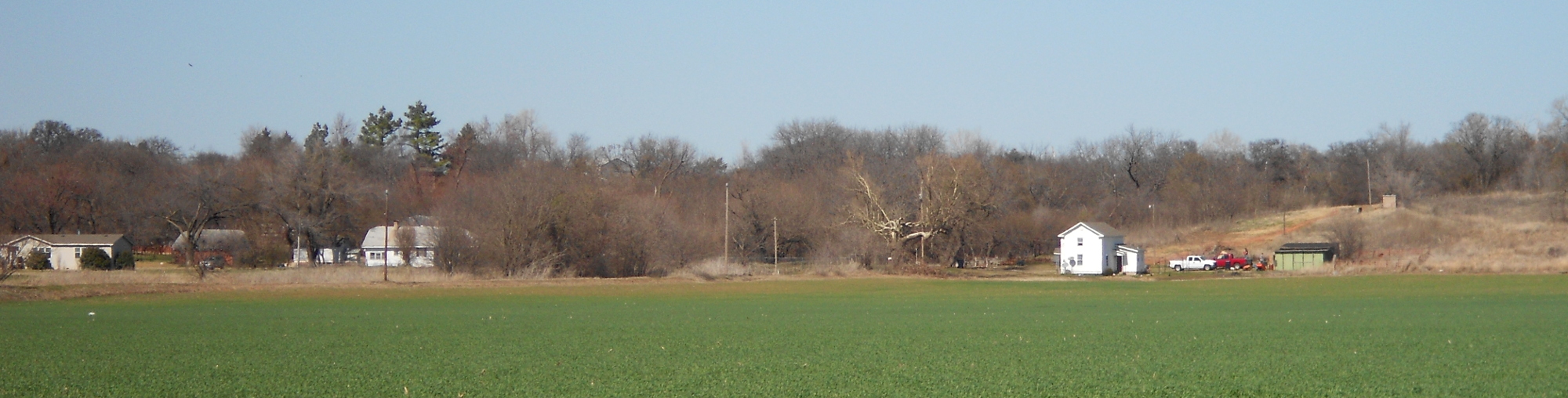
NE122ndBridgeNCanNE122ndatPostRdStill, the place had a quiet ambiance and I stopped to eat my snack. I watched a snapping turtle swimming in the semi-stagnant deep and just felt a sense of peace. I’ve been through here a couple of times before, but today was the day to stick around and soak it up. On the right is a shot of the bridge scene, and on the left is a wide angle of the fields north of the road.

10301NE122ndJoneOn the left here is an old house sitting on the edge of those fields. It is no longer inhabited but the owners are keeping it up decently anyway.12017NPostRd On the right is a house that sits down on the edge of the flood plain at the southern end of this part of Post Road. I was sitting on the ground on the slope down to the lower flood plain when I took this.

12500ThreeOaksDrJonesSomething I noticed from several different points around this area, and as much as three miles away, was the cupola on an rather opulent house just off NE 122nd on Three Oaks Drive. What that tells me is the view must be astounding from inside that thing. The house sits on the north slope at the edge of the North Canadian Valley, perched on the highest point of land for quite some distance in all directions. Back down that hill and facing out on NE 122nd was this halfway in-ground home.9221NE122nd I pasted two shots together from the side view off Three Oaks Drive. This is a very popular design and I saw at least two or three more out in this area just today. One I could see only from the backside, but recognized it by the wall and rail the wraps the edge. I caught a glimpse of the driveway that ran in front of it, with cars and only barns visible otherwise.

3810NMidwestBlvdSpencerBut that was nothing like the bunker I saw later on. If you come north on Midwest Boulevard as it starts to drop down into the Canadian Valley, you won’t know this is there. There is a thicket of evergreens screening it from the road. A sign on the gate is now nearly rusted and faded blank; it just barely offers the advice to please enter through the front gate, but the other side of the property ends behind some trees and no roads nearby. I’ll leave you to speculate.

Posted in Uncategorized | Tagged , , , | Comments Off on Cycling: Wandering Around Jones