NT Doctrine — 1 Corinthians 11

Keep track of how Paul’s teachings lead naturally from one thing to another. The previous chapter was about self-restraint for the sake of the gospel. We are feudal servants of Christ by covenant; His reputation is our first consideration in all things. The Covenant of Christ has boundaries, the same as any other covenant. But this New Covenant is different from the Old, in that it is not a covenant that creates a national identity.

Paul refers to feudal headship as an ancient tradition essential to Christians. The symbolism of headgear has not changed much, even in the post-modern West. Men under military orders today wear headgear to symbolize this headship, a national military authority. Whereas the Hebrew national covenant required men to wear headgear during worship, as if under a mobilization for war, the follower of Christ recognizes no human national authority. It disgraces Christ’s feudal claims for men to wear a head covering indoors, particularly during worship.

For women, a covering was never a matter of national identity; it has always been about how women are under the feudal moral covering of either father or husband. Equality of the sexes is anathema in Christ; male and female are not interchangeable. Just about the only females who were uncovered in public were either minors or prostitutes who had no moral covering. Paul uses ritual terminology to ensure there is no mistaking this. The human fact of birth through mothers does not change it. In Christian worship, women cover their heads and men do not, in order to portray the divine order of things.

That Paul also mentions hair has caused a lot of debate over the past two millennia. His point is that the two are related, at least in the context of what would be proper in his world. Not only did prostitutes avoid headgear, but they wore their hair short like men. In Corinth this saved time and confusion when sailors visiting town didn’t speak Greek or Latin; a woman with short hair was for rent. Women with long hair or coverings were off-limits. Men with long hair were gay prostitutes. Sailors passing a large building with people gathered in worship should not confuse a Christian church meeting with a pagan temple hosting sacred prostitutes of either flavor.

Christians who wanted to protest about these boundaries on the basis of “freedom in Christ” were out of bounds. Their self-indulgent streak made them a threat to the gospel witness. It’s that self-restraint principle again. The Corinthians struggled with that concept in everything.

The next example of that was in celebrating the Lord’s Supper, the Christian version of the Seder. It celebrates our deliverance from slavery. Instead of making us a human nation, we are part of an eternal family. How did the Corinthians manage to turn it into an individualized thing? What happened to being one in Christ?

Granted, there should be some degree of distinction. Some in the body are quite mature in their faith. The rest of the church needs to see their witness. But that’s not what happened in the Lord’s Supper there. They would gather together, but it was like little family picnics. Some families brought a large pile of food, and some brought enough wine to get themselves drunk, but nobody shared with anybody else. Some church members were compelled to watch others eat and drink but had nothing themselves. That might be a supper, but it was not the Christ’s Supper.

Eat your meals at home. This is a ritual celebration in which everyone shares as one, and it’s just a token amount of food and drink. Everyone gets an equal share or no one gets any at all. Pass around the bread and the cup to everyone. Christ implemented this ritual after the main meal was already consumed. The Bread of Promise became His Body, and the Kiddush Cup became His blood. It is a memorial of His sacrifice for us all. It’s as somber as a funeral until He returns, when it will become a wedding feast.

If you don’t get this right, you defile yourselves. Humility before the Lord is the best way to avoid His wrath. Too many Corinthian Christians suffered to the point their lives countered the testimony of Christ — weak, sickly and some died because the defilement kept them from the miracles of Christ. Do you not understand that if you embarrass Him, He will remove you from His Body, one way or another?

Flaunting your wealth during a church meeting is obscene. Serving each other is glorious. Other ritual matters they had asked about could wait until Paul showed up in person.
Posted in bible | Tagged , , | Comments Off on NT Doctrine — 1 Corinthians 11

Ride Photos 27

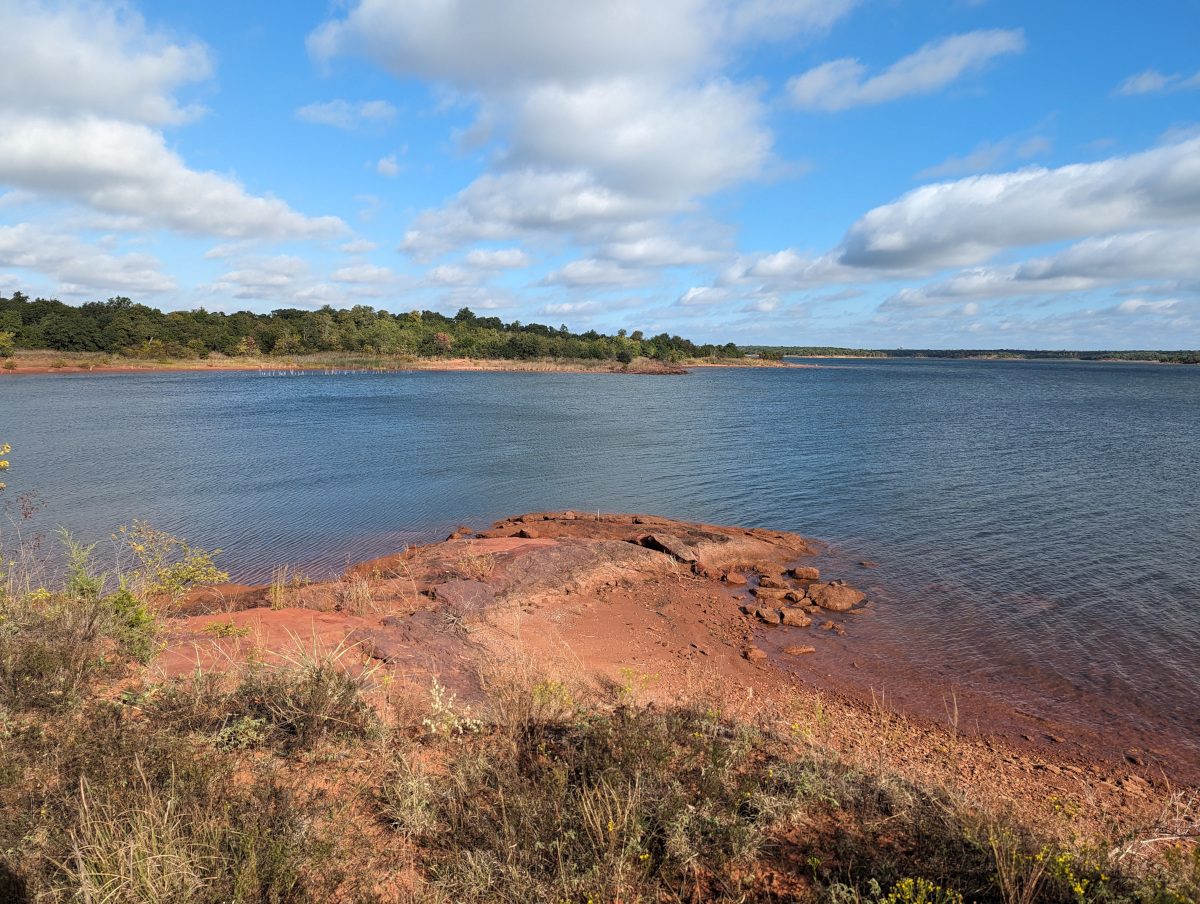
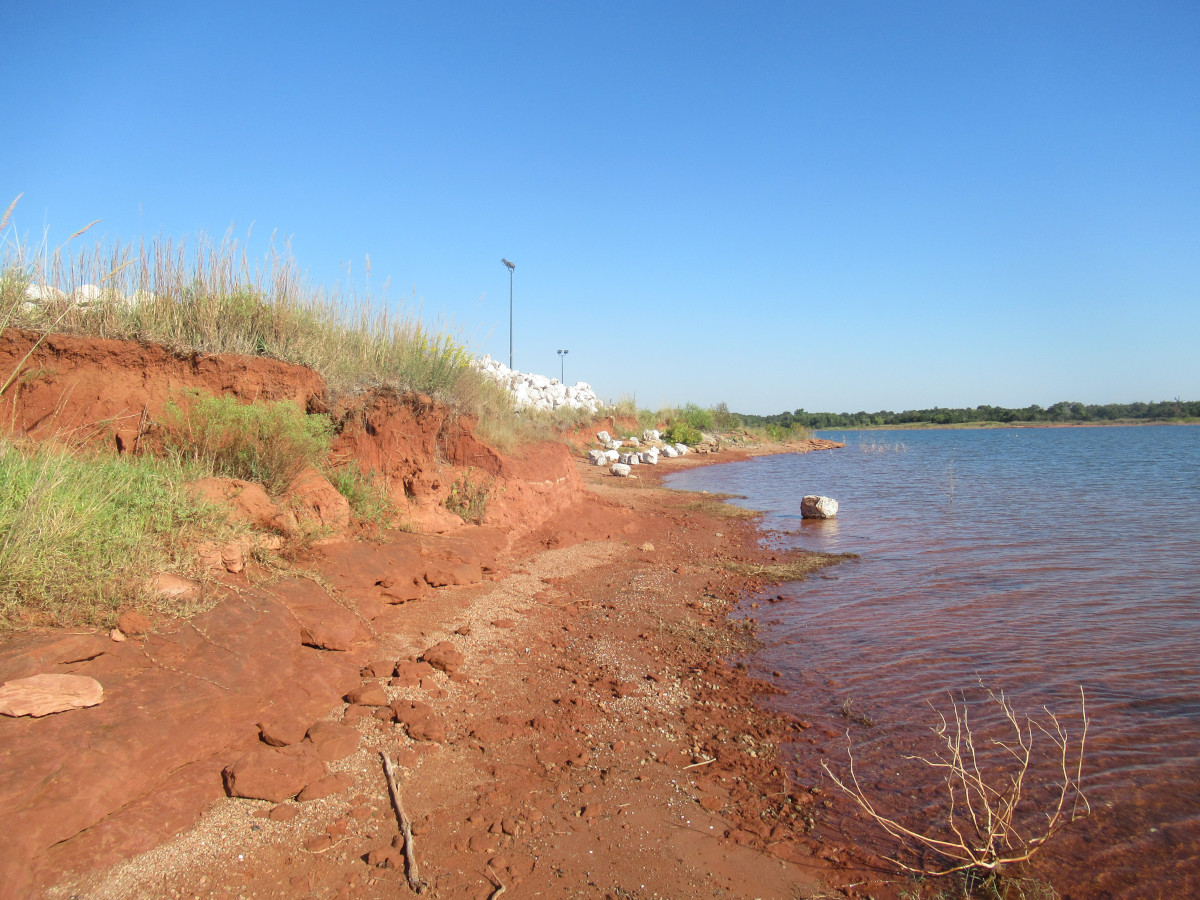
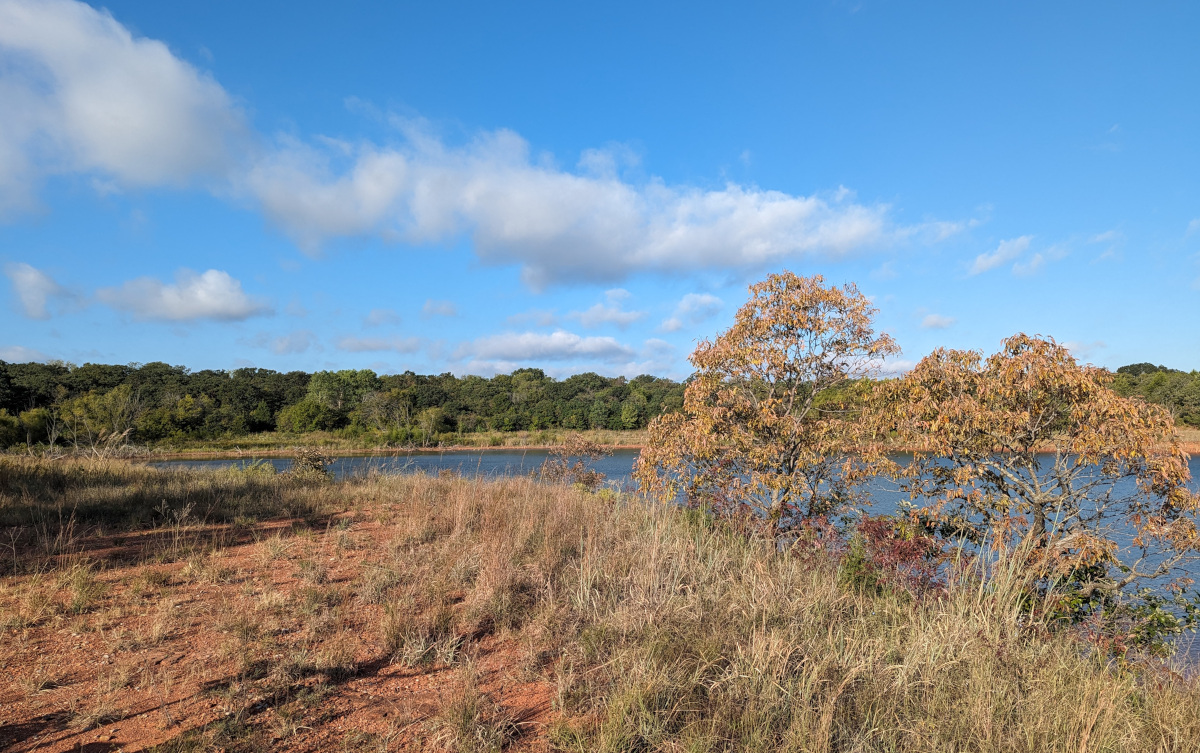
It’s been two years since I last visited some of the off-road points on Draper Lake. Today was 2 through 4, but in reverse order. I rode the trail starting at Point 4, which is currently under reconstruction. Lots of dirt, rocks and heavy equipment, but not much to see right now. Much of the lake is changing and the various agencies have invested in a lot of heavy work like that. This first image is a cove between Points 3 and 4.

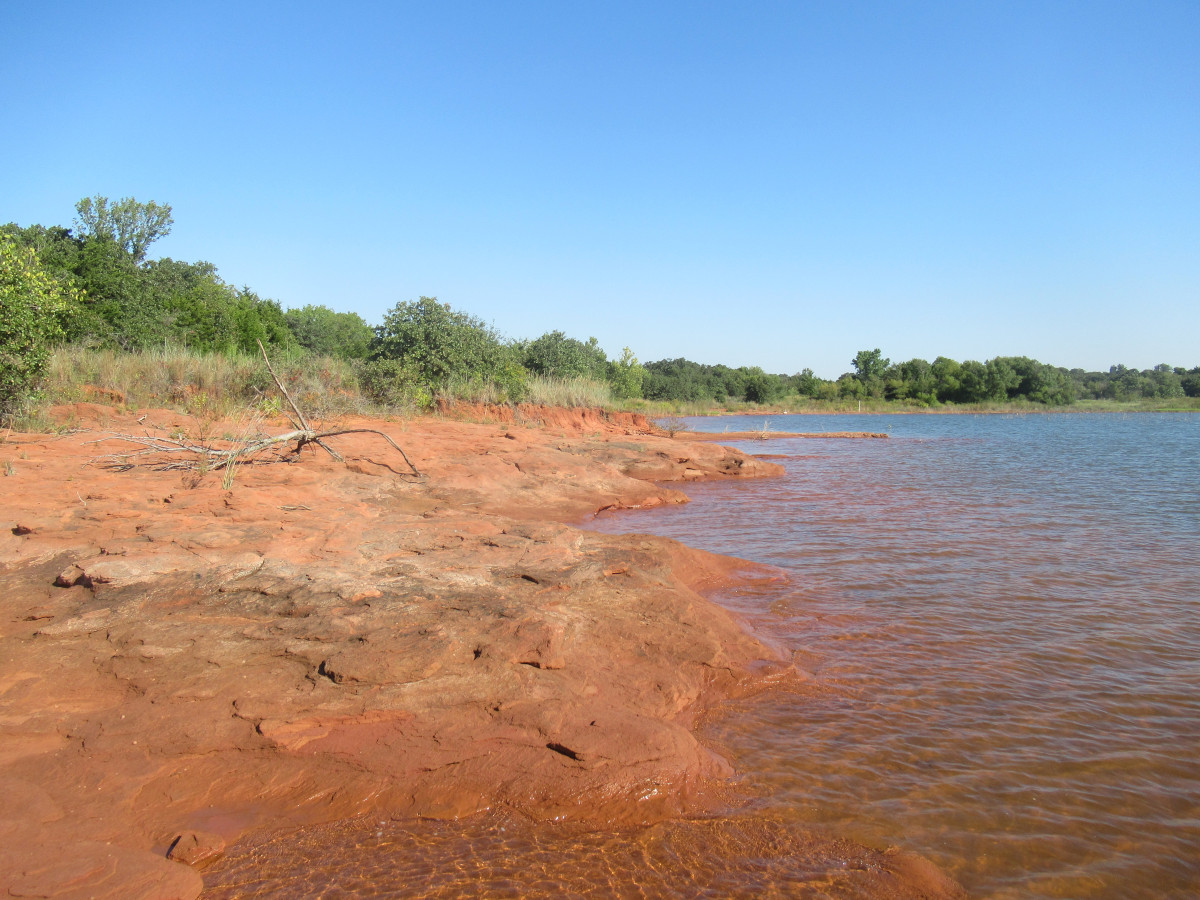
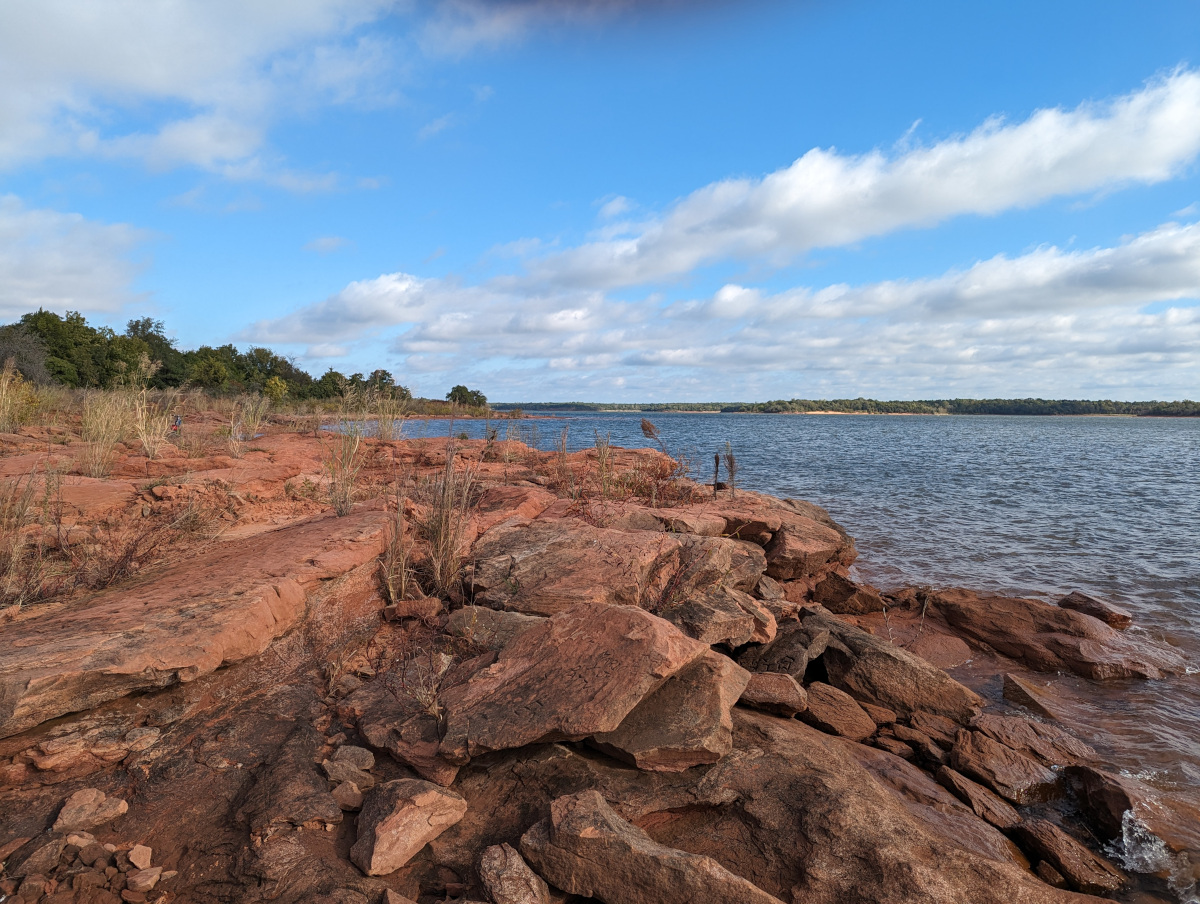
Meanwhile, nature has been at work in the past two years. Depending on what direction the shoreline faces, there has been some erosion that exposed rocky areas like this. Indeed, this one is a case of more exposed. These rocks were here the last time I came by, but they have been washed out underneath and have shifted some. In this case, the results are quite winsome. Given that today’s wind was blowing right onshore at this point, the waves were making a lovely noise.

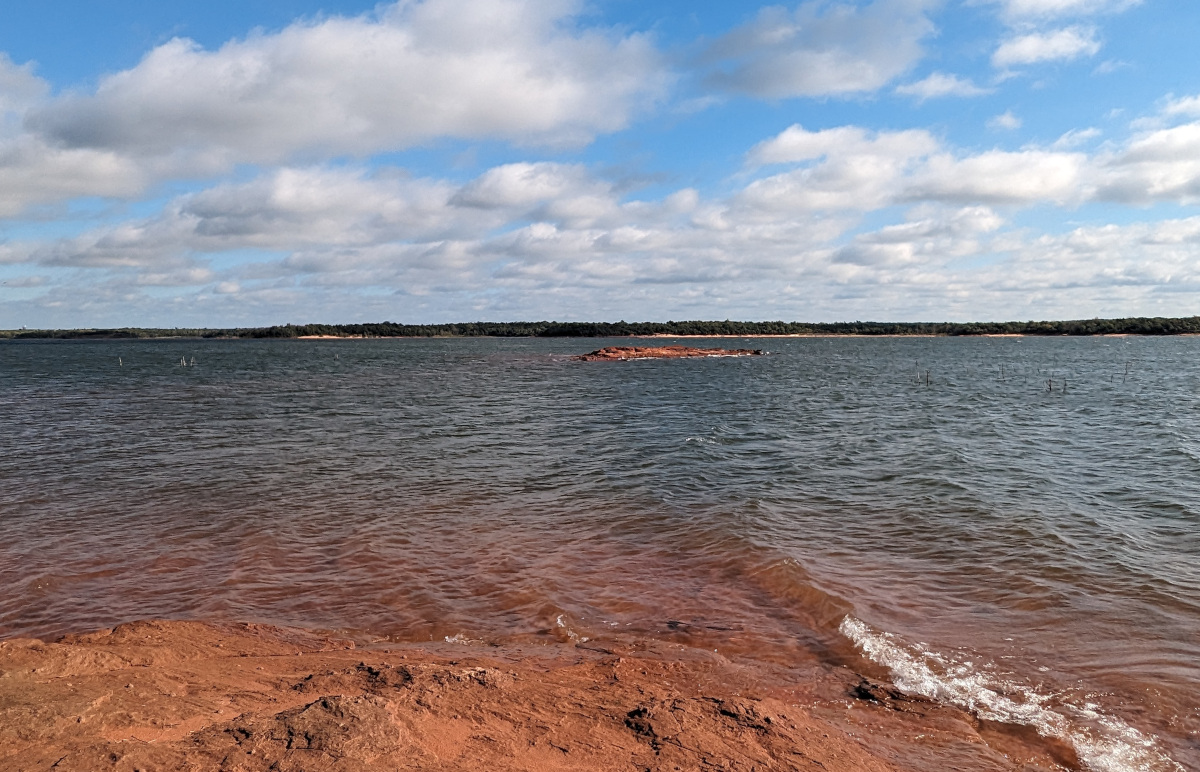
This is a case of the rock formations resisting the natural erosion. The shore on our right side has been eaten back a bit, but it served only to highlight the presence of the rocks. In this case, the rocks extend quite some distance out under the water, changing how the waves roll in. The rocks are not being undercut because they catch the waves too far out. Some of the construction is aimed at making some parts more accessible, but other parts less so, and this area is hard to get to unless you hike or bike.

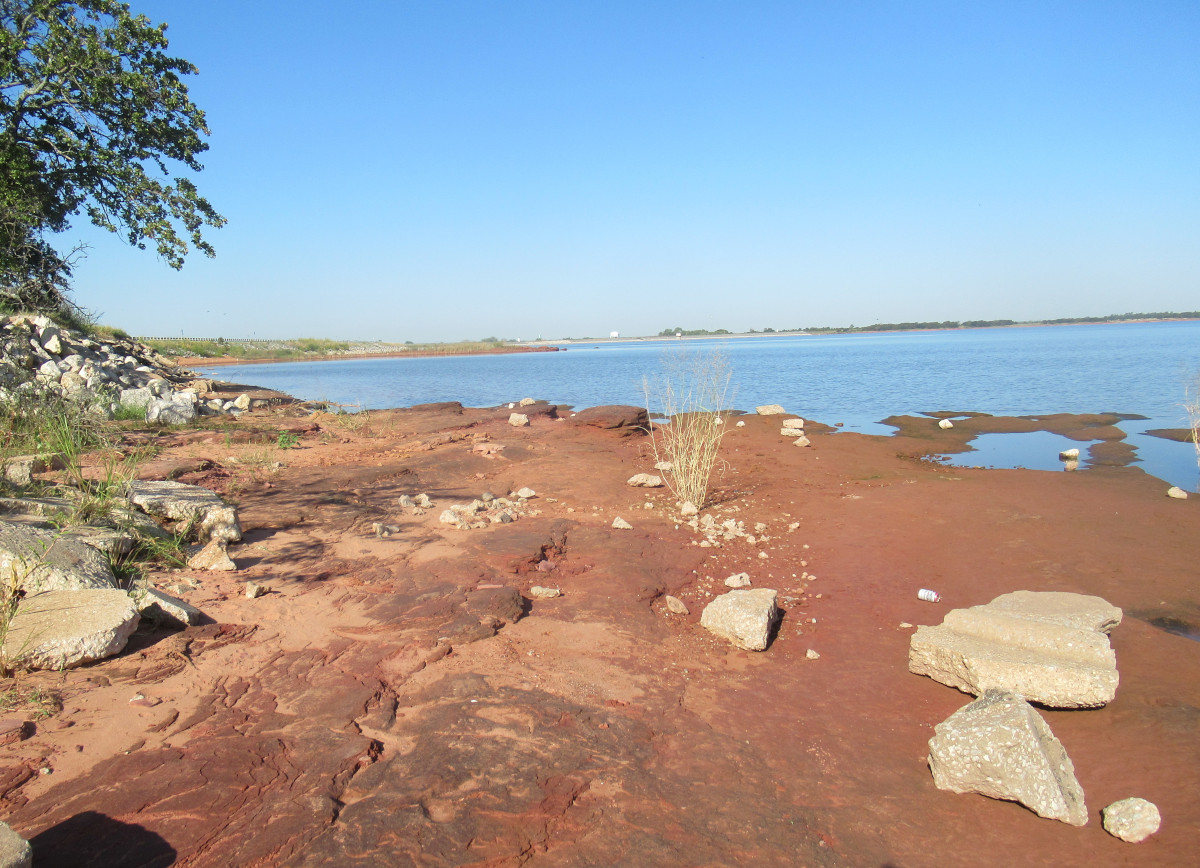
At one point, this island was attached to the shore by a long rocky isthmus, but it wasn’t very hard sandstone. I used to walk out onto the narrow outcropping, but the path has been washed away. Keep in mind that the general water level of the lake is quite low right now, but it’s been almost that low for the past two years. Rocks hidden in deep water don’t erode much; it requires wave action on the surface of the water. This long rocky point will not come back, but the harder stone out on the island will preserve it as is for quite some time.

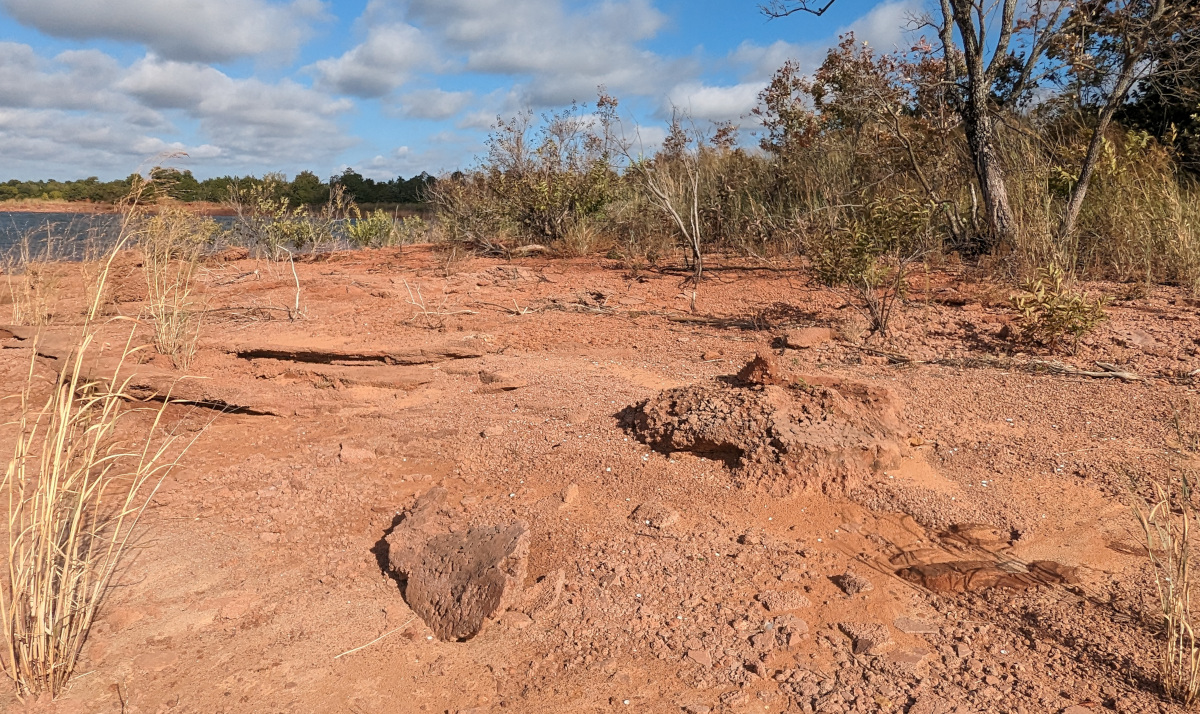
This is a bed of rose rock. I don’t know enough about geology to explain how it forms or where, but it’s about all that’s left of Point 3. This stuff forms in nodules that sometimes resemble flowers; if you poke around enough in places like this, you’ll find them of various sizes. This is very hard and heavy stone that isn’t likely to erode. This is actually being covered up. Point 3 used to be very lovely and dramatic, but because of where it faces, heavy rains have brought topsoil down over it, and this year an awful lot of grass grew up. The point is now just grass and dirt; the rocks are mostly covered.

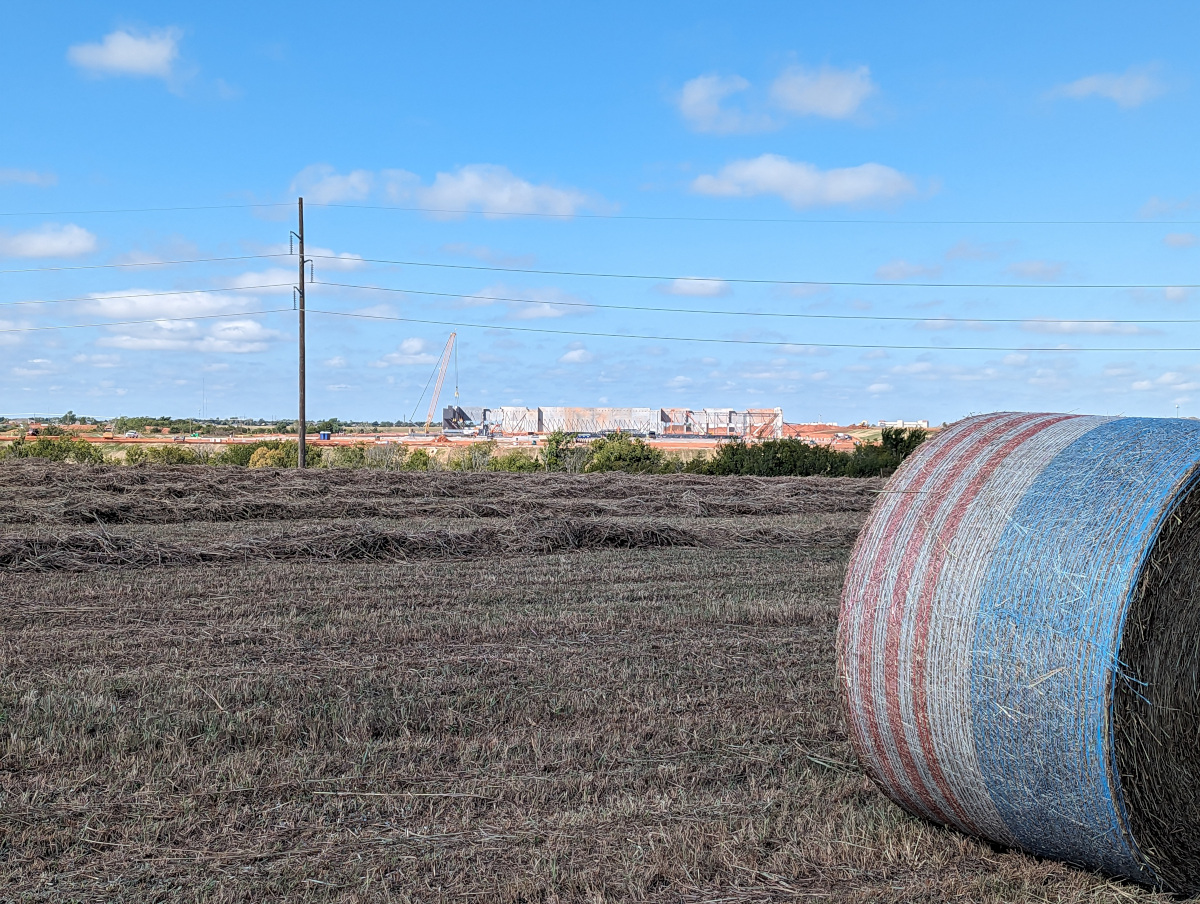
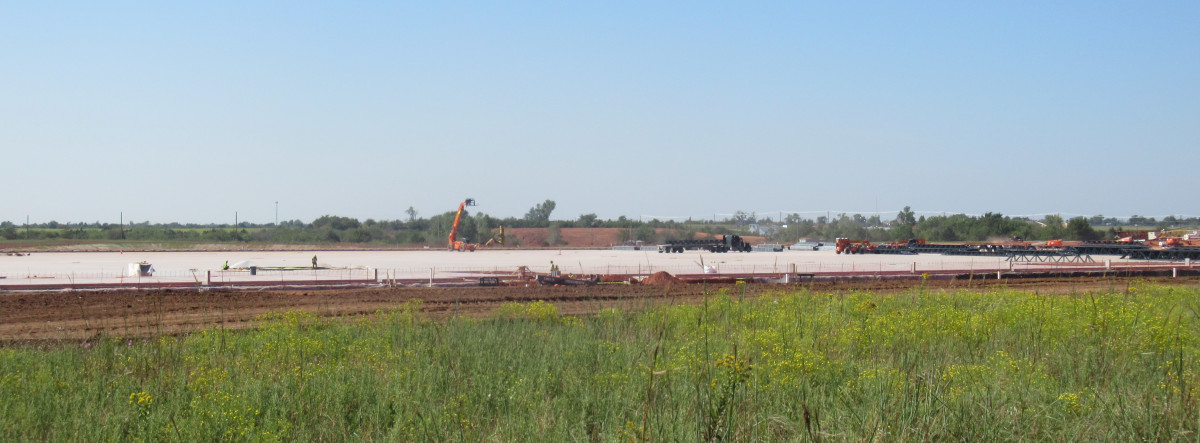
Meanwhile, the new Pratt and Whitney facility is making fast progress. I lined it up with a hay bale on purpose for contrast. Farming will continue all around this monstrosity for a long time to come.

My Zizzo folding bike isn’t a mountain bike, but it can do some off-road stuff if I’m not in a hurry. It was a pleasant ride, and there’s evidence the scant trails will remain open simply because of high foot traffic and a modicum of cycling. But for me, the changes in Points 2 and 3 were actually quite disappointing. They used to bear a dramatic face, but they are now just a place to walk and ride.

Posted in photography | Tagged , , | 2 Comments

NT Doctrine — 1 Corinthians 10

The fleshly nature is an inveterate enemy of the Spirit. The flesh must be captured, humbled and kept enslaved. Once we are spiritually born, it must be made to surrender sight unseen to whatever the Spirit will direct through the heart.

The process of humbling the flesh is repentance by Biblical Law. The Law of Moses was how the Israeli people’s fleshly natures were introduced to their new spiritual Master. They knew the drill; they understood what was required. Their culture included an awareness of the symbolism in the flesh pointing to eternal things in the Spirit Realm. They had no excuse. Even more so, since they watched miracles with their very fleshly eyes — following and being guarded by the Pillar of Fire and Cloud, the waters standing aside when they crossed, the miraculous provision of manna and water.

They remained dry when crossing the Reed Sea, but they understood how it represented cleansing from the old way of life, and embracing a new identity in the Covenant as an adoption treaty as God’s own family household. Nobody imagined the written code could cover every possible situation. As I wrote elsewhere, “Laws but paint an image of godly living on the surface of the human conscience.” Israel knew that; there was no problem with legalism in ancient times. That was how silly children saw things. This written Covenant was meant to inform the flesh, to prepare it for how the heart would operate under Jehovah’s reign.

Obviously, a large number of Israelis just refused to take it seriously. Despite having seen the mighty powers of their God, they kept violating the code. They died for that. We are supposed to look back on that and learn something about following Christ. Symbolically, He followed them through the wilderness; He was there in Spirit, and He enforces the same lessons today. We cannot afford to make the same mistakes. It wasn’t the code that killed them, though obeying it could have kept them alive long enough to understand. Rather, it was the hand of God who became very disappointed with their truculent insistence on idolatry and self-indulgence.

They partied because they rejected their Lord’s boundaries. So they died by the thousands on that day, and plenty more died in the testing with fiery serpents. They complained and fussed to have their fleshly desires met, and the Angel of the Lord slew them. It wasn’t the law; it was the rejection of what the law indicated about God and His ways.

Paul says that we are here in the Last Days, a phrase meaning no new revelations are coming from God. We have all we need in Christ. There is no temptation we will face that hasn’t already been dealt with adequately. Change the commitments of your heart; the Lord has promised to carry us through everything we might face.

It’s a simple law: flee idolatry. The Corinthians should have understood what this is really all about. It’s not the code, but what the code indicates to our fleshly nature about a spiritual nature. We use a ritual called the Lord’s Supper, abstracted from the Seder Ritual. The ritual bread is all about feeding the fleshly nature the new restrictions, with plenty of examples. We all refer to the living law code of Christ’s life on earth in order to understand. That’s what a law code does. We also have the ritual wine, to remind us of the sacrifice of the flesh to empower the Spirit in us.

This is what we learn from Israel; we have inherited their calling. It’s one calling that binds us all together, just like that single loaf of bread we tear apart to share as one body in Christ. It’s all of us sipping from one cup to share in how His sacrifice set us all free. Sure, we realize that similar rituals taken in the name of pagan deities (the opposition elohim in disguise) has no spiritual reality behind it. It’s all about the flesh. Don’t make peace (what a ritual meal represents) with those demons as they keep the flesh away from the Spirit of God. You will serve one or the other.

Paul keeps quoting their doctrine that “everything is lawful”. True enough as a matter of law code, but not everything is spiritual. Some of those lawful things can actually hinder peace with God. It’s not about the code, but the commitment of faith. If hedonism and self-indulgence is what killed all those disobedient Israelis, don’t use the law code as an excuse to let those things creep in and rule your lives.

What would it look like? Sure, eat what you find in the open market. Give our Lord thanks for all things. If you are invited by an outsider to a private meal, by all means, go and eat so you can testify of your Lord. Don’t pick over the food; just eat what they offer. If someone tells you a dish came from the pagan temple stall, then don’t eat it. Not because of your own conscience, but because of theirs. They don’t know the Spirit and His wisdom; they are creatures of flesh bound under laws. What will they think if you eat something you know was offered at a pagan temple? What kind of testimony is that?

No, it’s not possible to meet everyone’s silly expectations, but some things are pretty obvious and not burdensome to observe. Be mindful of Jewish sensitivities as well as Gentile ones. You are a testimony of faith. Give your brothers and sisters a chance to grow in the same faith by not provoking them on those obvious issues of lingering human conscience.

Posted in bible | Tagged , , , , | Comments Off on NT Doctrine — 1 Corinthians 10

Random Photos 13

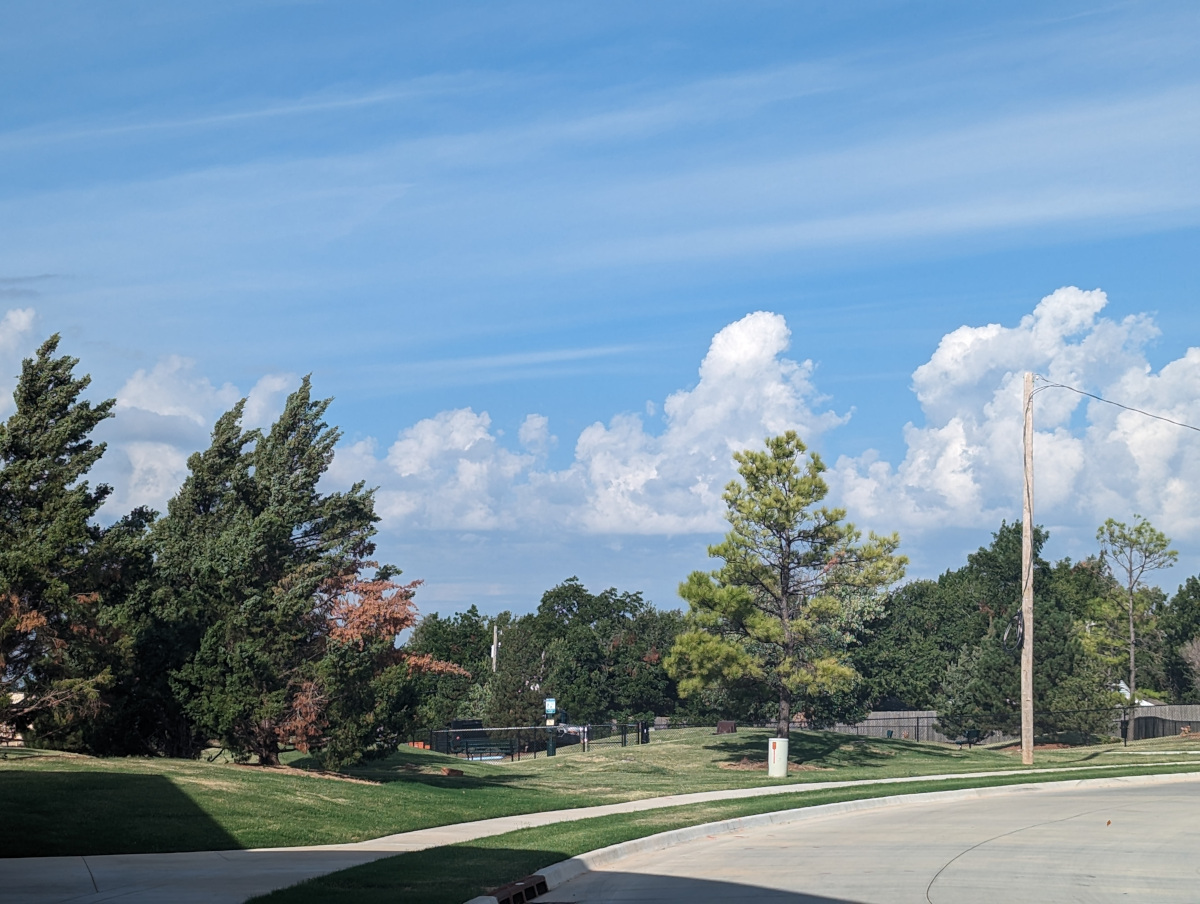
A couple days ago we had some significant thunderstorms. This is what it looks like as they approached the OKC Metro from the west. The be honest, these clouds didn’t hit us; they past just a mile or two north of us. What we got came later and wasn’t this dramatic.

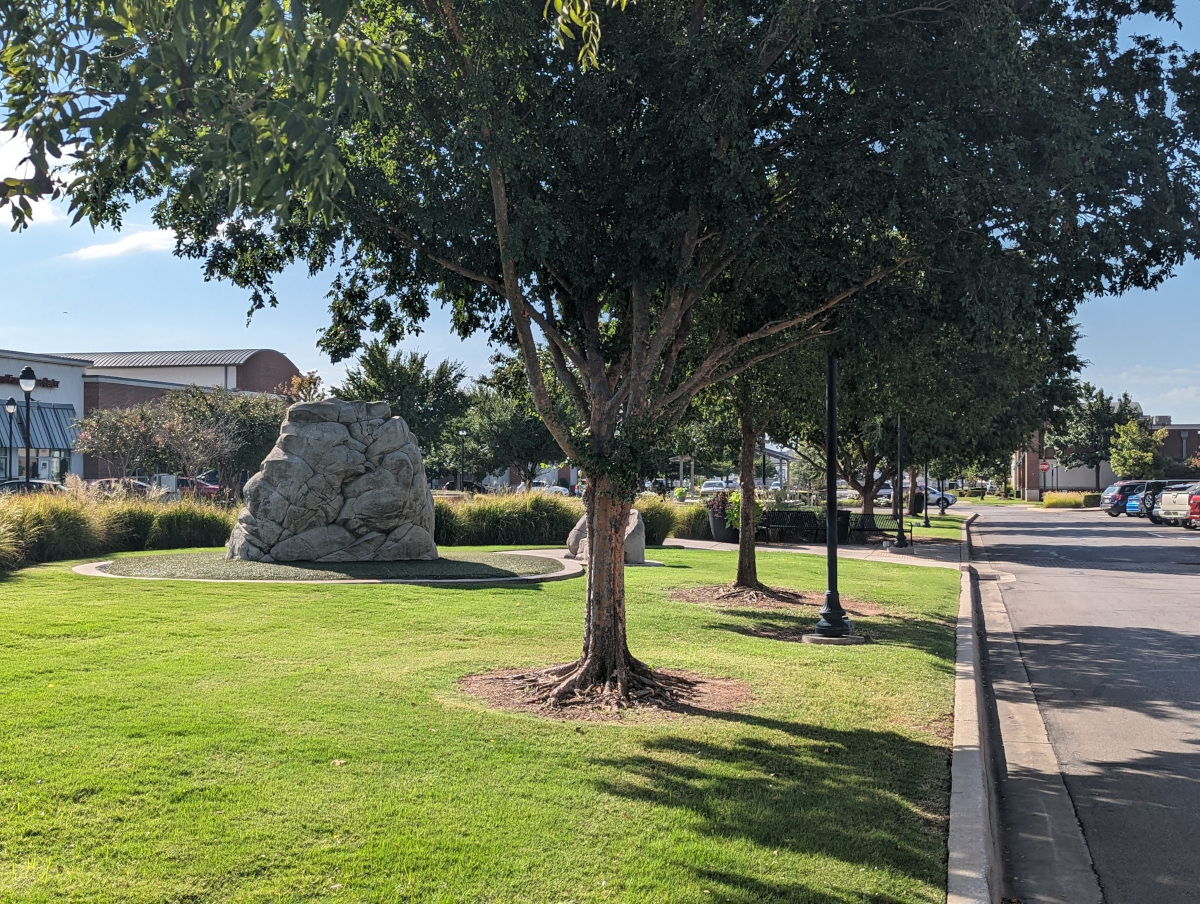
We have this big shopping area called “Midwest City Town Center” and this is the little park plaza in the middle of it. There are seldom any people out in this little park, so it has become a favorite prayer chapel. I just pick a bench that’s in shade during whatever time of day. It’s just about a half-mile from where I live, so it’s an easy quick ride and very pleasant with the fountain splashing to cover most noise.

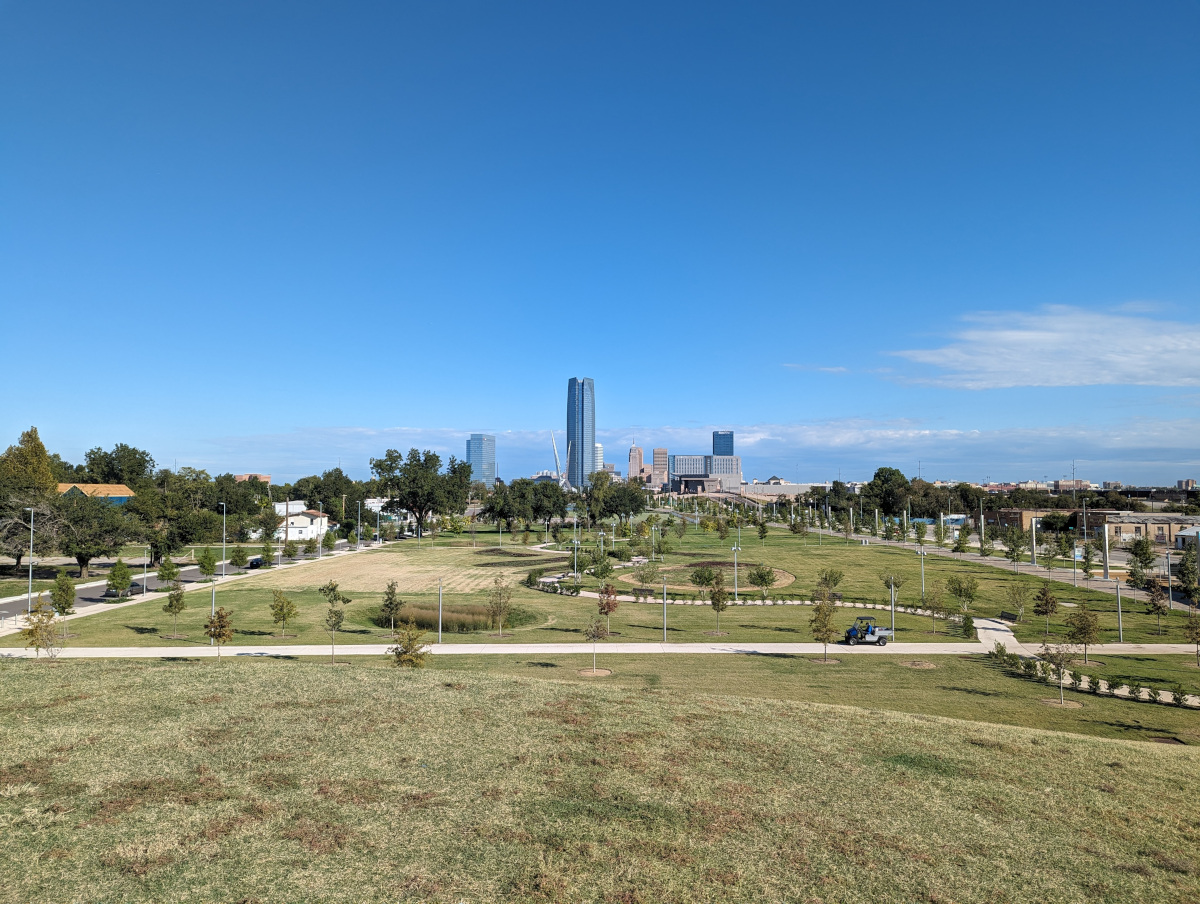
Now that it’s been open for a while, I decided to visit Scissor Tail Park today. This southern section is called “Lower Scissor Tail Park” on the maps; it’s south of Downtown OKC. The area was blighted with old dangerous buildings once housing businesses that had died long ago, most of them auto salvage type places. The city management did a good job planning this, but it took forever to build, considering what’s here. This image was taken standing on the lookout hill viewing back north to Downtown OKC.

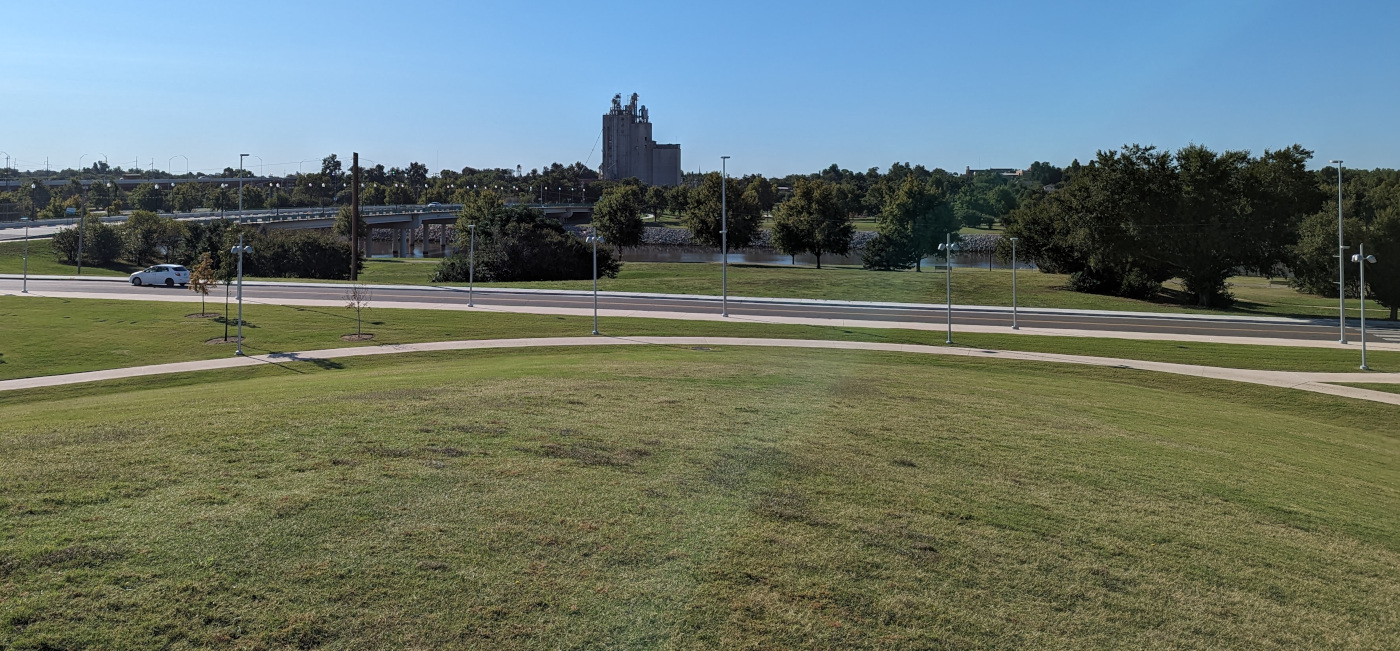
From that same lookout hill, this is the view in the opposite direction. The monster building is the Cargill Feed Mill. It’s not going anywhere. This one does vegetable-based feeds. The worst smell is perhaps the sorghum being heated and crushed, and it’s not that bad. What I wouldn’t give to get a few camera shots from the top of that thing…

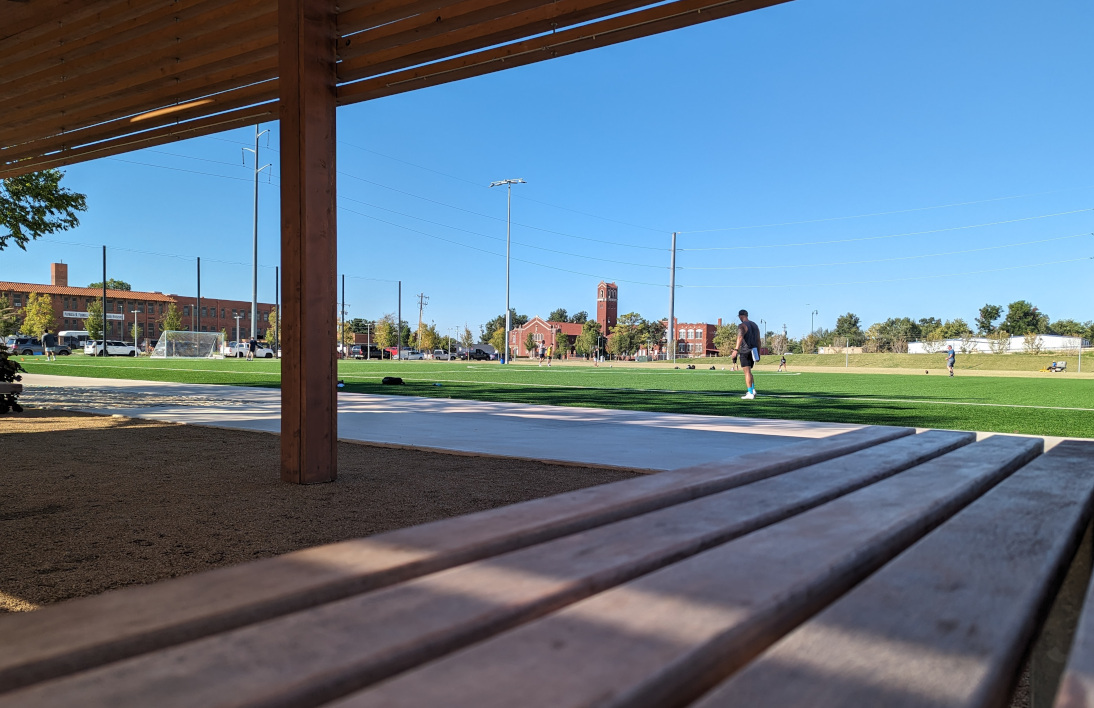
This is a sports field attached to the Lower Scissor Tail Park. Aside from the soccer pitch, there is a facility that lets people use equipment to play cornhole, lawn bowling, paddle ball, basketball, etc. It’s quite a sprawling area, impossible to get everything with my camera. Of course, in the background of this shot is the Little Flower Catholic Church. It’s a rather famous charity center, with a private school, that is now blessed with a much more pleasant view.

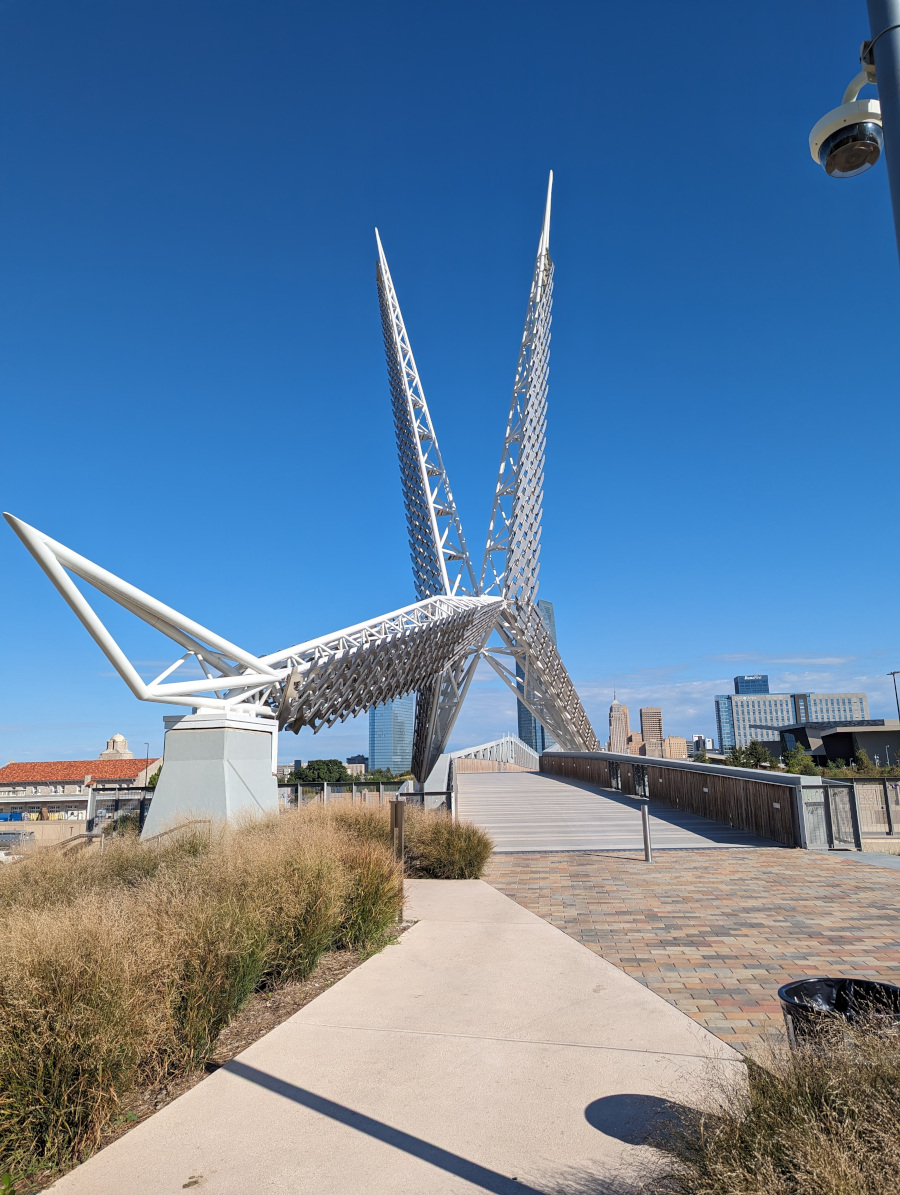
This is the namesake of the whole park, the Scissor Tail Bridge. It’s also called the Skydancer, supposedly the translation of what some local Native American tribe called the Scissortail Flycatcher, our state bird. The bridge was built first, then the northern half of the park, and finally the southern “lower” half in the past couple of years was finished. This bridge has been refurbished at least once due to vandalism. There had been some nice benches, but they were destroyed, and some other decorative features of the bridge were removed at the same time.

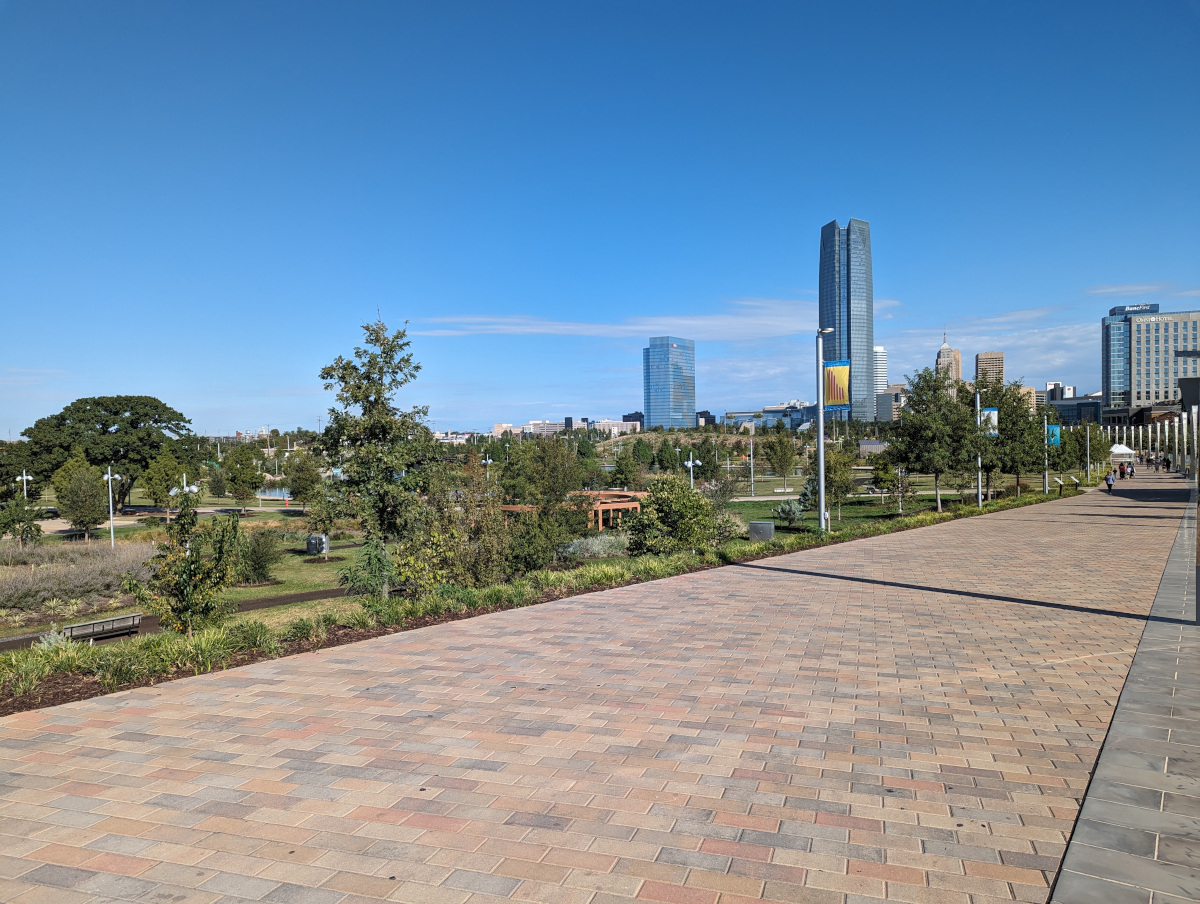
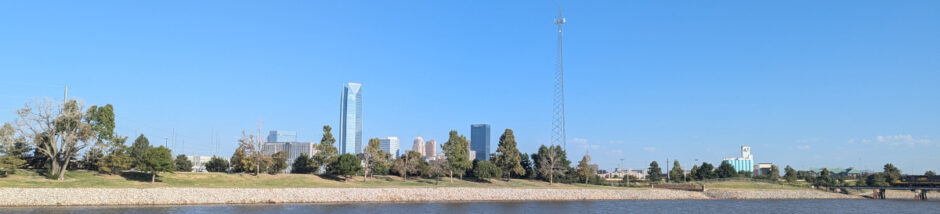
This is just a view of Downtown OKC from the original northern part of Scissor Tail Park. There’s actually some well-disguised clutter in there, stuff that can’t be moved or upgraded visually. Still, they did a good job of hiding that stuff. While the former majestic trees in our city were removed a couple of decades ago, the city management is trying to put some back.

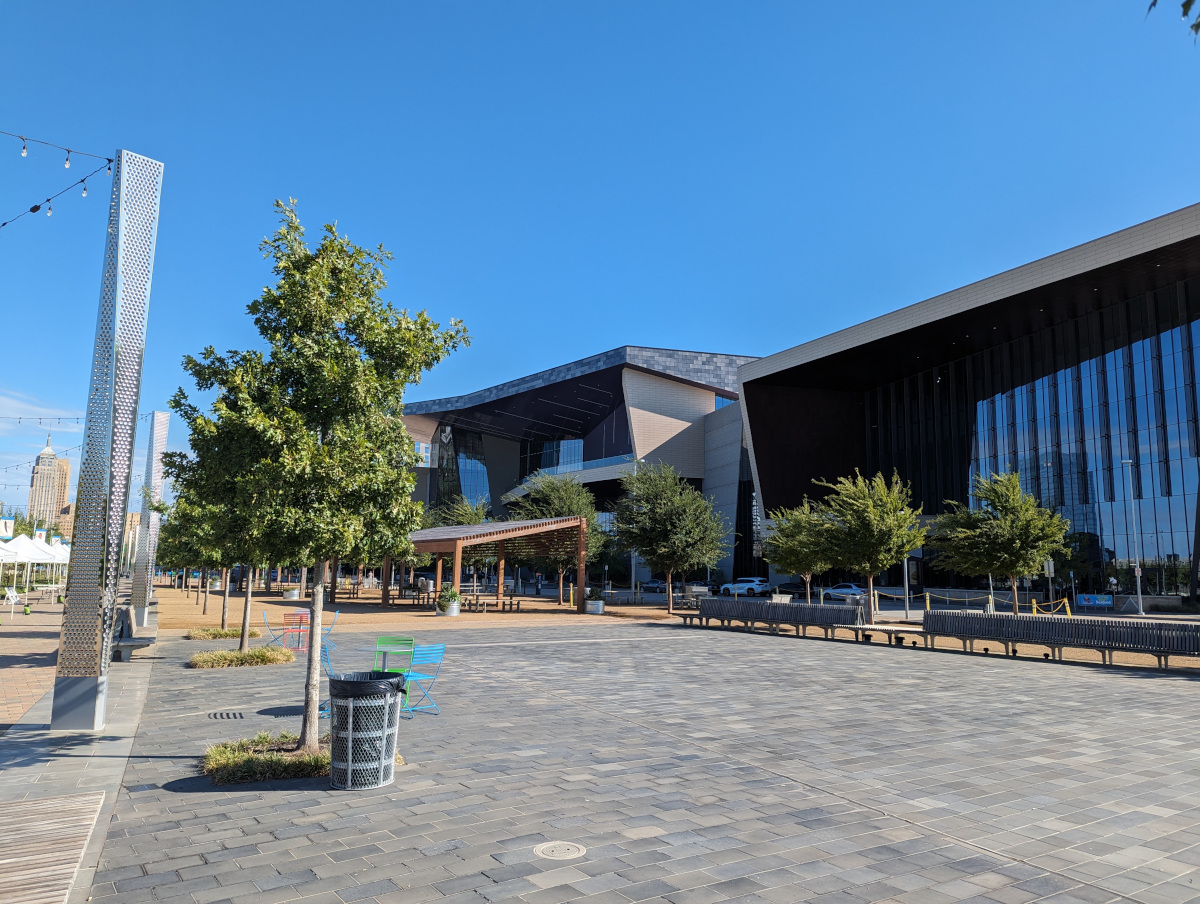
Some of the clutter is hidden by massive new buildings. This one is the OKC Convention Center, just across the street from the park. I recall seeing this under construction at a couple of different stages. There’s a new hotel attached, and several that were here before. The indoor sports arena is the next block over and some other downtown revival structures farther north into Downtown. The city is investing in public sculpture and other amenities to draw the tourist traffic. Just having a real pro basketball franchise (OKC Thunder) has made a huge difference. Not all of that big money is wasted.

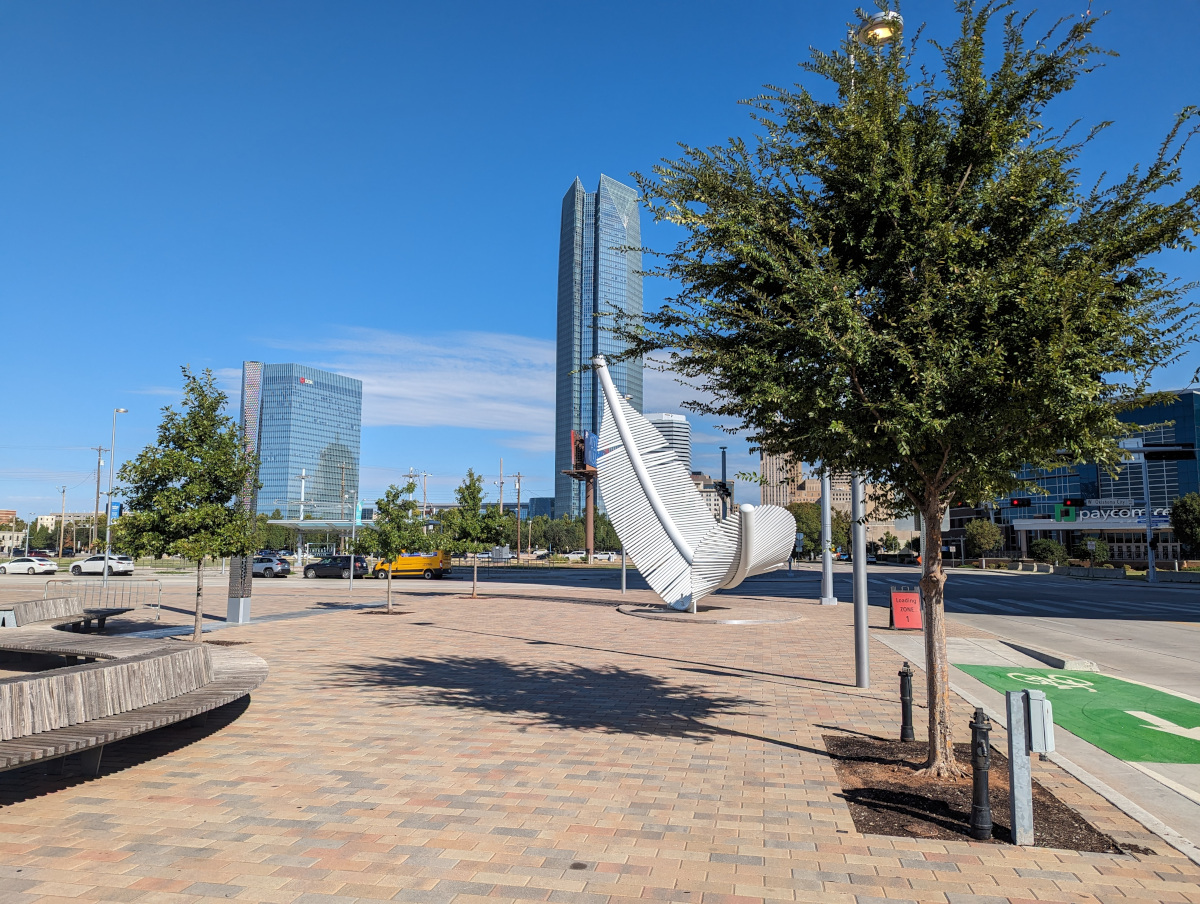
There’s not much accounting for taste, but this steel sculpture of a giant feather is at least amusing. A series of bond elections called MAPS included a lot of this gussy-up stuff. Of course, we can’t forget how much was spent on our bike trails that I love so much. I’ve seen the city’s so-called master plan for more bikeways as well as pedestrian friendly walkways in the works.

All of this stuff was shot with my Pixel 7 phone.

Posted in photography | Tagged , | 1 Comment

The New Civil War

Let’s consider the context again. Those who obey Biblical Law cannot consider themselves Americans. By secular law, we might be citizens of the US, but we are simply on loan from God. We belong to Him; the bulk of Americans do not. That includes church folks who don’t pay attention to the requirements of the Covenant.

They are in deep doo-doo. I quite agree with Victor Davis Hanson’s assessment of the situation for Americans. As long as they keep playing by the rules others give them, they are going to suffer an apocalypse. It’s already under way. The only hope they have is to rise up in armed revolt. They must stop playing by the rules that really don’t belong to them.

We could talk about that at length. Various codes of honor associated with American history are all bogus nonsense arising from a pagan past. They are not biblical. The Hebrew Scriptures paint a totally different concept of honor regarding what is allowed in political and military conflicts. The Bible sees nothing wrong with assassinations, for example. It’s just a way to get things done. You might imagine the Bible encourages sticking with the political leadership, but you would be missing the point. Our leaders are not anointed by God; they are permitted by God because this is not a covenant nation. Americans would be fully justified in starting a bloody internal conflict, because they are not under the protection and restrictions of the Covenant. If they were, they wouldn’t think of themselves as Americans, and they wouldn’t worry about what happens to this country. If they are worried about it, then they are under the law codes of the Bible, and not under grace with its eternal viewpoint.

You can bet that an armed revolt will not happen. At least, it won’t happen on a scale sufficient to do any good. Instead, the country will be torn to shreds as states secede — if the Americans are lucky. Should the states remain attached and subject to the ruling elite in Washington DC, it will be hell for everyone. The smart money is on promoting decentralization.

We are not concerned about smart money. You and I are called to remain aloof. It’s not that we are wholly uninvolved, but that a civil war is not our concern, because the fate of America is not our concern. It’s just the setting in which we operate for the Father’s glory. He is in control, and there’s an awful lot He will not tell us, because how we react to the surprises is a critical part of our witness to His glory. The best we can do is guess.

Posted in sanity | Tagged , , , , | 1 Comment

NT Doctrine — 1 Corinthians 9

In the previous chapter, Paul ends by saying he would voluntarily set aside freedoms and privileges granted by the gospel message in order to promote that message. This chapter expands on the idea.

Paul was not a slave under human law, but an acknowledged religious leader. He was one of the select few who had actually been with Jesus and had seen Him after His resurrection. This was a high privilege, indeed. Should anyone doubt that Christ called him as an apostle, the Corinthians could not do so. The mere existence of a church in a morally corrupt place like Corinth was quite the testimony of his calling.

So, when churches welcome the surviving members of the Twelve and Jesus’ younger brothers as the Christian equivalent of royalty, rolling out the red carpet and sparing no expense in hosting them, would the Corinthians deny Paul a simple meal? Would they give him a hard time if he brought along a Christian wife when he came to visit, the way others did? For doing precisely the same work, would Paul and Barnabas be required to pay their own way?

Paul cites ancient traditions that everyone understood. Common troops could not soldier if they had to pay their own way. Agricultural workers always got a share of the food they produced; it was the law. Besides, without that share, they wouldn’t be very diligent. Then Paul points out how some parts of Mosaic Law still applied in terms of the underlying principles. It’s not that God cared so much about oxen that He demanded they be unmuzzled when treading grain, but it demonstrates His priorities, His divine moral character. On the basis of the law about not muzzling an ox, we justly deduce that those who minister the gospel get paid for their ministry.

God Himself said that spiritual work is productive for the community, too. It was that way under Moses when priests shared in the offerings they presented to the Lord on behalf of others. Those Christian royalty were not involved in planting the gospel in Corinth, and it was fine that they be supported on their travels. Still, Paul was not angling for the church to start paying him anything.

Apparently some were suggesting that Paul was the same as some religious hucksters, trying to make people feel like they owed him something, or that he bragged about his accomplishments. Were that the case, there’d be more to boast of if he had volunteered for this ministry. However, he denied serving voluntarily; he admitted that Jesus Himself had coerced Paul into the gospel ministry. Paul had always felt wholly inadequate for this work, but someone far above him had entrusted Paul with this unspeakable treasure. That privilege was more than enough reward for Paul.

Thus, Paul accommodated all kinds of weirdness and weakness from every sort of people. They put all kinds of claims on him that he knew were not his burdens to bear, but he did so voluntarily so he could be in a position to share the gospel with them, to demonstrate the character of his Lord.

Corinth hosted the Isthmian Games every two years. The city had a strong athletic heritage. Like athletes, the believers should train the way Paul did, subjecting himself to unnecessary burdens to overcome his moral weaknesses. That wilting piece of greenery the winning athletes wore couldn’t compare to the eternal glory of the gospel. You must enslave your flesh to the Spirit in order to join the victors in Eternity.

Posted in bible | Tagged , , | Comments Off on NT Doctrine — 1 Corinthians 9

Ride Photos 26

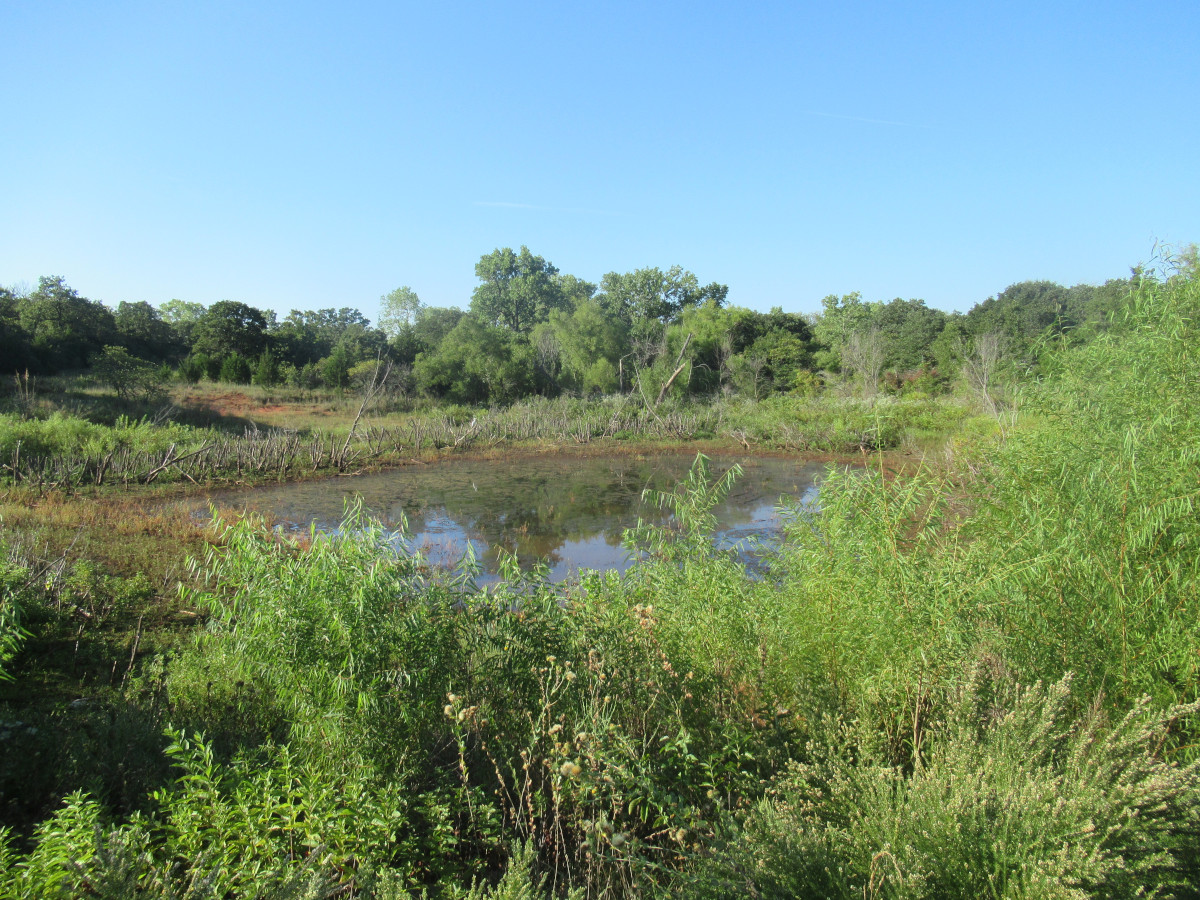
Today I rode out to Draper Lake. This time I felt like visiting at least one of the many land points, so I started with Point 1. On the way, I passed this swampy overflow basin. It was here before the bikeway was built, so they left a culvert connecting it to the main body of water. However, the current very low lake level means this little pond is temporarily orphaned and swampy.

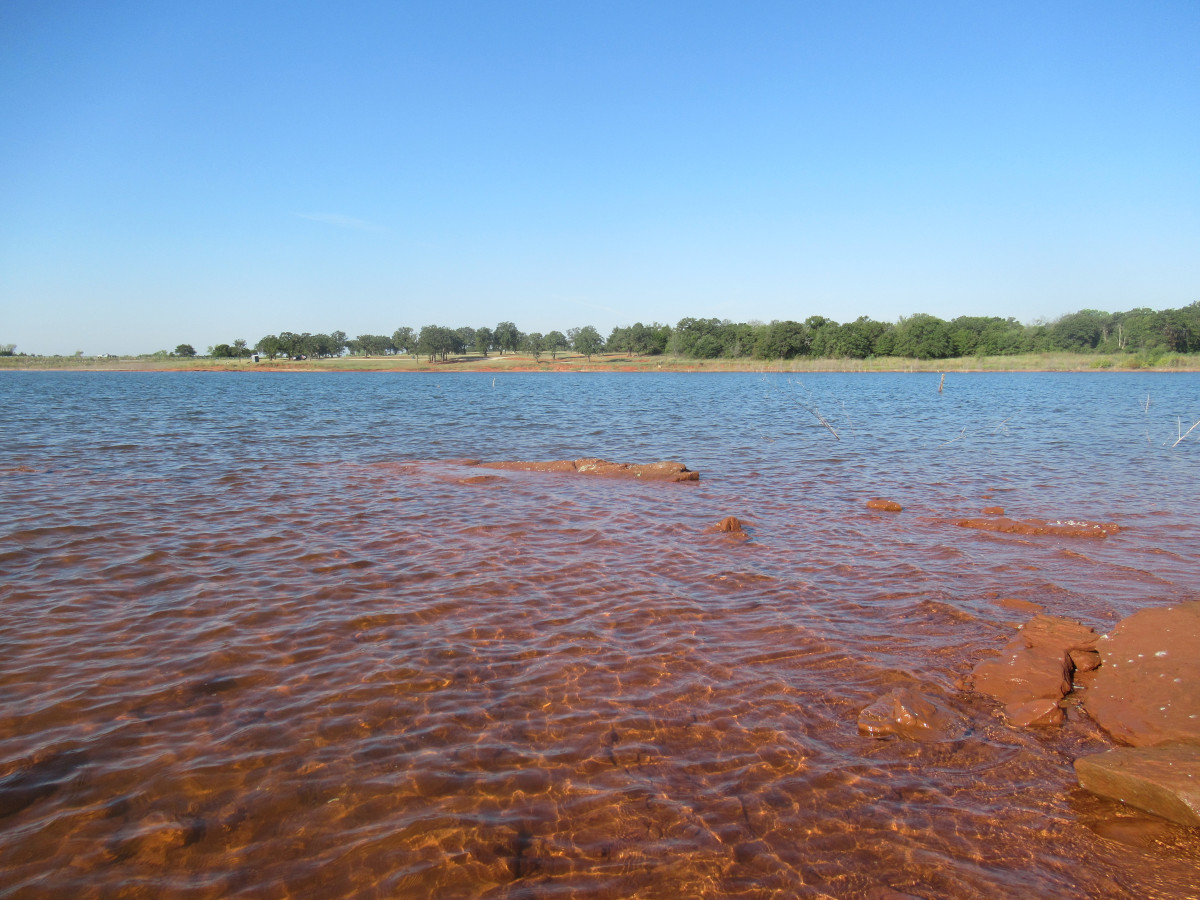
Out on Point 1 there’s a long projection of land that juts out into the water southward. It stays there because it’s almost all rock, particularly underneath the thin layer of dirt. In this image, I tried to capture the shallow rock formations that indicate how durable this finger is. Not many real boats can tolerate that kind of thing, so it turns out some people do model boating on this point. I saw someone working on one out of the back of his van. He never got around to launching it while I was there.

Here’s just more of the rocky shoreline. I took a lot of shots, but only a few turned out. The sun was awfully bright and coming from an angle that made it difficult for this particular point on the lake.

But for all the underlying rock here, Parks and Rec will still be placing rip-rap on the existing shore in the near future. Thus, the massive pile of small boulders in this next shot, some spilled down onto the shore already. There is an awful lot of improvement work going on around the lake right now, to include roads upgraded, while others have been permanently closed. A few more small areas have been placed under preservation, meaning no more riding there.

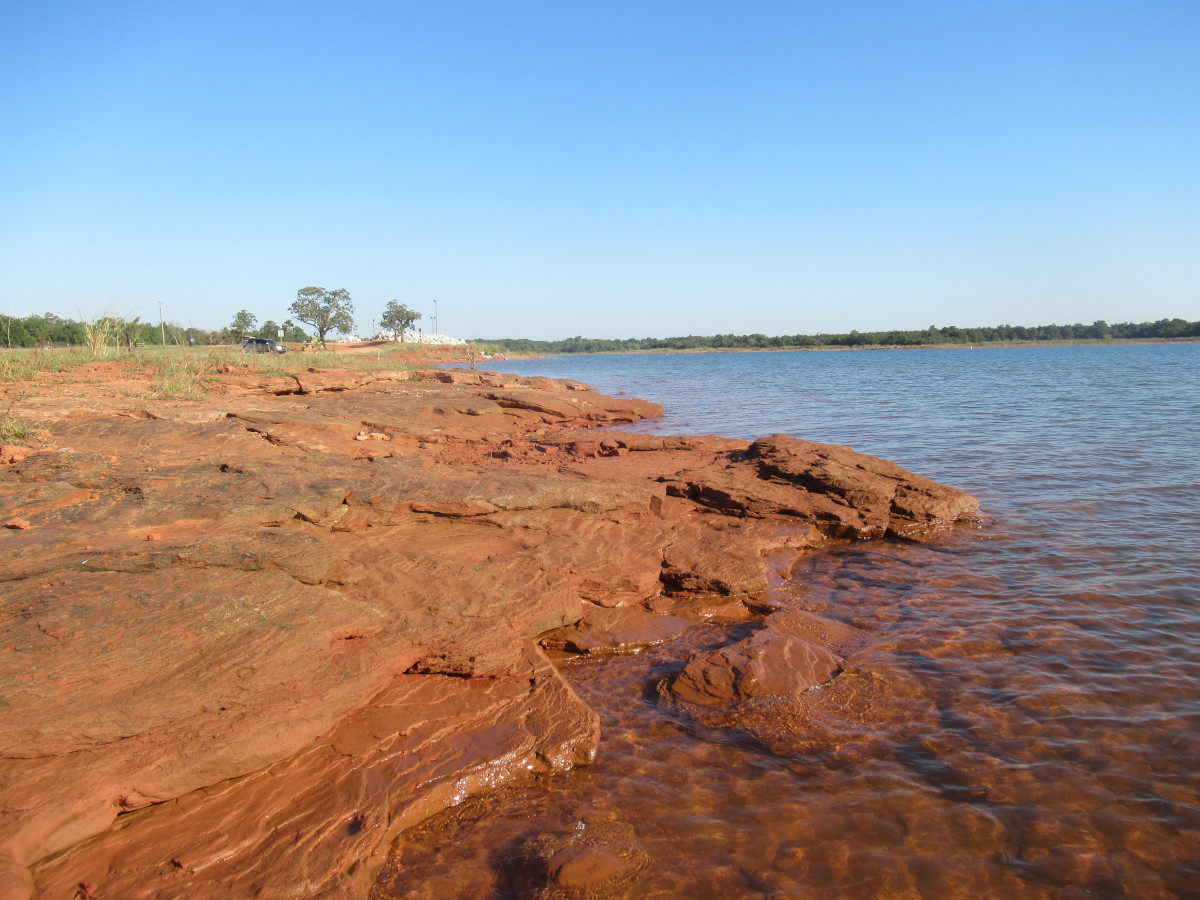
In this area of the lake, the old shoreline road is still open to human powered rides and feet, paws or hooves. It was a pleasant ride, and this next image shows that the rock layer extends quite some ways along the shoreline. It was quieter here as it’s sheltered from the southerly breeze, which was driving the waves today.

The construction crews finally posted a banner on this massive ten acres of concrete indicating that this facility will be the new home of Pratt & Whitney. They are still laying a few more concrete pads to fill in some gaps, but the steel framing for the building has already begun showing up. They aren’t wasting any time on this thing. Every time I come out here, the progress is noticeable. This is just a quarter-mile from the southern edge of Tinker AFB, a major aircraft repair depot, so the reason they are building here should be obvious.

Posted in photography | Tagged , , , | 2 Comments

The Message above All

Our government lies — reflexively, instinctively. When did it not lie? The problem is that the MSM operates as an arm of the government, and so the MSM lies psychotically, as well. I can’t give you links to the statistical details because no one is allowed to publish the facts. You have to glean them from the alternative sources.

Here’s what you might learn: The lockdowns, quarantines and masking rules of the COVID pandemic were in themselves more deadly in the long run than if we had simply done nothing and let the disease run rampant. No lives were saved by the restrictions; many were lost because of them. When you look at the long term results of just the economic losses alone, more people have already died, and continue to die, from economic effects of restrictions than would have died from the disease. A few governments in the world refused to play along with the hysteria, and their results are a lot better than every country that enforced the so-called health mandates.

The government will do all it can to prevent you from learning that, and particularly to prevent you sharing that. And Big Technology has agreed to silence it, a censorship that has been rather effective. Any message differing from that of the government has been suppressed. The author of the linked article notes: “Without censorship, we might have won that debate, and if so, the world could have moved along a different and better path in the last three and a half years, with less death and less suffering.”

Now, brace yourself: This has nothing to do with our spiritual goals or the gospel message. That kind of censorship and careless human slaughter is not what nailed Jesus to the Cross. Rather, it’s merely a symptom of what He died for. If you get all entangled with fighting that battle, you will have abandoned the gospel of Jesus Christ.

Here’s the paradox: If you obey the Word, your life here in this fallen world will be as good as it possibly can be. The problem is how we define “good”. God keeps His promises, but His promises are on the far side of the Cross. The Cross was Christ’s greatest victory; most humans don’t get that. You have to die to live. If all you understand is the literal meanings of the words, you don’t understand anything that matters.

In pursuit of our Father’s glory, there is a utility to fighting censorship. The Bible recognizes no kind of “rights” at all. It’s the wrong approach to what God considers important. What really matters is our feudal submission to (AKA, faith in) Christ, and the personal relationship that comes with it. But if I take some actions to support or defend the US 1st Amendment, it does help keep the door open for the gospel, as well.

However, at the root of things, it’s not a question of having the “right” to share the gospel. Rather, we have a mandate to do so, rights and censorship be damned. We should gladly face the sword as the price of shouting our message from the housetops. Of course, that’s an image, a symbol of our commitment. We don’t so much resist as persist.

My loyalty is not to the 1st Amendment, but to the gospel. They are not the same thing. So the question is purely tactical whether I might help to defend the 1st Amendment. It is the gospel itself which demands I refuse to vaxx (AKA, “clot shot”), never mind the US Constitution or principles of liberty. There is no such thing as “God-given rights”; those are simply man-made reasonings. You could say that this popular phrase references a different god. None of that stuff reflects the Bible, despite the rabid assertion that it does.

I will ignore government laws, and the US Constitution, and principles of liberty, whenever they conflict with my calling and mission in Christ. But as long as those things aren’t in the way, I don’t mind playing along. So, I’ll use whatever means present themselves as amenable to the message.

As long as Big Tech and the cloud services ignore me, and don’t hinder my message, I’ll use them. I’m not an activist about that stuff. But if I find them a hindrance, I’ll go around them or avoid them, and only to the degree they are a problem. At some point, there’s no doubt they’ll be too much trouble, but for now, it’s working just fine.

Example: Google has already done things to hinder people spreading the gospel (closing accounts of people who are assertively anti-woke), so I don’t trust them with my work very much. I’m careful, very selective of what I do with their software and storage. I recommend as much to everyone. By contrast, Microsoft online services haven’t done that, so I’ll use their storage and transmission of my work more freely. I recommend it for others.

Of course, Windows is somewhat vulnerable to snooping and censorship at the OS level, but it’s a toss up whether I use Windows or not. On my current hardware, not. I make no recommendations on that. Without the OS, the online version of MS Office is a hindrance on Linux, even with their own browser and a paid subscription. Office Online does not work the same as Office installed on a Windows computer. It keeps changing the format automatically, and won’t let me change it back to what I believe I need. Instead, I use an older version of Office that runs on Linux/WINE.

Google’s Chromebooks are too much hassle, but Android devices are inescapable. I’m not aware of Apple/Mac interfering with the gospel, but I simply cannot afford their stuff, so it’s not an issue right now. I’m open to trying it out when it comes within reach, simply because their privacy policies are rather strong.

But you see how I’m rather mercenary about computer technology. There’s a balance between privacy and freedom versus the necessity of using the existing means. It’s not worth it for me digging much farther into the technology itself. The same goes with concerns about liberty and rights. Those are not central concerns; they aren’t major elements of my calling and mission.

Theories and speculation about how this will all end in a harsh globalist government don’t move me. The gospel indicates any such victory will be short-lived. Frankly, I find that threat unlikely in the first place. Some Americans will face that, but not all of us. And there is absolutely nothing I can do to stop it. Most of those who say they will unite to fight it won’t. They talk big, but I’ve seen them cut and run too often. There’s no utility in expecting any meaningful resistance at the street level. Your best bet is the state government where you live, and that may not be worth much, either. But a globalist regime is built on lies, so it won’t last long even if it does come to full power.

Still, I’d come closer to fighting any human government over the freedom to present my message than I would any other form of resistance. Yeah, that means there may be a limited utility in the 2nd Amendment, too. We’ll see; it’s not a core principle of the gospel message, but I am not averse to shedding blood in the process, mine or anyone else’s.

Posted in sanity | Tagged , , , , , , | 1 Comment

NT Doctrine — 1 Corinthians 8

The letter the Corinthians wrote to Paul had a lot of questions. Among them was the issue of food offered to idols. We sense that Paul is quoting their comments in that letter, but it’s hard to be sure without quotation marks.

Just 50 miles from Athens, Corinth boasted a lot of highly rational thinkers who prided themselves on being less superstitious than their fellow Greeks. Sure, we recognize that our brains are capable of grasping factual information. Sadly, the more factual knowledge you think you possess, the less moral truth you can see. The fallen flesh takes great pride in its own talents, inflating your opinion of yourself. What really matters is not your erudition, but your submission — to Christ.

It can be taken as fact that there is only one God. All those pagan idols really mean nothing. Most of humanity seems to defer to about as many false deities as they do human rulers. But it’s not enough to adhere to the one true God as a fact; you must know Him and recognize His mastery over our human existence.

Not everyone has that sense of assurance. They instinctively worry that our Father is as venal as the pagan deities of mythology. And they reflexively worry that those other gods might somehow still be real, and that the Father is as easily provoked to jealousy as any human lord. Then again, there were also Jewish Christians who suffered a similar overly sensitive conscience about such things. We could say that Talmudism is little more than superstition, since it obscured Jehovah’s personality and true nature.

In a place like Corinth, it was common for pagans to support their favorite deities by cooking fancy dishes and bringing them as offerings to the temples. What the temple staff didn’t eat was sold in some kind of open market, with accommodations to eat on site. It was as close to fast food as the ancients ever got. It had the effect of making meat a lot easier to include in your diet in a society that seldom offered meat in small portions already cooked.

Some of the Corinthian Christians were intellectuals who never took seriously the pagan associations. They had no conscience about eating in the temple bazaars. They were elitist about it, snickering at those who still labored under the burden of superstition. Should the elitists prod someone with a weaker conscience into eating the temple cuisine, it could destroy the latter’s faith. The internal battle was not healthy; they still needed time with the Lord to get used that level of freedom.

Paul agreed that eating such food made no real difference to our souls. Despite Jewish obsessions about it, Jesus and His disciples had taught that Jews were missing the point about kosher, and Paul understood this very clearly. The real sin here was the arrogant elitism that snickered at overly sensitive consciences. Paul’s attitude was to seek awareness of where his companions stood on things. If they had a weak conscience, it was a lot easier to avoid meat altogether and just eat what was safe.

God does not promote smug elitism.

Posted in bible | Tagged , , , | Comments Off on NT Doctrine — 1 Corinthians 8

Urban Journey 04

First, a random photo from my most recent visit to Draper Lake. Along the main trail itself, there was simply too much uncontrolled greenery to get any good photos. However, I got off the trail and visited the southern shore of the lake for this shot. Crews had done some work and this part of the shoreline is off limits to bicycles, but not up on the cut bank.

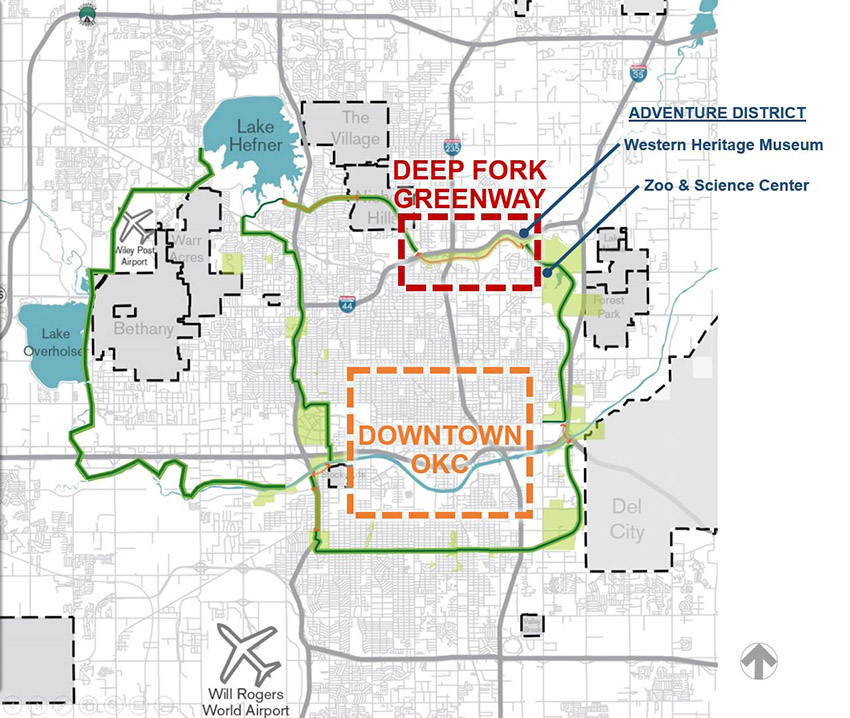
This map was released by OKC Parks and Recreation back when the contract was announced. The red box at the top shows the relative location of the proposed Deep Fork Greenway Trail. It was broken into 4 phases, and yesterday I visited Phase 1, the eastern end. It’s been under construction for several months. The crew isn’t large and weather has caused some delays, not to mention a couple of surprises.

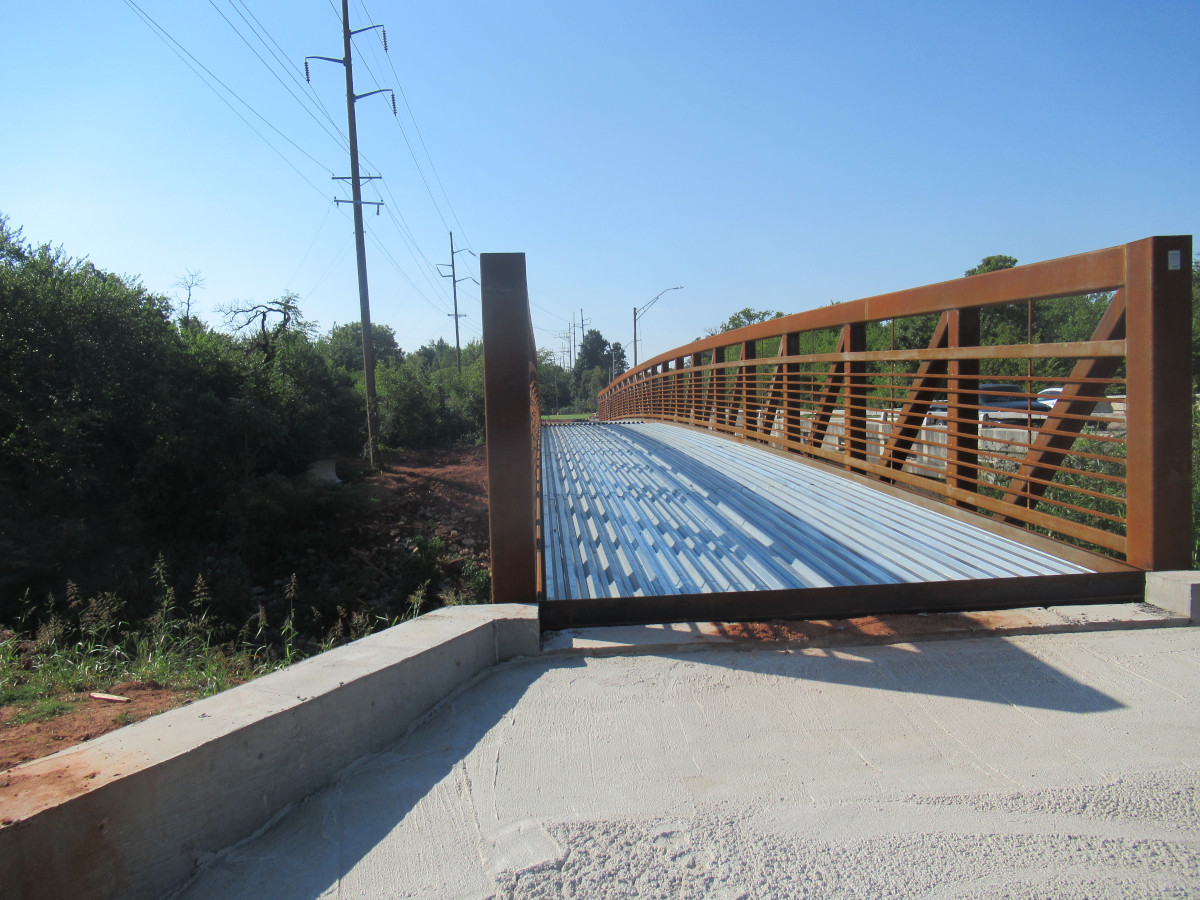
This bridge is quite new. I wasn’t expecting the city to use concrete decking. That means the frame is put in place first, as we’ll see later, and the concrete deck is added afterward. However, I’m not surprised to see that the bikeway bridge is separate from the roadway bridge. The latter is already on the list for upgrade/replacement some time later. I’m counting on this project to be finished late; almost nothing in OKC is done on time.

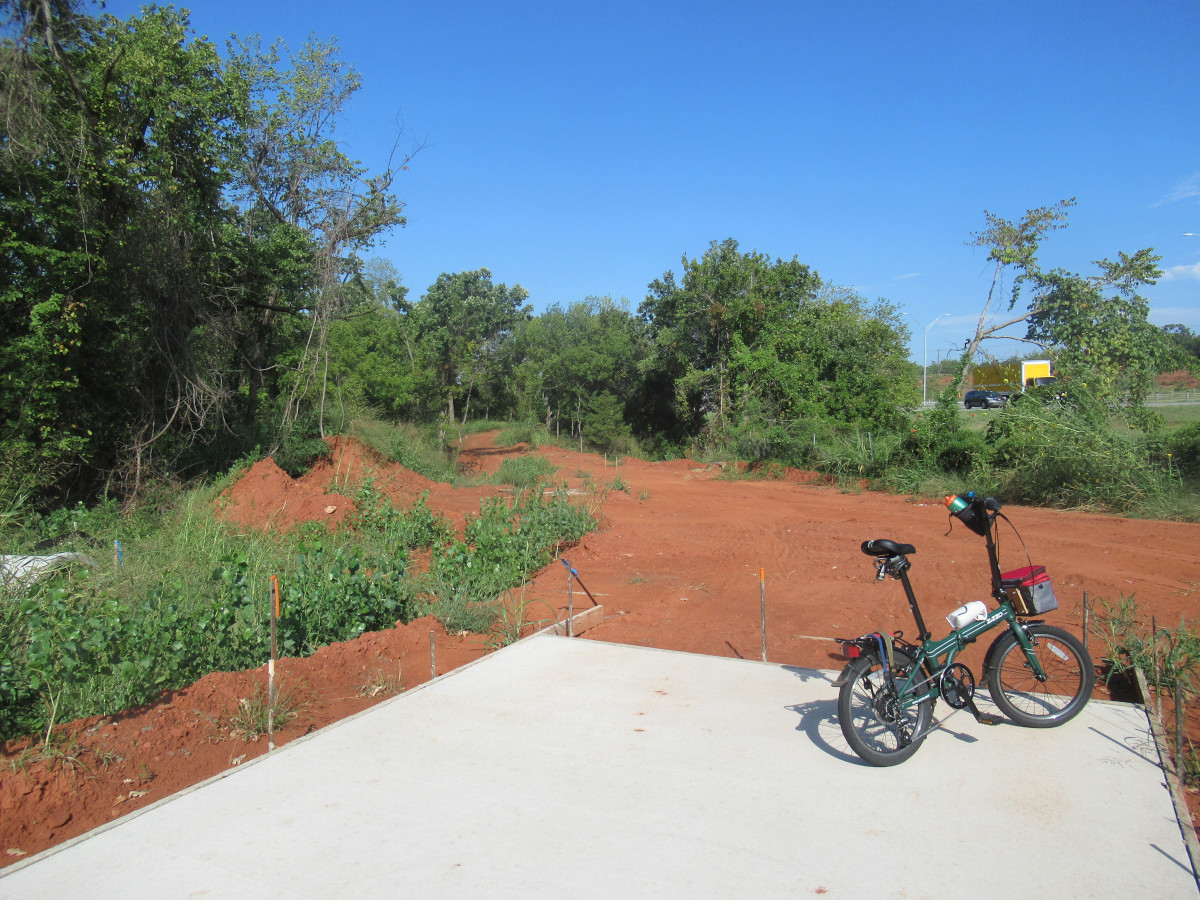
The trail ends abruptly after about one-third of a mile winding along the Deep Fork River bank. This part has been completed for months. I encountered what I took to be an inspector in a pick-up coming the other way; he just waved. I rode on the dirt for a ways because I suspected there was some cause for the unfinished work.

This is the cause. From what I could discern, having assisted with dirt work in the past, there was something buried here that required attention before it could be paved over. I couldn’t see anything in particular, but the digging pattern indicates something was there hindering the placement of a retaining wall, and it probably required waiting for whomever was legally responsible for it to do something with it. The contract would not likely have covered such surprises.

On the western end of Phase 1 is this undecked bridge along Kelly Avenue. You can see how it works. There is a stout corrugated steel bottom upon which the concrete is poured. Phase 2 will begin across the bridge, and then across the street westward (to the right in the image). It will run along the south bank of Deep Fork River near a historic mansion hidden in a forest. I believe the city owns the mansion and land, but it’s under preservation. Since it’s not ready for visitors, no one gets to see it without special arrangements.

Posted in photography | Tagged , , , | 2 Comments