New Biking Facilities in OKC

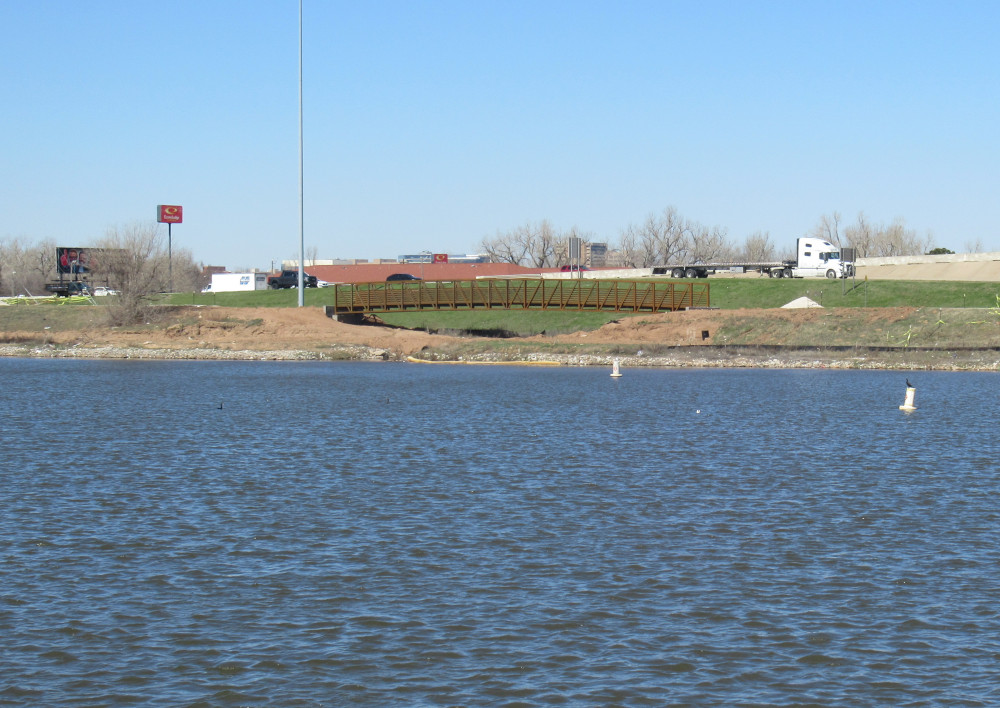
While not officially open for use, this bridge represents the near completion of the newest bikeway, extending the north River Trail all the way to the Katy Trail. I missed the placement of this last bridge. Unlike other bike bridges in the OKC Metro, this one didn’t have a prominent bottom frame. Instead, the upper frame is bigger and heavier. The sides of this bridge are above head height. And I’m not the only cyclist ignoring the barriers and riding this trail already.

OKC didn’t play tightwad on this project. The amount of materials and work that went into this is substantial. There wasn’t too much room left when this bridge was built decades ago, but this isn’t dangerously close to ride under, nor is it likely to flood easily, since the entire section of the river for several miles has massive flood controls installed. The city actually put this up for a vote to collect extra sales taxes and so forth to fund it as a series of projects going back decades.

The trail was squeezed between the river and Interstate 40. Here, the floodway offered enough structure to put the trail on top, but that meant you are almost within arms’ reach of the vehicles passing on the highway. I’m not kidding; the “shoulder” of the interstate is almost nonexistent at this point. This spot is also no place for conversation, as you might imagine. Still, it’s well built and should last for quite some years.

This trail starts at the Boathouse District, AKA Riversports facility. Some private sponsors got involved and they constructed a “basecamp” for cyclists. There will be safety classes (mostly for kids) and lots of training facility, as the following images will demonstrate. This is all supposed to officially open in about six months. That’s when they new trail goes live, as well. However, this stuff is wide open for use already, no fees. It will be operated mostly by the volunteers, from what I hear.

From the top of the converted shipping container in the previous photo, you can see the full layout of the “pump track” provided by Velosolutions. It’s for all wheels, not just bicycles. I rode across it, but it’s not my thing. Still, it’s nice to see this kind of stuff. You can find videos online to show it all off (beware, the video features country music performed by someone with a foreign accent).

I believe these fabricated loops are relatively new, and they appeared to me too small for adult riders. I’m sure it’s all part of the skills development concept of the whole park. There are several of these scattered across one part of the park. I’ve seen local news videos of kids using them, which tends to confirm my impression.

There’s also a real mountain bike loop with elevated features. You can find a video of it here. In the background is at least one dirt hill that appears to be some part of the whole thing. I didn’t investigate because it’s not my kind of thing. I was much more interested in how the city invested so much into biking in the past few years.

As of now, I no longer have to ride through the hospital district and Bricktown to get to River Trails. While there remains one patch lacking pavement, the city knows cyclists are using the entire trail now that the last bridge is installed. It’s just a matter of time before the near-useless barriers will be removed. I can now come in on NE 4th and turn left along the river bank, and ride away from motor traffic all the way to the Boathouse, several miles, and it connects directly with the north River Trail.

Posted in cycling, photography | Tagged , , | 2 Comments

Getting Around It

The banking crisis is just another part of an ongoing, long-term plan of passive-aggressive conquest. From Paul Craig Roberts:

To summarize, smaller conservative and prudent banks that invested in “safe” assets such as US Treasury bonds face bank runs. Larger banks with massive derivative risks are one bond trader’s mistake away from exploding the financial system. The 2008 crisis and the potential for more crises rests entirely on the repeal of Glass-Steagall and the enactment of Frank-Dodd. We are looking at the total, complete failure of intelligence on the part of the US government and economists. Their handiwork has the capability of collapsing the existing financial system of the world. It was the work of total idiots.

There is, of course, the question: Is this real stupidity or is a plot unfolding to collapse the financial system as we have known it in order to “save” us with the introduction of central bank digital currency? Are we passing from the remnants of democracy and self-government into total tyranny?

A study finds that 200 US banks face the same risk as those that destroyed Silicon Valley Bank. The Federal Reserve’s higher interest rates are destroying the banks’ solvency. Yet the Federal Reserve has not backed off its disastrous policy, and with Credit Suisse’s failure looming, the EU central bank raised interest rates! Yes, people are stupid. But are they this stupid? Could this be intentional with a secret agenda in mind such as digital currency?

I believe it is a secret agenda. The implementation of a bank-controlled digital currency means the government gets to decide how you spend your money, and eventually, whether you get to keep it in the first place.

This is part of a larger pattern. Let’s put it into perspective.

Biblical Law is not reasonable; it’s a matter of faith. You can gin up all kinds of reasoning, and maybe even some practical outcomes, as the motivation for accepting something that resembles Biblical Law, but only at the cost of ignoring the miraculous hand of God in that law.

A core element in neocon policy is the cynical embrace of a moral code to bring about a stable and prosperous society, thus enabling a military conquest policy over any foreign government that dares to refuse their imperial economic and political dominance. They don’t actually believe in the God of the Bible, but raise up some body of law and custom based on human reason and traditions, and they call it Judeo-Christian values, making it a false god. It bears only a superficial resemblance to the Covenant of Moses or the teachings of Christ.

But there are too many people who resist such a value system, and not merely because it’s bogus. Rather, they are morally rebellious and promote an alternative that is either secular or pagan, but the result is about the same; it’s feminist at heart. Thus, we have globalism rising from the roots of feminism. The neocons were once part of that crowd, but as the left became more radical, the neocons left to form their own agenda. Instead, the neocons hijacked the conservative movement. They tolerate the dominance of the Zionist Christian voting block.

You really need to understand that neocons are not Zionist, but are using Zionists to get things done. Yes, “neocon” is a label that points back to the Jewish ethnic agenda, but they would prefer not to have a home state for Jews. It’s pure elitism. Their moral cover depends on Jews having no “home” for refuge from persecution. The claim to being a poor, persecuted minority (essential to their manipulation) is weakened by the existence of a political entity like Israel.

Get this: Jews and the Jewish elite are two different things. The Pharisees have always been contemptuous of the peasants; “these people are accursed, not knowing the Law” (referring to the Talmud). This attitude is part of the Jewish elite ethnic agenda, which no longer includes such a strong religious element. It’s not exactly Talmudic, but is influenced by Talmudic ambitions as expressed in the False Messianic Expectations (see the Wilderness Temptations of Christ). At any rate, most Jews worldwide (the peasants) are leftist, and some are Zionist, whereas the core elite leadership is mostly neocon, a separate ideology. The stated neocon agenda is, for the most part, the expression of the Jewish ethnic agenda — manipulate the Gentile world into chaos and then take over as the saviors.

Thus, a neocon like Netanyahu can appear to be Zionist friendly, but in the long run, he’s trying to destroy the modern State of Israel as it has existed until now. That state has a very strong leftist voting block, and a competing orthodox voting block. Neither is amenable to neocon leadership. Netanyahu will at the least remake government so that the neocons can dominate without resistance. Thus, it can become the home of the neocon agenda, using military force to undermine and destroy any government that resists neocon global dominance. It makes Israel the single biggest thorn in the side of the whole world. If his policy destroys Israel, so much the better, to restore the image of Jews as having no refuge in this world.

It may not have started out that way, but in practice, the neocons are herding the globalists, preparing to push them out of the way at some point down the road. They also herd Zionists to get a voting block with money to support their agenda without really having to promote their agenda openly as neocon, which was somewhat discredited under Bush II.

Thus, globalist policy agenda items are often steered by neocons under various guises, because the neocons will use those same oppressive controls for their own policies later down the road. The Jewish elite agenda is not precisely to destroy the West, but to humble it under their authority by destroying the Gentile resistance to Jewish dominance. Jews hate us, but want very much to enslave us.

The globalist agenda to censor anything that isn’t “woke” enough is just what the neocons hope to hijack later. The effects of seizing banking will work a whole lot better if everything, including banking, is controlled via the Net. It’s the power of a deep conviction that fires one’s whole life, but without the messiness of having to inculcate such a fire by personal interaction. It simply becomes impossible to do anything that isn’t controlled by those beliefs, never mind what is inside your soul. You will have no leverage whatsoever to resist.

In other words, the neocons have learned from at least some of their mistakes. What we see in the Netanyahu takeover of Israel’s government is their dream for the entire world. But if the globalists will implement the mechanism for them, why not let them run with it? Once the insane wokism becomes intolerable, the neocons can swoop in and bring us some relief. The pattern has already been established by using various “sane” lefties as foils to the insane wokism, like Jordan Peterson. He’s a lefty globalist, but everyone ignores that because he promotes a saner brand of leftism. Neocons only pretend to be right-wing; they are still secretly lefty, just the “sane” version that dominated Democrats before they were radicalized by the New Left.

As we’ve often noted before: The Radix Fidem way is to step back from all of this. We have an otherworldly message, not a competing political agenda. Yes, we could come up with better policies, but the foundation of any better human government is Biblical Law, or what Catacomb Resident calls “the Covenant” — AKA, the Code of Noah. Anything less does not warrant our involvement.

Instead, we must pray and prepare for ways to get around the human political agenda and still present our message to the world.


Posted in sanity | Tagged , , , , , , , , , , | 3 Comments

NT Doctrine — Acts 14

While it was certain the Gentiles would respond more strongly, Paul and Barnabas continued the same standard approach in each city, when possible. They would start with the Jewish synagogue and offer the gospel message to Jews first. So they did at Iconium.

As usual, the message that welcomed Gentiles without having to convert to Judaism first caused trouble, but it took a while in Iconium. Meanwhile, there were plenty of signs and miracles to support the message. Those Jews who still rejected the gospel eventually stirred up a mob against Paul and Barnabas. This time, the city itself was just about evenly divided between those who hated the missionaries and those who favored them. When the haters had a firm plan to stone the two, the plot leaked and the two left town.

This time they headed south and a bit west over rolling hills to Lystra. It would have been about a day’s hike. The unexcavated mound today stands among farm fields to the west outside the village of Hatunsaray, in the Meram District of Turkey. Here I’ll quote a couple of paragraphs from my previous commentary:

This was a distinctly Phrygian city, with almost no Jews, so no synagogue. The preaching took place in the public forum, probably the city square just inside the main gates. While preaching, Paul realized that a man born crippled had gained complete trust in Christ, sufficient to be healed. Paul directed the man to stand, which the man did with great enthusiasm. The problem was the context. These folks had a pagan temple outside the city gates, and at some point had simply renamed it as a temple of Zeus/Jupiter, the closest from the Greek/Roman pantheon to their ancient deity. There had been some legends about Zeus, with his spokesman Hermes, visiting the area and performing miracles. The locals seized upon this association, and began chattering excitedly in their native dialect, which Paul and Barnabas didn’t understand. Since Paul was younger and speaking, they assumed he was Hermes the Messenger, while the older Barnabas was Zeus, the King of gods. A few went off to fetch the temple priests and a sacrifice fit for their patron deity. When Paul and Barnabas realized what was happening, they reacted as typical Jews, tearing their garments to symbolize distress over blasphemy.

The approach Paul used was tailored to those lacking knowledge of Jewish religion. They first protested that they were mere men. The whole point of their message was to turn them away from useless animal sacrifices to dead gods, and to embrace the One True Living God. He is described as the one who made all things, who tolerated the nations wandering from the true revelation. We note in passing God’s tolerance was in part due to the failure of Israel to get the message out. Meanwhile, He made sure nature testified of Him, by having regular seasons and predictable crops. This hearkens back to the Covenant of Noah, which remained in force among all Gentile nations. It was still difficult to dissuade the local priests from leading a sacrificial celebration for the city residents, as Paul surely taught them that Christ had become the final and eternal sacrifice under all covenants.

The two stayed for some time, but eventually the Jewish troublemakers from Antioch and Iconium caught up with them. Taking advantage of the residual tension from the misunderstanding with the local priests, these agitators stirred up a mob to stone Paul and drag him out of the city. As Barnabas and some Christians gathered around what they thought was Paul’s dead body, he simply rose to his feet and went back into the city.

The next day they traveled several days toward the border of the Roman province of Cilicia. They would have passed an extinct volcano, a ring of snow-capped peaks with a high bowl valley nestled in the middle. East of there was the city of Derbe, whose ruins have been partially excavated. The mound stands today just below the Cilician mountain range that separated Paul from his homeland and the city of Tarsus. In Derbe there was no drama, and they stayed quite some time.

This has now been at least a couple of months since the two left the church at Antioch. There was no way they could have traveled on the main road through the Cilician Gates (a narrow pass, the only way through the range). At that time, western Cilicia was ruled by local kings who had vigorously guarded their pagan religions under Roman protection. It seems Jews did not travel that route, and just passing through would have been pretty risky for Christian preachers. So they retraced their journey, stopping to encourage the new churches they had planted along the way and ordaining elders.

As was typical of the church in Jerusalem, elders were administrative leaders, rather like heads of households. Each church was organized like a synagogue under one or more elders, and the members were taught to regard each other as one family. Eventually they would have added men playing a priestly role, and called them pastors, but that came later. It was critical to encourage the churches to become strong family units to face the persecution that was just getting started.

Thus, Luke tells us how they eventually made their way back to the home church of Antioch. When they delivered their report, it brought considerable rejoicing over the strong response from among Gentiles. The two missionaries stayed home for at least a year.

Posted in bible | Tagged , , , | Comments Off on NT Doctrine — Acts 14

Another Church Attack

I never get tired of defending God’s truth. I do get tired of all the ways people try to attack that truth.

If you are paying attention to the Scripture, you know that this could not be the End Times. The one defining factor of the End Times is an effort to oppress faith itself. Religious oppression is common to mankind from beginning to end, but genuine attacks on faith are quite rare. Right now, human governments aren’t paying any attention to genuine faith. Their focus is on other kinds of power. Thus, the only source of attack on genuine faith is from religious folks who are threatened by a true biblical faith.

That doesn’t mean the attacks from Zionists. Indeed, genuine biblical truth does not support Zionism. If we tell the true story about Judaism/Talmudism and how it continues to influence the Jewish tribal agenda of today, then it threatens the Jewish lie that they are still God’s Chosen. They are not. Telling that truth threatens the Zionist agenda. Once you understand the centrality of covenants in God’s revelation and and in His dealing with humanity, you realize that the Covenant of Moses died on the Cross, and the Covenant of Christ is the only covenant God offers. The only way to be His Chosen today is in Christ.

And that’s the key to understanding a genuine attack on faith itself. It’s really not about the Jews, because their agenda isn’t really about the issue of faith. Things have drifted quite a ways since the First Century Judaizers fanned out across the Mediterranean Basin to undermine the churches by attacking genuine Christian faith. The churches became corrupt, but genuine faith still stands. Jews went on to fight other battles.

Thus, the current attack on true faith comes from church folks.

This is an example of that. The podcast is more than two hours long, and the speaker drones on and on about something he regards as too complicated to address in brief. He’s wrong. His argument is pretty simple, and it boils down to an effort to paint genuine faith as Gnosticism. He does a fair job of it, if you aren’t really up on the religious and philosophical debate he attempts to address.

On the one hand, there’s plenty of churches that muddle through this minefield without a clear sense of purpose, except to exist as a corporate entertainment franchise. They appear to be movers and shakers, and their doctrinal purity is never much of an issue. On the other hand, among churches with a strong historical legacy to defend, there’s typically a potent reliance on reason. They simply redefine the word “faith” to mean a bundle of theological doctrine, and each different tradition asserts their bundle is the only true biblical version, to the exclusion of others.

They all arrive at these theological positions by relying on reason, not the mystical union of man submitting to God personally. It’s all of that pagan Aristotelian thing again, where they insist that faith is reasonable, but some reason they cannot find a path to unity with others. That’s because the key failure of reason is that it always strives to justify whatever it is a man really wants, and they all want something different. That’s how reason works; it will seek to find “objective rules” that justify one particular kind of fleshly lusts. Those, while those lusts are highly cloaked, they haven’t gone away. Human reason is a function of fallen flesh, and it never escapes the Curse of our fallen nature.

They all still believe that human reason is not fallen, and can be perfected. They then try to define (restrict) God according to reason, which is just human rebellion in disguise.

It’s not that reason is useless, but that is must be subject to faith. And faith is not something in your head, but in your heart. The Bible itself suggests the heart is superior to the mind, though you won’t find it clearly stated anywhere. Here’s the kicker: The real scholars of the Ancient Near Eastern cultures, of which the Hebrew people were a part, will tell you that they all uniformly rejected the supremacy of reason and trusted first in the heart. The objects of their faith varied widely, but the principle of faith over reason was unanimous with folks like Abraham and all of his descendants. Every educated man knew that, so it wasn’t necessary to state such a principle.

God revealed Himself in those terms. Further, He specifically built the culture of the Hebrews and their language, because His truth can be captured only in the mysticism of faith over reason. Hebrew mysticism is the defining character of Hebrew scholarship, and Jesus was a Hebrew mystic.

So, in that linked podcast, the speaker tries to make the case that a non-rational approach is “Gnosticism” because it sets aside fact and reason, and asserts a truth that comes down from above. How does he imagine God spoke to Moses? How did God speak to Balaam, who went into a trance of sorts, or Elisha who did the same thing when the kings asked about the coming battle (2 Kings 3)? Elisha called for a praise musician so he could enter a proper contemplative state to hear from God. And how about Jesus and His penchant for climbing mountains in darkness where He would could turn His face to the blowing winds and hear the voice of His Father?

Oh, but that’s “Gnosticism” according to that podcast. It’s as if we can’t afford to trust God to meet us when we move out of the realm of reason. That’s “out there” in non-rational space where anything could happen. Yep, there’s a risk. If you don’t first embrace the God of Creation, then you are in highly unprotected space. But it’s not that hard to get comfortable with that space and make God your Master. The Bible talks about it a great deal, and what you should expect to experience when you get there. It’s not just “spiritual space” where demons roam by themselves; the angels outnumber them two-to-one. We are talking about heart space where God meets us, unless we haven’t bothered to submit to Him in feudal commitment. And that feudal commitment is what the word “faith” actually means. It means meeting personally with God in your heart. The Bible specifically says the heart can be perfected, but not the intellect.

Of course, there’s one other thing the podcast doesn’t approach, at least not the part I listened to (I didn’t have two hours to waste on something like that): If you venture off out of rational space, you won’t end up in the preferred safe behavior of church leaders. Specific to that podcast was the attempt to use religion to justify a very specific brand of political libertarian belief. Yeah, of course Jesus taught that — not! Jesus taught tribal feudalism, His Father’s only provision for how we should live on this earth.

Right now, the attacks on faith have been pretty weak. I’ve gotten more grief from Zionists on this blog. However, Zionists are in a weaker position, so they tend to be more reactive. Church folks still rule the vast sweep of religious western folks. If their position should ever weaken, expect them to start being more activist. Until that happens, the biggest threat to this blog is Zionism.

Posted in teaching | Tagged , , , , , , | 2 Comments

Ukraine War Is a Mere Distraction

The war in Ukraine will not end in a clear winner. However, if it comes to an end, it will be on Russia’s terms. Should it not end, it will morph into a war between Russia and the West, a separate event eclipsing the war in Ukraine to the point it becomes by itself meaningless.

Any analysis of the Ukraine fighting that tries to paint a clear winner is a flat out lie. There is no moral high ground. Two thugs are duking it out in a mud pit. It’s simply that Russia isn’t quite as deep in the moral pit as Ukraine is. Russia’s move makes some sense: defending the Russian people who live in Ukraine from a nasty and hateful genocide. As long as you ignore the genocidal activity Ukraine conducted since the Maidan Revolt, you will never understand anything that matters about the fighting in Ukraine. Russia’s invasion is not simple malevolence.

Pure and simple malevolence has never once explained any human activity; there is always a perceived self-interest. When you take a wide view of the situation in Russia, Putin’s self-interest is to at least appear to protect the Russian people. His is a nationalist role. His whole image is based on leading the nation to something that at least feels better than the Soviet experience, and restoring the feeling of being uniquely Russian and not some bastard child of the West. The invasion of Ukraine was politically the least dangerous thing to do.

And you need to understand that a large portion of the Soviet system of government was rooted deeply in the ancient Russian way of life; it was not pure communism by any means. The Soviet system would have failed without resurrecting suppressed Russian society. That portion of their identity still stands. They tend to view the Soviet period as externally imposed, and any residual nostalgia in the elder population rests on the simple assertion that it was better than the Imperial Russia that came before. They recall the empire as squelching their ancient heritage. By contrast, Ukraine has no historical identity at all. It is an artificial construct of very recent vintage, so Nazism had no competition when it was planted there.

At any rate, Russia has the advantage, but they aren’t doing a really good job of it. Their system is better than Ukraine’s, but it’s a better version of the same system. Both are riddled with a particular brand of post-soviet corruption, but it’s far worse in Ukraine; it has been since the end of the USSR. Further, the economic weight behind Russia is exponentially larger. The combined investment of western resources in Ukraine’s military effort is still smaller than Russia’s, and western investment is not nearly as consistent. Further, Ukraine’s corruption is wasting those resources far faster than they can be brought into play.

Yes, the Ukraine could have done better, but that was never their intentions. The whole point has been from the beginning to sucker Russia into a quagmire. The government in Ukraine is just a puppet regime. It serves a far distant agenda, and the people and land of Ukraine are just expendable assets. As long as you waste energy focusing on the war in Ukraine, you will miss what’s really happening.

The US government itself is just a servant in this long-term dream. There’s no certainty that our Congress and POTUS will carry through on the plan. We can pray they fail to follow higher orders from the neocons. We can seek the Lord’s face that the US won’t push as far as the neocons would like, that somehow a move of reluctance will rise. If that prayer fails, it’s almost certain we will see an exchange of weapons of mass destruction between the West and Russia, and this will certainly drag China into it. The neocons have this crazy notion that they can survive a nuclear exchange, whether the US does or not.

I’m convinced the West would lose that war. Not because of some systemic analysis, but I say that because the US is clearly more repugnant to God than the rest of the world. We have offended Him in ways the rest of the world together has not dared. We have no hedge from God; it’s just a matter of time. Our opponents are easily less defiled, and there’s good prophetic reason to see them as having a future far beyond the end of the US.

If Russia and China can ride out the storm, they won’t have long to wait for the collapse of the West.

Posted in social sciences | Tagged , , , , | Comments Off on Ukraine War Is a Mere Distraction

NT Doctrine — Acts 13:13-52

After returning to Antioch, there came a time when prophets praying got the word to send out Paul and Barnabas on a missionary journey. They took John Mark along. The first headed to Barnabas’s home territory, the Island of Cyprus. It was there they had the encounter with Bar-jesus, the Jewish sorcerer and false prophet, who tried to keep them from sharing the gospel with the local proconsul, Sergius Paulus. Paul cursed him with temporary blindness, to bring a literal match to the fog of his moral blindness.

From there, the headed to the Turkish coast and walked inland to Perga, whose ruins today stand in the modern Turkish town of Aksu. There was a large Jewish community here. For some reason, John Mark bailed out on them and returned home to Jerusalem. Meanwhile, the intrepid pair hiked a very difficult route through the Taurus Mountains northward along the Kestros River (AKA Cestrus), along the shore of Lake Limnai, and up to edge of the hills where another Antioch stood in the district of Pisidia. This city also had a large Jewish community and a synagogue.

It was common for synagogues to ask Jewish visitors to address the congregation with any worthwhile message. Paul obliged, citing enough history of Israel to emphasize how Jehovah had remained faithful despite the whining and moral wandering of the nation. Everyone thought of King David’s reign as the golden age for Israel. And it was King David who prophesied so clearly of a Messiah who would take up his role. Paul mentioned specifically that the Messiah would not rot in His grave, but would rise back to life.

The only person who qualified under this prophecy was Jesus. Paul notes that John the Baptist identified Him as the Messiah. But the Jewish leadership didn’t recognize Him, and had Him executed. This did not hinder Jesus, but He rose from death and was seen by dozens of people for over a month afterward.

Then Paul relates how Jesus fulfilled the Covenant of Moses and opened His own new covenant. In this, He offers redemption on a level Moses could not have offered. He quotes from Malachi, warning them not to reject their Messiah.

Every synagogue had Gentiles who attended the services. As everyone filed out of this meeting, the Gentile visitors asked Paul and Barnabas to come back and teach some more of this message the next Sabbath. Moreover, some of the Jews joined these folks in following Paul and Barnabas around, marveling at this powerful teaching. So, when the next Sabbath rolled around, the curious Gentiles had packed the synagogue house.

This didn’t sit well with the Jewish members. Whatever was going on here, it wasn’t for them, but these two were using their synagogue to promote something they decided was too easy. As soon as they realized that the peculiarities of the Law were no longer required under this Messiah, they began stirring up trouble, blaspheming the name of Jesus.

Paul and Barnabas made it clear that, since Jews were rejecting their own Messiah, they could quite literally go to Hell. Meanwhile, the missionaries were going to the Gentiles to offer them the eternal life the Jews refused to embrace. Paul quotes from Isaiah 49:6 regarding God’s original intent to reach all of humanity with His truth. This brought celebration from the Gentiles. Luke is careful to note that those who were Elect embraced the gospel message.

The nascent Gentile church exploded there. Meanwhile, the embarrassed Jews managed to politick among the civic leaders to get these two missionaries expelled. Out at the edge of the city, the two men took of their sandals and shook off the dust. It was an ancient Hebrew ritual to condemn the sins of the Jews who provoked this situation. The dust of the ground itself was a defiling presence.

Paul and Barnabas headed east along the foot of the hills above Antioch to a city named Iconium (modern Konya). Apparently any work with Jews had become just a sideline, as the message drew a massive number of Gentiles. They rejoiced that God had fulfilled His original plan of reaching out to bring redemption to the whole world.

Posted in bible | Tagged , , , | Comments Off on NT Doctrine — Acts 13:13-52

A Time of Higher Polarity

Yeah, what he said.

This is a time for polarization. You may recall that as Jesus came closer to His final Passover, He began saying and doing things that polarized His audience. His teaching about the Bread of Life (John 6) was pointedly aimed at driving away those who refused to embrace the otherworldly nature of His message.

On the one hand, there are just a few examples where Jesus struggled with someone to help them grasp the otherworldly nature of parables. He did try to help His chosen disciples, and once invested some extra time with Nicodemas. These were people whose faith already had captured them, but their flesh was resisting. Their hearts needed a boost to move farther. On the other hand, Jesus had no problem with burning bridges with those who had no faith. He provoked the Pharisees quite often.

Sometimes you just know that the Lord is telling you the day of polarization has arrived. Those of you who know something about me will understand when I say that I have come to another of those thresholds in my ministry. I’ve been involved in some outreach here and there, and some of those efforts are finished. Whatever good I might have been able to do in those efforts is done. It’s not a matter of being tired, but that the reaction in those places serves to signal it’s over. Let there be some distance between us.

Let me reiterate the message on Catacomb Resident blog in another way: The Lord’s wrath is falling on the whole world. My convictions tell me that within twenty years, civilization will be destroyed by natural catastrophes. Most of the human population of this planet will die. Everything mankind has sought to build will be wiped away. Most of what humans do right now is utterly futile. It is highly unlikely that I will survive. My own cross is out there in front of me somewhere nearby.

That does not excuse me from the task of continuing to share the message. All it does is help me decide where to share it, and how to share it. Where I perceive hearts are closed, because people keep striving after the bread of the stomach, I will move away from them. Where I encounter folks able to embrace the message, even as they struggle, I’ll be glad to invest more of the resources and energy I have left.

I’m not telling anyone else how to engage their ministry audiences. This is my own personal convictions at work. If you want me involved, you’ll need to express an understanding of this move. This otherworldly orientation must be a part of the main purpose and message. It’s time to hammer home the Bread of Life parable.

Posted in personal | Tagged , , , | Comments Off on A Time of Higher Polarity

Ride Photos 22

I haven’t been idle, but the weather has hindered my riding a lot lately. The other issue has been upgrading some of the bike parts. At least it’s not so cold now. Our first image is the north end of the Katy Trail, up near the Cowboy Museum. OKC had proposed extending this trail to run alongside NE Expressway to better connect with other existing bikeways. Of course, this indicates they’ll need to place a new bridge over the Deep Fork just for the bike path, unless they completely replace the existing road bridge with a wider one.

Same project, but farther up and across the river and turning alongside the NE Expressway. This should run up somewhere between the Deep Fork River and the highway a couple of miles until they can connect it to the marked bike route (a street designated for bicycle traffic) on Grand Boulevard where it runs into Nichols Hills.

Another new bikeway is apparently being called the Greenway Trail and extends the north bank River Trail from the Boathouse Recreation Zone to the other end of the Katy Trail. This is one that is mostly finished, but not ride-able yet because it needs two bridges. This is the first bridge being put into place. The bridge is in two parts, pre-built and trucked in to the site. Then the two halves are assembled with the help of a crane.

This is the same bridge after completion. I had to come up to the very edge of the First American Museum construction site to get these pictures. This is the smaller of the two bridges. The other one has the site ready, but it’s a longer bridge, so it’s a different kind of project. It will include a ramp on either end to gain enough clearance for the bracing of the bridge that runs under the deck. I hope I can catch them putting that one in place, too.

My last shot is just a random picture I took of a home site. This is the remains of what had burned down. I didn’t see any charred remains, so it must have been some years ago, and has been washed clean by the rains. Instead, there’s a car parked on a portion of the foundation.

Posted in cycling, photography | Tagged , , | 2 Comments

NT Doctrine — Acts 12

The previous chapter takes us up to about AD 46. Once again, Luke pulls back in time to catch up some more background. What had happened in Jerusalem after Paul left?

Back in AD 41, there was finally a Herodian on the throne of Judea and Galilee again. Herod Agrippa I (AKA Marcus Julius Agrippa) had spent time in Rome with the household of Emperor Tiberius. At some point he made friends with Caligula, who later became emperor. At first, Caligula granted him bits and pieces of the old Jewish kingdom. Being a very clever diplomat, Herod Agrippa managed to finagle his way up the ladder until the Emperor made plans to grant him the whole thing. But before things were officially set, Caligula was assassinated. Herod Agrippa wisely supported Claudius in the disputed imperial succession. Because the latter came out the winner, he rewarded the Jewish royal with the entire kingdom of his grandfather, Herod the Great.

Our text refers to him simply as Herod. He was clever enough to work at restoring the cooperation between Jews and Rome, in part by playing the role of a faithful Jew himself. Thus, he began oppressing the Christians in Jerusalem. He arrested James the Son of Zebedee and executed him. This really played well with the Sanhedrin, so he also had his troops hunt down Peter and arrest him. It was exceedingly rare for any court cases or sentencing during Passover and Unleavened Bread, so Peter sat in prison a whole week. He was held in the custody of four squads of four soldiers each, sixteen in total. They would rotate their three-hour shifts during the twelve hours of night. Two sat awake while the prisoner slept chained between them. Another guarded the door to the chamber, and yet another stood at the door to hallway.

The church prayed mightily in their own round-the-clock rotation the whole time Peter languished in this situation.

This was the royal prison, which we believe was part of the Herodian Palace, standing off on the western hillside of the expanded city. The night before Peter was to be executed, he slept soundly — so much so that the angel had to play rough to awaken him. The place was lit up like the day, and the guards never noticed a thing. The angel told Peter to get dressed for departure. Peter thought for sure he was dreaming. Exiting the next two doors, the guards again never seemed to notice. At the outer gate onto the street, it swung open by itself. They strolled along the main street. As soon as they turned the corner, Peter found himself alone and realized that it was not a dream.

So he made his way back to Bethesda Quarter in the shadow of the Roman fortress and the Temple Plaza. Standing there was the large home of Mary, mother of John Mark, likely the place of the Upper Room. Peter knocked at the outer gate to the courtyard of the home. He got the attention of a servant named Rhoda. When she recognized Peter’s voice, she completely forgot to open the gate, and ran inside to tell those who were on the night rotation for prayer. They were praying for Peter’s safety, but couldn’t imagine that he was actually out of jail. Eventually, they concluded it was his angel and they had better see what he wanted.

When the gate was opened, they all surely had a million questions and Peter had to silence them so he could slip inside quietly. He told them what happened, and ordered them to report it all to James, the brother of Jesus, and the rest of the church leadership. The whole point here is that Peter was passing the baton, and James was now the senior apostle on duty among the Hebrew Christians. Peter then went underground. We know that he ended up at Rome sometime later, but it’s unlikely he went there immediately.

Meanwhile, back at the jail, the next shift rotation came on duty and discovered there was no one in the chains. This set off a panic. After checking the make sure none of the other troops garrisoned there had pulled a prank, Herod gave the sixteen the sentence due their prisoner. That was how it worked in the royal Jewish military. Herod then left and headed to his retreat on the coast, which happens to be the same place Cornelius was serving: Caesarea.

Herod reigned only three years. His diplomacy began to fail. He earned the enmity of the Roman Legate for the region, and managed to alienate some minor officials, as well, who offended him in turn. At some point he was hosting some games in honor of the Roman Emperor. It was during these festivities that he had been showing off, dressing in the most sumptuous robes. One of the groups who had offended him was the Sidonians, and he cut them off from food shipments. They grew precious little of their own, and imports from farther afield were more expensive. So they bribed Herod’s chamberlain (manager of the royal household), who then got them an audience with Herod while he was preening in public. On that day he wore a robe of woven silver threads, and gave a fancy diplomatic speech to receive them.

They played to his vanity and kept remarking just loud enough to be heard that this must be the words of a deity. This was consistent with their pagan religion, but it was wholly improper for a man claiming to be a Jew. Since he didn’t correct their extravagant praise of him and warning them to give glory to his God, the Lord struck him down. Nobody knows exactly what kind of malady it was, but it involved worms eating through his organs until he died.

His son was too young, so the throne was vacated yet again. Once again, the Christians in Judea were relatively safe, and the churches grew and prospered. It was during this time of growth that Paul and Barnabas came down from Antioch with the relief funds. After some fellowship, they left, taking John Mark with them back to Antioch.

Posted in bible | Tagged , , , , | Comments Off on NT Doctrine — Acts 12

NT Doctrine — Acts 11:15-30

Peter had used his last key; the Gentile treasury of souls had been opened to the Lord. It was one thing to go into all the world and preach the gospel, and we can be sure the Jewish believers were thinking that meant chasing down Jews wherever they traveled. But the Lord said to make disciples of all nations, using the word that typically referred to Gentiles. There were no ethnic boundaries to the Kingdom of Heaven.

They still believed that Gentiles had to convert to Judaism first, before embracing Christ. When Peter got back to Jerusalem, he caught flak from his fellow Jewish Christians. So Peter took the time to explain the whole story in detail. We begin with the punchline: The Holy Spirit fell on these Gentiles. It was God’s choice. All they could say to that was a subdued celebration that God had redeemed Gentiles, too.

Luke drops back a few months on the timeline to add something important. He mentions the Diaspora Jews driven out of Jerusalem by Paul. Those Greek-speaking Christian Jews from Cyprus and what is today the coast of Libya turned out to be very energetic evangelists. At first they shared the gospel with only their fellow Greek-speaking Jews. They did so in Lebanon, up the coast of Syria, and back home in Cyprus. Of particular interest here is that they clustered in Antioch; Turkish Antakya is the modern city. It was founded by the Seleucids and had become the third largest city in the Roman Empire, and the imperial headquarters for that region.

At some point, it was impossible to keep a lid on the gospel, and Christian faith began to blossom among the Gentiles there. The leadership in Jerusalem got wind of this after Peter shared his experience with Centurion Cornelius, and decided they should send their own ambassador to the growing community there to make sure things were on track. They chose Barnabas, the wealthy Cypriot who would carry some weight with the evangelists who had planted the church there.

Passing through the smaller Christian churches along the way, Barnabas arrived in Antioch and was delighted by the progress. Luke notes that the label “Christian” was first coined here to refer to someone who followed Christ. But Barnabas felt they needed someone strong enough to keep them on the path. He traveled up the coast a ways to Tarsus and persuaded Paul to join the work there in Antioch. The Christian community there grew massively.

After hearing how well things were going there, the believers in Jerusalem sort of adopted Antioch as family. In particular came a prophet named Agabus. At some point, he prophesied that there would be a famine in the Roman Empire. Luke notes this came true in AD 46 during the reign of Emperor Claudius, helping us to peg a date to his narrative as shortly before that. With the warning in their ears, the believers in Antioch, living in a very wealthy city, decided to gather a love offering for the first Christians back in Jerusalem, who had been driven underground. Things would be a lot tougher for them because of their situation, but also because the land itself was more vulnerable to famine in Judea.

They dispatched Paul and Barnabas back to Jerusalem with the relief funds.

Posted in bible | Tagged , , , , | Comments Off on NT Doctrine — Acts 11:15-30